


90 Day Pilot to Stop Unpaid Claims for US Home Care Owners


Stop unpaid claims by preventing avoidable denials and prioritizing high-value appeals. Verify eligibility at every patient touchpoint, build a payer-specific authorization calendar, and triage denials by return on investment instead of chasing every one. MGMA-style benchmarking and Experian Health’s prioritization research both point to the same fix: catch problems upstream, and let data decide which denials are worth fighting.
TL;DR:
Verifying eligibility three times and maintaining a payer-specific authorization calendar can prevent most avoidable claims rejections.
Tracking key metrics like first-pass acceptance rate and denial origin stage helps identify and address upstream issues causing unpaid claims.
Automating eligibility checks and implementing denial prioritization tools can significantly reduce administrative workload and improve claim acceptance.
Small agencies benefit from outsourcing intake and authorization functions, while larger ones should consider integrated revenue cycle management systems for best results.
Setting thresholds for appeals versus write-offs and conducting regular denial trend reviews optimize recovery efforts and reduce lost revenue.
Table of Contents
What Causes Unpaid Claims in Home Care Agencies?
Five failure points account for nearly every unpaid claim your agency will see this year: eligibility gaps, missing prior authorization, coding errors, thin documentation, and blown filing deadlines. Coverage changes fast in home care. A client’s Medicaid or Marketplace plan can lapse mid-episode, and if nobody rechecks eligibility before the next visit, that claim is dead on arrival.
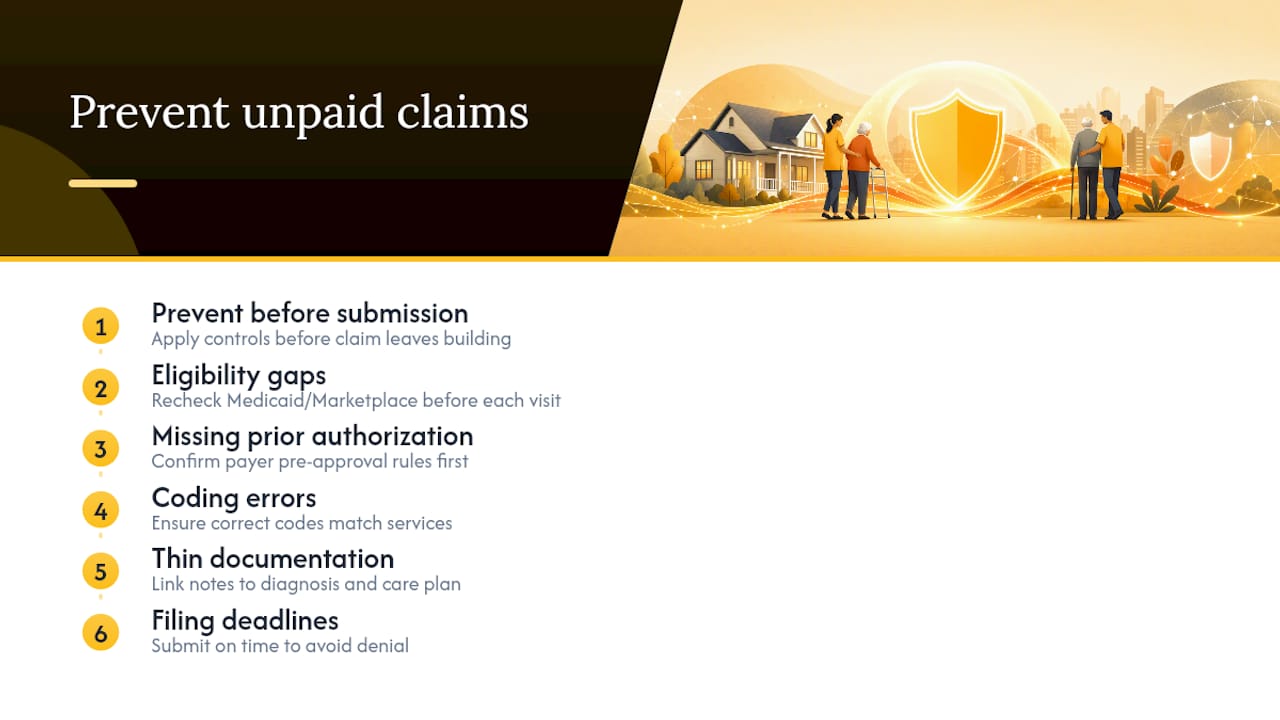
Prior authorization is the second biggest trap. Every payer has its own rules for which services need pre-approval, and those rules change without much warning. Documentation gaps show up when notes don’t clearly link the service delivered to the diagnosis or care plan a payer requires. Coding errors and late submissions round out the list, and both tend to compound the other four when a team is already stretched thin.
Industry data backs this up: a substantial majority of denials are theoretically avoidable when agencies apply the right controls before a claim ever leaves the building, according to research on the revenue cycle. That single figure should reframe how you think about your billing team’s job. It’s not cleanup. It’s prevention.
Quick Wins You Can Implement This Week
You don’t need a system overhaul to slow the bleeding. Start with these five moves:
Verify eligibility three times, not once: at scheduling, again before the visit, and a final check before claim submission.
Add an authorization number field to every schedule and claim form so a missing auth can’t slip through unnoticed.
Build a payer-specific auth calendar tracking which services need pre-approval and how long each payer’s approval typically takes.
Set an appeal-versus-write-off threshold so staff aren’t spending an hour chasing a $40 denial.
Hold a weekly 20-minute denial-triage meeting to sort new denials by cause and assign next steps immediately.
For staff, keep a short daily checklist: confirm insurance status, confirm authorization number, confirm documentation matches the service code, and confirm the claim is submitted inside the payer’s filing window.
Eligibility confirmed and dated
Authorization number present and valid
Documentation matches billed code
Claim submitted before the deadline
Pro Tip: Print your payer auth calendar and tape it near the scheduler’s desk. The agencies with the cleanest first-pass rates are the ones where the rule is visible, not buried in a shared drive nobody opens.
How Do You Diagnose an Unpaid-Claims Problem?
You can’t fix what you don’t measure. Five numbers tell you almost everything about where your revenue cycle is leaking.
Metric | What it tells you | Reasonable target |
First-pass acceptance rate | Share of claims paid without rework | single-digit percentage, per industry benchmarks |
Denial rate by origin stage | Which step (registration, auth, coding) causes most denials | Track trend, not a fixed number |
Days in A/R | How long cash sits uncollected | Under 40 days for most home care payers |
Appeal win rate | Share of appealed denials that get paid | A high rate signals good triage |
Average denial age | How stale denials get before rework | Under 30 days |
The average initial denial rate across practices is around double digits, while top performers keep it below a single-digit percentage, according to the same first-pass acceptance research. That gap is your improvement ceiling.
Run a 90-day origin-stage audit to find out where your denials actually start: pull every denial from the last quarter and sort it into registration, authorization, documentation, coding, or submission. This single exercise, recommended in step-by-step denial-reduction guides, usually reorders an agency’s priorities overnight. Owners often assume coding is the problem when the real leak is eligibility checks skipped at scheduling.
Once you have reason-code counts, turn the top three into scrubbing rules your team checks before every submission.
Building a Prevention-First Workflow
A prevention-first workflow means every claim passes through five checkpoints before it ever reaches a payer, with one person or role accountable at each step.
Eligibility verification happens at scheduling and again 24 to 48 hours before the visit. Assign this to whoever owns the schedule, whether that’s an in-house scheduler or an outsourced coordinator.
Prior-authorization ownership goes to one role, not a rotating cast. This person tracks the payer auth calendar and confirms approval before service delivery, not after.
Documentation linked to evidence means every note ties the service back to the care plan and diagnosis a payer will ask about if it audits the claim.
Pre-submission scrubbing and denial-risk scoring catches format errors and flags claims with a history of getting kicked back. This is where automation earns its keep.
Reconciliation and feedback closes the loop: every denial gets logged, categorized, and fed back into the scrubbing rules so the same mistake doesn’t repeat.
Who owns this depends on your size. A single in-house coordinator works for very small agencies. Mid-sized agencies often pool a billing specialist across a few roles. Many now outsource the function entirely to a dedicated support Pod or trained virtual assistant model, which spreads the workload across specialists who already know home care documentation standards rather than relying on one generalist wearing five hats.
Start narrow: codify the rules for your top three payers and your twenty most-billed procedures. Document each rule’s source, who owns it, and when it gets reviewed, so the knowledge lives in a system instead of one person’s head.
Pro Tip: Review denial trends weekly and revisit the full picture monthly. Weekly catches the fire; monthly tells you whether you’re actually putting it out.
Weekly: quick denial audit, assign rework
Monthly: trend review across origin stages
Quarterly: full 90-day audit and rule refresh
Should You Appeal or Write Off That Denied Claim?
Not every denial deserves a fight. Set an appeal ROI threshold: if the expected recovery is less than your average labor cost per rework, write it off and move on.
Classify each denial before deciding:
Payer processing error — appeal almost always; these are usually quick wins.
Eligibility gap — appeal only if coverage was active at time of service; otherwise write off and fix the intake process.
Missing authorization — appeal if you can show the service was medically necessary and retroactive auth is possible; otherwise write off.
Documentation gap — fix the note and resubmit if inside the filing window; appeal only with strong supporting evidence.
Timing decides more outcomes than paperwork quality. Most payers give you a defined window, often 30 days, to rework or appeal before the claim becomes permanently unrecoverable, a cadence supported by step-by-step revenue-cycle guidance. Track each payer’s specific window separately; they are not uniform.
Track your appeal win rate monthly. Insurers have little incentive to speed this up. Analysis of unpaid claims shows delayed payments generate investment income for carriers, which is exactly why the burden of speed and triage falls on you.
What Technology Actually Reduces Unpaid Claims?
Four categories of tools deliver real return for a home care agency, and none of them replace the human ownership described above.
Eligibility automation checks coverage in real time instead of relying on a manual call to the payer.
Custom claim-scrubbing applies your own denial history to catch the errors that actually happen in your agency, not generic industry rules.
Denial analytics dashboards show origin-stage trends without a manual spreadsheet pull every month.
AI-driven prioritization scores denied claims by likelihood of payment, so staff rework the ones worth their time first, a method Experian Health has documented reducing wasted staff hours on low-yield appeals.
Before buying anything, check for explainability (can it tell you why a claim was flagged), payer-rule coverage for your top payers, and integration with your existing practice management or EMR system.
Investment path | Best for | Trade-off |
Full RCM software suite | Larger agencies with dedicated billing staff | Higher cost, longer setup |
Trained virtual assistants + payer playbook | Small to mid-size agencies | Lower cost, faster to start |
Clearinghouse scrubbing alone | Any agency, as a baseline | Catches format errors only, not root causes |
Clearinghouse scrubbing matters, but it’s last-mile validation. It can’t fix a lapsed policy or a missing referral that should have been caught weeks earlier, a limitation revenue-cycle experts point out regularly. Prevention has to happen further upstream than any scrubber can reach.
An Operator’s View on Fixing Unpaid Claims
Most agencies treat billing as the department that cleans up after everyone else’s mistakes. That’s backwards. The fastest improvement usually comes from moving eligibility and authorization checks out of the billing team’s hands entirely and putting them at the front of the pipeline, where scheduling happens.
Outsourcing intake and after-hours coverage to a dedicated support team, rather than one overworked employee, keeps documentation consistent even when a caregiver calls off at midnight. Consistency at that stage is what prevents the denial three weeks later. A 90-day pilot with a defined scope and a clear before-and-after on first-pass acceptance rate tells you fast whether the model works for your agency.
— Ian Dwight Abejo
How The BOSS System Helps Stop Unpaid Claims
The BOSS System is the alternative to hiring and training an in-house billing department piece by piece. Instead of one overworked coordinator trying to cover eligibility checks, intake, and authorization follow-up alone, you get dedicated specialists trained specifically in home care billing and A/R, plus a 24/7 Command Center that keeps documentation clean even when a shift call-off happens at 2 AM.
A trained home care coordinator through The BOSS System costs about 70% less than the same hire in-house, once you account for payroll taxes, benefits, and equipment.* That gap goes straight into your margins instead of your overhead. The Command Center documents every after-hours call so nothing falls through the cracks before it becomes a denial, and billing specialists trained in home care workflows keep authorization numbers and eligibility checks where they belong: ahead of the claim, not behind it.
If you want to see what a 90-day pilot looks like for your agency, start with The BOSS System and ask about a discovery call scoped to your current denial rate.
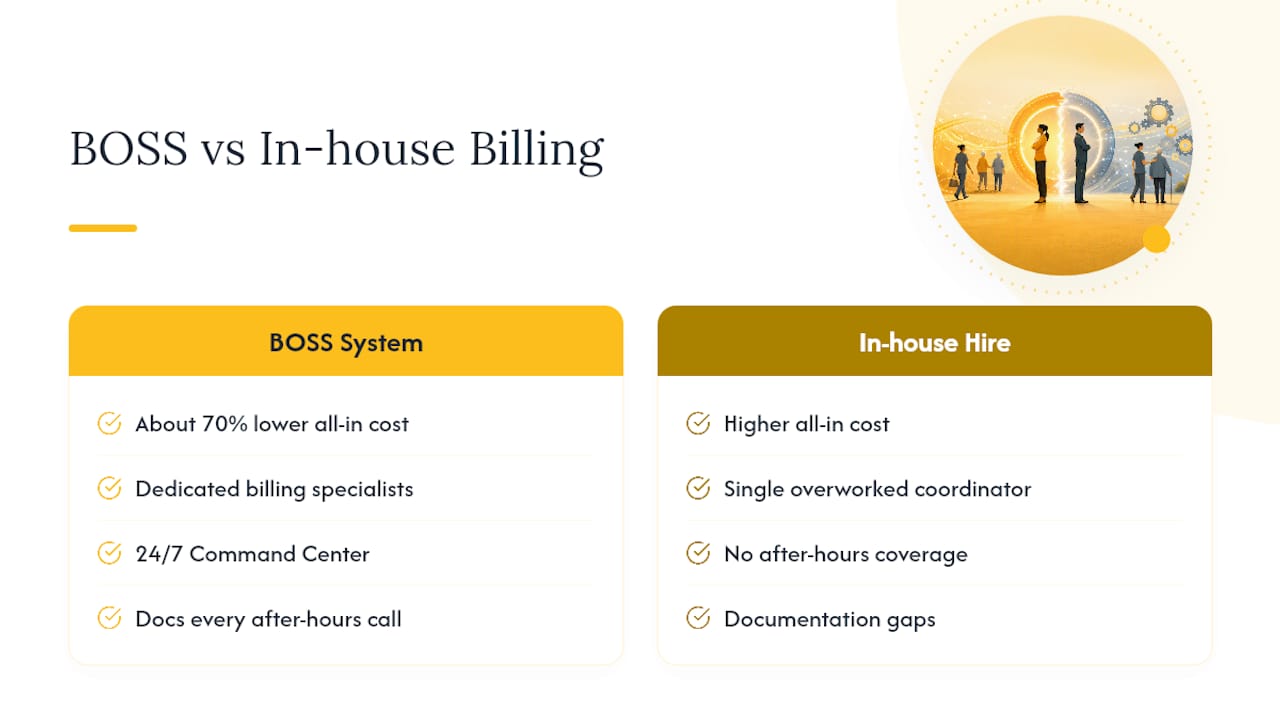
*Compared to average all-in cost of an in-house coordinator (salary, payroll taxes, benefits, admin costs). Sources: Indeed, IRS, Bureau of Labor Statistics.
Sources
Recommended


Comments