


Hit 75–85% FCR: Owner Playbook for First Call Resolution in Home Care


First call resolution in home care means solving a caller’s request the moment they call, whether that’s a discharge planner confirming a start of care, a caregiver reporting they can’t make a shift, or a family asking about billing. No callback, no transfer, no missed shift the next morning. A realistic target is resolving most calls on first contact, generally aiming for about three-quarters to just over four-fifths. Your first move: pull the last 30 days of call logs and find out where yours actually stands.
TL;DR:
Most home care agencies aim for a first call resolution rate of 75% to 85%, requiring regular review of call logs and performance metrics.
AI-driven call routing can reduce service costs and case resolution times by approximately 20%, improving referral capture and client retention.
Structured intake processes demanding six key fields and tiered routing rules significantly decrease callback delays and increase first contact success.
After-hours calls that involve protected health information must be handled with secure systems and signed HIPAA agreements to avoid compliance risks.
Outsourcing functions like 24/7 answering and shift backfilling to trained teams can cut operational costs by around 70% compared to in-house staffing.
Table of Contents
Why First Call Resolution Home Care Metrics Drive Revenue
A missed or mishandled call rarely feels like a financial event in the moment. It is one. Discharge planners are working through a list of agencies, and the first one to confirm the referral typically wins the placement, usually inside a 60 to 90 minute window. Every call that goes to voicemail during that window is typically a client handed to a competitor.
The math compounds from there. Faster answering and cleaner intake can lift booked assessments and first-month care value, according to ROI modeling built around monthly call volume and qualified-intent share. On the cost side, fewer callbacks mean fewer clinician wake-ups at 2 AM for problems an intake layer could have handled.
Statistic Callout: Industry data shows AI-driven answering and routing can cut service costs and case resolution time by roughly 20% for the operators using them well. That’s not a marginal gain. It’s the difference between a coordinator who ends her day at 6 PM and one who’s still fielding calls at midnight.
Referral sources notice the pattern too. Discharge planners and hospital liaisons remember which agencies pick up and which ones make them wait, and that memory shapes where the next ten referrals go.
How to Measure First Contact Resolution in Home Care
FCR is simple to calculate: divide the number of calls resolved without a callback, transfer, or follow-up ticket by total calls received, then multiply by 100. If your intake line handled 400 calls last month and 310 were closed out on that first contact, your FCR sits at 77.5%.
That number means little in isolation, so pair it with a short list of supporting metrics:
Answer time: aim under 20 seconds, ideally 10 to 15 seconds, since slower answering drives up abandoned calls.
Abandoned call rate: calls hung up before anyone answers; track weekly, not just monthly.
Referral time-to-confirm: how long between a discharge planner’s call and your written confirmation.
Booking rate: what percentage of qualified inquiries convert to a scheduled assessment.
Statistic Callout: Connecting scheduling, EVV, and documentation into a single data layer makes FCR gains stick instead of drifting back down, according to home care KPI research. Agencies that track FCR in isolation from scheduling data tend to see short bursts of improvement that quietly erode within a quarter.
Run a full audit monthly. Spot check weekly by listening to five to ten random calls, especially ones logged after 5 PM or on weekends, where resolution rates typically drop hardest.
Call Types, Intake Fields, and Routing Rules That Actually Work
Not every call deserves the same urgency, and treating them all as emergencies is how clinicians burn out. Most agencies see four recurring call buckets, and only two of them justify waking someone up overnight.
Named clinical referrals from discharge planners or physicians — escalate to an on-call clinician within two minutes of intake capture.
Urgent caregiver call-offs affecting a shift within the next 12 hours — escalate immediately to whoever is filling shifts that night.
General family inquiries about services, pricing, or availability — capture as a structured record for next-day callback; no overnight escalation needed.
Administrative questions (billing, scheduling changes, paperwork status) — log and route to the appropriate back-office role during business hours.
Every referral call, regardless of bucket, needs six fields captured before the caller hangs up: the discharge planner’s name, the referring facility, payor source, requested start date, clinical reason for referral, and urgency level. Miss any one of these and your team ends up calling back to ask, which is exactly the delay that costs you the placement.
The operator guidance on intake calls recommends writing these routing rules down in plain language and handing them to whoever answers your phones, whether that’s an employee or an outsourced team. Verbal instructions get forgotten. Written SLAs don’t.
The Operational Playbook to Improve First Call Resolution
Fixing intake isn’t a single project. It’s a sequence, and skipping steps just means you’ll circle back to them later anyway.
Run a 30-day call-log audit. Pull every call, tag it by type and outcome, and find out what percentage actually resolved on first contact. This is your baseline, not a guess.
Test your own line on a Friday afternoon. Call your agency at 4:45 PM like a discharge planner would. Time the pickup, note whether the person answering can capture a referral without transferring you three times.
Write intake scripts with required fields built in. The script should force capture of the six referral fields before the call ends, not leave it to memory.
Set tiered routing rules and an auto-callback system. Anyone who calls and doesn’t reach a live person should get a callback within five minutes, based on outbound SLA practices service businesses use to recover missed bookings.
Connect your phone system to scheduling and CRM. A referral captured on a call should populate directly into your scheduling workflow, not get retyped by hand later.
Run monthly QA. Listen to 10 to 15 calls, score them against your script, and pick one specific thing to improve next month, not five.
Pro Tip: Score calls on a simple three-point scale: fields captured, tone with the caller, and time to resolution. Trying to grade ten different criteria per call guarantees nobody does the QA consistently.
Where Outsourced Intake Fits: The Command Center Pod Approach
Some agencies fix intake with better scripts and internal training. Others reach a point where the volume, the after-hours gaps, or the staff turnover make in-house intake unsustainable, and that’s where outsourcing the function makes sense.
The problems worth outsourcing are specific: consistent 24/7 answering, structured records instead of sticky notes, real-time shift backfilling when a caregiver calls off, and an owner who can actually sleep through the night. The Command Center Pod from The BOSS System is built around exactly this model, covering after-hours calls with a trained team rather than a single answering-service employee.
If you’re evaluating any vendor for this function, hold them to a checklist:
A signed BAA in place from day one, not promised “later.”
Flat-rate pricing, since per-minute billing rewards vendors for keeping calls long instead of resolving them fast.
Structured intake capture that feeds your scheduling system directly.
Written tiered escalation rules, not judgment calls made on the fly.
The BOSS System was founded by Ian Dwight Abejo and Amy Abejo, who own and operate their own home care agency, which means the Pods are staffed by people trained in home care workflows, not general call center reps reading a script cold.
Building a Simple First Call Resolution Dashboard
You don’t need enterprise software to track this. A single shared spreadsheet or a lightweight dashboard tool works fine, as long as someone actually looks at it weekly.
Start with a 30/60/90 day rollout: week one is scripts and callback SLA, day 30 is your first full audit comparison, day 60 is testing whether referral confirmation speed improved, day 90 is a full re-audit against your original baseline.
Track six numbers on your dashboard:
FCR percentage, calculated weekly
Percentage of calls answered within 20 seconds
Abandoned call rate
Referrals confirmed within 90 minutes
After-hours call handled rate
Missed-call recovery rate (how many abandoned calls get a same-day callback)
Statistic Callout: Integrating this data with scheduling and billing, rather than tracking phone metrics alone, is what makes FCR gains durable instead of a one-month spike that fades. If your Friday-afternoon test call fails, don’t just retrain the person who answered. Check whether the script itself was missing a required field or whether the routing rule was unclear.
After-Hours Coverage and HIPAA Considerations
Nights and weekends are where most home care agencies lose their FCR gains right back. A caregiver calls off at 11 PM, nobody picks up until 7 AM, and by then the family has already called a competing agency asking why nobody showed up. After-hours coverage isn’t optional infrastructure. It’s the part of the operation most exposed to both revenue loss and compliance risk.
Any call handled after hours that touches protected health information, a patient’s name, condition, medications, or care plan, falls under HIPAA. That applies whether the person answering is an employee, an answering service, or an outsourced team. If you’re using any third party to handle calls, a signed Business Associate Agreement needs to be in place before the first call comes in, not negotiated after an incident. Ask directly whether documentation from after-hours calls is stored securely, whether access is logged, and whether the vendor can produce records during an audit.
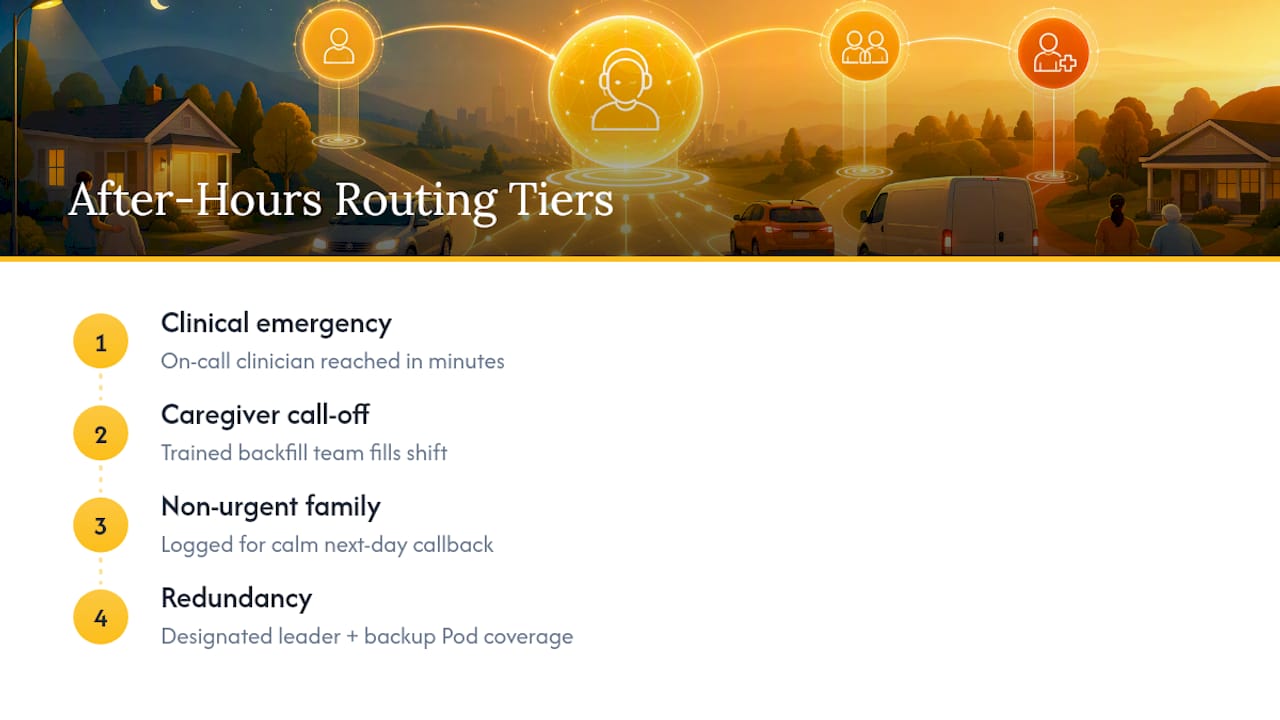
The practical fix most agencies land on eventually is a tiered system with built-in redundancy: real clinical emergencies reach an on-call clinician in minutes, caregiver call-offs get a shift backfilled by a trained team, and non-urgent family questions get logged for a calm next-day callback. That structure only works if it doesn’t depend on one person being awake and available every single night. A team with a designated leader and backup coverage, like the Command Center Pod model, solves the single-point-of-failure problem that keeps so many owners checking their phones at 3 AM out of habit rather than necessity.
Owner Perspective: Write the Rules, Then Trust the Team
Most FCR failures aren’t a training problem. They’re a permission problem: nobody told the intake layer what they’re allowed to decide without calling you first. Write it down: “Confirm any referral matching these six fields without waiting for my approval.” Then step back.
— Ian Dwight Abejo
Getting Started With The BOSS System
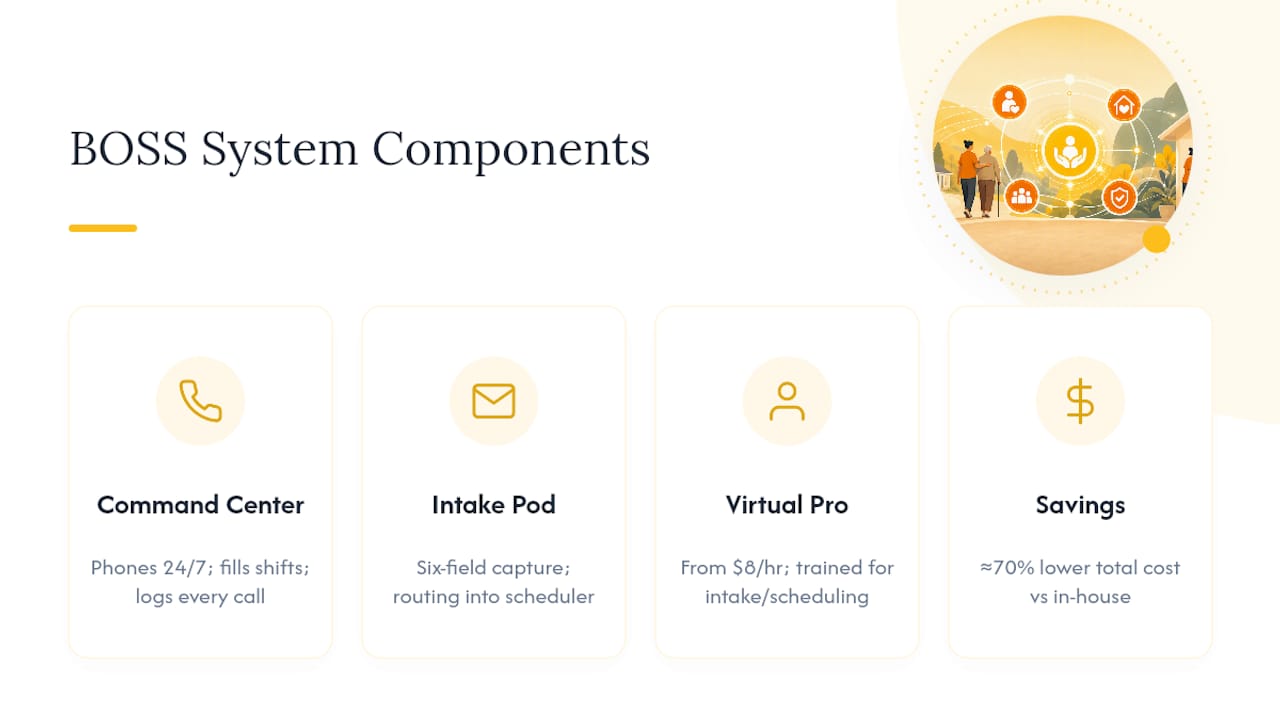
If the gaps in this article sound familiar, missed referrals at 4 PM on a Friday, a caregiver call-off nobody catches until morning, an intake process that lives in someone’s head instead of a written script, that’s the exact operational failure The BOSS System was built to close. A trained home care coordinator through BOSS runs roughly 70% less than the same hire in-house once you account for payroll taxes, benefits, and equipment, because there’s no local salary or overhead attached to the role.
Three Pods map directly to what’s covered above. The Command Center Pod covers phones 24/7, filling shifts and documenting every call before your office opens. The Intake & Patient Communication Pod handles the structured six-field capture and routing rules from earlier, feeding referrals straight into your scheduling system. And BOSS Virtual Professional, priced from $8 per hour, gives you a trained specialist for the specific role you’re missing, whether that’s intake, scheduling, or credentialing.
A first call with The BOSS System typically starts with a look at your current call volume and where your leaks are, similar to the 30-day audit outlined earlier in this piece. From there, most owners either start a free trial or move directly into a Pod built for their agency’s specific gap. Review the full service lineup to see which Pod fits before your next Friday-afternoon test call catches you off guard again.
Sources
For deeper KPI benchmarking, see service business KPI guidance and The BOSS System’s outsourcing overview.
FAQ
What Counts as a Resolved Call in Home Care?
A resolved call is one where the caller’s need is fully addressed without a callback, transfer, or follow-up ticket, whether that’s confirming a referral, filling a shift, or answering a billing question. If your team has to call the person back later to finish the job, it wasn’t resolved on first contact.
What Is a Good First Call Resolution Rate for a Home Care Agency?
Most well-run agencies target 75 to 85% FCR, tracked weekly alongside answer time and abandoned call rate.
How Fast Should a Discharge Planner Referral Be Confirmed?
Discharge planners often decide within a 60 to 90 minute window. So named referrals should reach an on-call clinician within two minutes of the call ending. Waiting until the next business day routinely means losing the placement to a competing agency.
Does The BOSS System Handle After-Hours Calls?
Yes. The Command Center Pod covers phones 24/7, including nights, weekends, and holidays, with a trained team that fills shifts and documents every call rather than relying on a single on-call employee.
What Does BOSS Virtual Professional Cost?
BOSS Virtual Professional starts from $8 per hour. Pricing for other Pods, like the Command Center Pod, isn’t published and requires a direct conversation to scope your agency’s needs.
Recommended


Comments