


Ops First Fix to Lift Referral Conversion for Home Health Agencies


Referral conversion is the share of referred prospects who become paying clients, calculated as conversions divided by total referrals received. A typical benchmark sits between 2.5% and 3.5% for referral marketing overall, though home health agencies chasing top-quartile performance should aim well past that. The number depends heavily on how you define “referral” and “conversion” in the first place, so get that definition locked before you compare yourself to anyone.
TL;DR:
Improving contact speed by responding within 48 hours can significantly increase referral conversion rates, especially in home health settings.
Locking a 60-day conversion window and tracking detailed referral data, including source and outcome, enables more accurate measurement and improvement.
Fixing operational issues like after-hours intake and structured scripts has a greater impact on conversion than incentives or landing page quality.
Referral numbers should be compared against relevant benchmarks, such as referral-customer rates, rather than ecommerce or B2B averages.
A reliable referral report focuses on participation rate, share-to-conversion, cost per acquisition, and lifetime value to demonstrate real revenue impact.
Table of Contents
What Referral Conversion Means and How to Calculate It
Referral conversion rate, sometimes shortened to RCR, is one formula: conversions divided by total referrals, multiplied by 100. For example, if your agency received a number of physician and discharge-planner referrals last month and admitted a proportion of those referred patients, your RCR reflects that conversion ratio. That single number hides a lot, though, which is exactly why marketing professionals and agency managers get burned comparing their RCR to a number pulled from a blog post without checking what the other program actually counted as a “referral.”
The confusion usually starts with vocabulary. A referral source could mean a discharge planner, a physician’s office, a past client, or a walk-in who mentions a friend’s name. A conversion could mean a signed intake, a completed assessment, or first billed visit. Until your team agrees on both definitions in writing, every dashboard number is guesswork dressed up as data.
The Data You Need to Measure Referral Conversion Accurately
You cannot compute a trustworthy referral conversion rate from partial records. Most agencies discover their intake log is missing half the fields that matter the moment they try to build a real report.
Here’s the minimum data set worth capturing on every referral:
Referral source (facility, physician, discharge planner, past client, marketing channel)
Referrer ID or name, so you can track performance by source over time
Date referred and date of first contact attempt
Contact details for the referred patient or family decision maker
Outcome (admitted, declined, pending, lost) and the reason when known
Conversion date and the revenue or care hours associated with that client
From those raw fields, you build the metrics that actually tell you something. Participation rate measures how many eligible referral sources send at least one referral in a given period. Share-to-conversion tracks what portion of shared referral links or verbal referrals turn into an actual contact. Referral CAC is your cost to acquire a client through referral divided by the number of referred clients acquired. Referred LTV compares the lifetime value of referred clients against clients from other channels, and it usually favors referrals by a wide margin.
Field or Metric | What It Captures | Why It Matters |
Referral source | Origin of the lead | Identifies which relationships to nurture |
Date referred vs. date contacted | Response speed | Predicts conversion probability |
Outcome + reason | Win/loss detail | Reveals fixable leaks |
Referral CAC | Cost per acquired client | Justifies incentive spend |
Referred LTV | Long-term value | Benchmarks against blended CAC |
Dedupe referrals by patient name and date of birth, not by referral ID alone, since the same family often gets referred by two sources within days of each other. Most agencies find a 60-day conversion window realistic for home health, since insurance verification and family decision-making take longer than a retail purchase ever would.
How Do Your Referral Conversion Numbers Compare?
Referral marketing across industries converts at an average of 2.5% to 3.5%, but that figure comes largely from ecommerce, where the buying decision takes minutes rather than weeks. Top-performing ecommerce programs reach a share-action rate near 4.64%, and the top 10% of programs start around 13.38% on that same metric.
Benchmark callout: In B2B contexts closer to home health referral patterns, referrals convert at roughly 3.6 times the rate of cold outreach, and referral-sourced business can account for a majority of new revenue in mature service businesses.
The gap between these numbers and your own agency’s RCR often comes down to definition, not performance. Consider these distinctions before you panic over a “low” number:
Share-action rate measures how often a referral link or mention gets acted on at all, which is a wider funnel than final conversion.
Referred-order rate measures completed transactions, closer to what a retail program tracks.
Referred-customer rate measures net-new clients, the metric most home health agencies actually care about.
For a home health agency, a referred-customer conversion rate generally targets a moderate to high proportion, reflecting warm, professional referral relationships. Rates below typical expectations often indicate issues with contact speed rather than demand.
A Step-by-Step Method for Analyzing Your Referral Funnel
Fixing referral conversion starts with measuring it the same way every time. Here’s a repeatable process.
Lock your conversion window. Pick 60 days as your standard for home health referrals and stick with it across every report.
Define your canonical referral source field. One source category per referral, no blended tags, no duplicates spread across two spreadsheet columns.
Compute base RCR, then decompose it. Break the single number into stages: referral received → first contact attempted → contact made → assessment scheduled → client admitted.
Segment by referrer type, cohort, and time-to-contact. Hospital discharge planners often convert differently than physician offices or past-client referrals, and lumping them together hides the real leak.
Run one focused test at a time. Change contact speed, change the intake script, or change the incentive, but not all three simultaneously, or you won’t know what moved the number.
Validate the win against referral CAC and referred LTV. A tactic that lifts conversion but doubles your cost per acquisition isn’t a win.
Pro Tip: Track time-to-first-contact separately from time-to-conversion. Agencies that fix contact speed alone often see conversion lift before touching anything else in the funnel.
A referred lead that goes 48 hours without a human response starts behaving like a cold lead rather than a warm one, and that single variable explains more lost referrals than any incentive structure ever will.
Tactics That Actually Move Referral Conversion Numbers
Fix operations before you touch marketing. Responsive follow-up to referrals is critical, since delayed responses often lead to lost conversion opportunities regardless of marketing improvements.
Operational fixes come first:
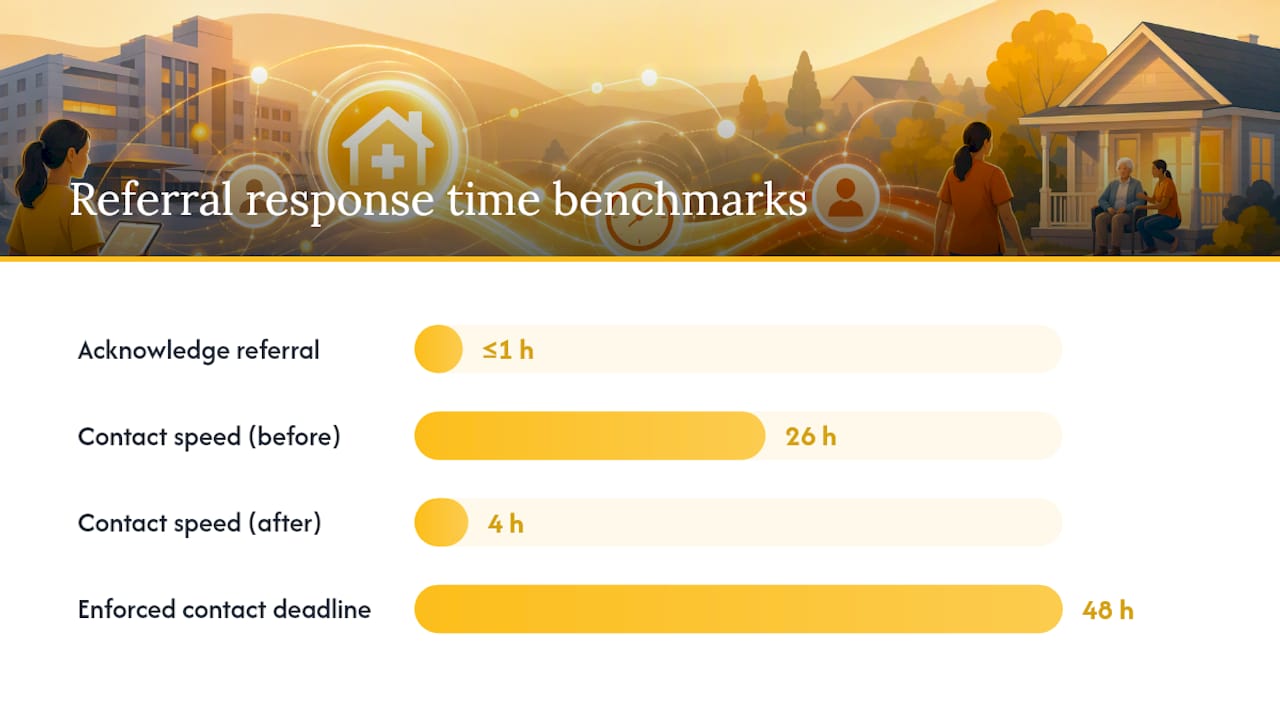
Acknowledge every referral within the hour, even if it’s an automated text confirming receipt.
Enforce a 48-hour contact rule as a hard internal deadline, not a suggestion.
Build a structured intake script so every caregiver or intake coordinator asks the same qualifying questions in the same order.
Cover after-hours and weekend referrals, since discharge planners and hospital social workers don’t stop working at 5 p.m. on a Friday.
Program design matters next. Double-sided incentives, where both the referrer and the new client get something of value, tend to outperform one-sided rewards. Micro-asks work better than a single big pitch: ask a satisfied family member for one introduction instead of a list of ten names. Surface the ask at peak satisfaction moments, like the 30 to 60 day mark after a positive care experience, rather than burying a referral form in a footer nobody scrolls to.
UX and technology close the gap. A dedicated referral link tied to each source, a landing page built for mobile referral traffic, and CRM automation that fires a task the second a referral lands all reduce the human error that kills conversion. Trigger-based workflows that alert a coordinator immediately outperform manual daily reviews of a shared inbox.
Staffing determines whether any of this holds up at 2 a.m. A dedicated intake coordinator, or an outsourced command center built for 24/7 capture, catches referrals that would otherwise sit until Monday morning. Coach your team specifically on follow-up tone and speed, not just volume.
Pro Tip: Pilot a 30-day double-sided incentive test with one referral source category before rolling it out agency-wide. You’ll know within a month whether the incentive changed behavior or just changed your margin.
Run these as short, structured A/B tests and report the lift in plain numbers to leadership: contact speed improved from 26 hours to 4, and conversion rose accordingly.
Building a Referral Conversion Report Leadership Actually Reads
A referral dashboard earns its place on a leadership agenda only when it ties directly to revenue, not just activity.
Build the report around these elements:
Participation rate by referral source category, tracked monthly.
Share-to-conversion and referred-customer conversion shown separately, never blended into one number.
Referral CAC compared against your blended CAC across all channels.
Referred LTV, since referred customers show measurably higher lifetime value than clients acquired through paid channels in most comparisons.
Pipeline contribution, meaning what dollar value of active care hours traces back to referrals this quarter.
Time-to-contact, tracked as an average and as a distribution, since one 5-day outlier can hide behind a healthy average.
Reporting cadence that works: daily alerts for new intake, a weekly exception report flagging any referral untouched past 48 hours, and a monthly or quarterly business review tying referral CAC and LTV back to overall client acquisition cost.
To compute ROI on an incentive program or an outsourced intake service, subtract the fully loaded cost (incentive payouts, staffing, software) from the revenue attributable to converted referrals, then divide by that cost. A referral CAC that lands meaningfully below your blended CAC, paired with higher referred LTV, is the argument that gets a referral budget approved next year.
Where After-Hours Intake Closes the Biggest Conversion Leak
Most home health referral losses trace back to one root cause: nobody answered fast enough. A referral that arrives at 9 p.m. on a Thursday and waits until Monday morning has already cooled, and the family or discharge planner has often moved to the next agency on their list.
An operationalized model built specifically for this problem closes that gap in a few concrete ways:
24/7 capture means a referral call at 2 a.m. gets a trained human response, not a voicemail box.
Dedicated, trained intake coordinators run the same structured intake script every time, which removes the variability that comes from whoever happens to pick up the phone.
Immediate documentation means the referral lands in your CRM the moment it’s received, not hours later when someone finally has time to type it in.
The measurable impact shows up in the numbers this article already covered: faster time-to-contact, fewer referrals lost to silence, and lower administrative overhead than staffing an equivalent in-house night shift. The BOSS System’s Command Center was built around exactly this workflow, and agencies using it report faster follow-up and fewer missed referrals as a direct result of round-the-clock coverage.
The Bottom Line on Improving Referral Conversion
Referral conversion improves fastest when you fix contact speed and definitions before you touch incentives or landing pages. Most agencies have a measurement problem before they have a marketing problem.
Your first 90 days should include:
Establish a clean baseline RCR using one consistent definition and a 60-day window.
Build your referral-eligible cohort list, segmented by source type.
Set up CRM triggers that alert a coordinator the moment a referral arrives.
Fix landing page and intake script friction points identified in your funnel breakdown.
Run a 30-day double-sided incentive test on one referral category and measure the lift.
Why Most Referral Advice Gets the Priority Backward
The conventional wisdom on referral conversion treats it as a marketing problem: better incentives, better landing pages, better templated asks. The research doesn’t support that ordering. A referral that sits unanswered for two days loses most of its conversion power regardless of how generous your incentive is or how polished your landing page looks.
What gets underestimated is how much of this is a staffing and operations problem wearing a marketing costume. Agencies obsess over incentive structure while a referral from a discharge planner sits in a shared inbox until Monday. Fix response speed first. Everything else, incentives, landing pages, gamified asks, only works once someone is actually there to answer the phone.
The other overlooked piece is definitional discipline. Agencies compare their numbers to ecommerce benchmarks that measure a completely different funnel stage, then either panic or celebrate for the wrong reasons. Get your own definition consistent before you worry about anyone else’s.
— Ian Dwight Abejo
Sources
Recommended


Comments