


Compliance First Office Phone Coverage: Built by Home Care Owners


The right move for most home care agencies is outsourcing office phone coverage to a trained team, not a single after-hours employee, so calls get answered live, shifts get backfilled in real time, and every interaction is documented in your system of record. This works best for owners and office managers drowning in call-off calls at 2 a.m. Before signing anything, verify the vendor’s business associate agreement and its escalation matrix.
TL;DR:
Outsourcing office phone coverage to a trained team reduces the risk of missed calls, late shifts, and poor documentation compared to a single-person on-call model.
Vendors must have a signed business associate agreement and a detailed escalation matrix that includes breach notification timelines, data encryption standards, and designated contacts.
A team-based coverage model with comprehensive training of at least 8 hours onboarding and 12 hours ongoing, plus clear response time targets and live system access, ensures reliable after-hours support.
Proper onboarding involves a detailed caregiver roster, care plan instructions, escalation trees, and simulated call tests to verify documentation flows into your system of record.
Technology should enable call forwarding, integration with scheduling software, and documentation within your existing records, avoiding separate portals or manual log reconciliation.
Table of Contents
Why Agencies Outsource Office Phone Coverage: Operational Benefits That Show Up in the Numbers
How Should Urgent and Non-Urgent Calls Be Handled Differently?
Publisher Perspective: Why The BOSS System Built the Command Center Pod Around a Team, Not a Person
How to Evaluate The BOSS System for Your Agency’s Phone Coverage
Why Agencies Outsource Office Phone Coverage: Operational Benefits That Show Up in the Numbers
Missed calls in home care do not just annoy a family. They turn into empty shifts, which turn into client complaints, which turn into lost referrals. Outsourced coverage closes that gap by putting a trained team on the phone every hour a caregiver might call off, a family might panic, or a referral source might need an intake answered fast.
The staffing math behind this is not going away. The Bureau of Labor Statistics projects strong ongoing growth for home health and personal care aides, which means overnight call-offs and last-minute openings are a permanent feature of this industry, not a rough patch you’ll grow out of.
Cost is where the decision usually gets made. A trained home care coordinator through an outsourced command center pod can cost significantly less than the same hire in-house once you factor in payroll taxes, benefits, and equipment. [^1] That is a client-stated figure, but the logic holds regardless of vendor: overnight coverage staffed internally means paying for a full-time or shift-differential employee to sit by a phone that might ring twice a night.
Track these KPIs once coverage goes live:
Average response time per call
Percentage of calls resolved without owner escalation
Shifts backfilled within a defined window (e.g., 2 hours)
Missed-call rate month over month
Number of after-hours owner wake-ups per week
[^1]: Compared to average all-in cost of an in-house coordinator (salary, payroll taxes, benefits, admin costs). Sources: Indeed, IRS, Bureau of Labor Statistics.
What Does HIPAA Require From an After-Hours Phone Partner?
Any outside team that answers calls, coordinates care, or touches scheduling data involving patients is very likely creating, receiving, or transmitting protected health information. That relationship generally requires a written business associate agreement spelling out permitted uses, safeguards, breach duties, and subcontractor flow-down. HHS guidance is blunt on this point: a vendor calling itself “HIPAA compliant” in a sales deck is not the same as a signed contract with enforceable access controls and incident handling.
Before you sign, confirm the contract and workflow include:
A written BAA naming permitted uses and disclosures of PHI
Subcontractor flow-down language if the vendor uses backup staff or third-party tools
Breach notification timelines and duties spelled out in writing
Encryption standards for data in transit and at rest
Audit logs showing who accessed what, and when
There are narrow exceptions where a covered entity can contact patients through certain services without a BAA, according to HHS’s own FAQ, but nearly every answering or coordination arrangement in home care falls outside those exceptions.
Pro Tip: Run a simulated overnight call before you sign anything. Have someone pose as a caregiver calling off and a family member reporting a fall, then check whether the vendor’s documentation lands cleanly in your system of record within the promised window.
What Should You Require From an After-Hours Phone Partner?
The single biggest evaluation mistake agencies make is hiring a vendor built around one on-call person instead of a team. One person gets sick, drives through a dead zone, or simply sleeps through a page, and your coverage disappears exactly when you need it most. Ask any prospective partner who backs up the primary responder, and get a specific answer, not a reassurance.
Training depth is the next filter. Providers reporting at least 8 hours of onboarding and 12 hours of ongoing training, including compliance content, were tied in Activated Insights’ 2025 benchmarking report to materially better retention and revenue outcomes. Use those hours as your baseline when a vendor describes its training program.
Operational standards worth pinning down before contracting:
Defined response-time targets for urgent versus routine calls
Live access to your caregiver roster and eligibility status
A process for verifying credentials before offering a backfill shift
Named escalation contacts, not a generic “we’ll call someone”
Documentation that lands in your agency’s own record system, not a separate portal you have to check
Ask prospects directly: “Walk me through what happens if your lead responder is on another call when a fall is reported.” A vague answer here is a red flag. So is a vendor who cannot show you a sample escalation matrix before you sign.
How Do You Onboard an Outsourced Phone Coverage Team?
Outsourcing the phones does not outsource your responsibility for what happens on them. Build a pre-contract packet before the vendor answers a single live call:
Current caregiver roster with contact information and credential status
Care-plan alerts and any client-specific instructions the team needs to see
A written escalation tree naming who gets called for what, in what order
Templates for documenting call-offs, complaints, and emergencies
Pilot the relationship before going fully live. Run overnight simulations covering a caregiver no-show, a family complaint, and one genuine emergency scenario, then check whether documentation flowed into your system of record correctly and within your target window. Baseline your KPIs during this pilot so you have real numbers to compare against once volume increases.
Integration checklist before production:
Secure, role-based access to your scheduling and documentation software
Clear permission boundaries on who can update records versus who can only view them
An exception report that flags anything the team could not resolve on its own
Defined SLAs for response time, backup staffing triggers, and the exact threshold that wakes the owner
Once live, treat the first 90 days as a testing window, not a set-and-forget arrangement. Review call logs weekly for the first month.
How Does Escalation Work With Clinical Teams?
An escalation matrix only works if it connects to your clinical team, not just a call log that someone reads the next morning. Federal home health regulations describe care coordination duties that require after-hours staff to follow structured escalation paths, reference the client’s actual care plan, and loop in physicians or practitioners when a call crosses from administrative into clinical territory.
That means your after-hours partner needs more than a phone number for “someone on call.” It needs a named escalation path with tiers. A caregiver calling off gets handled by the coordination team directly. A family reporting a medication concern gets escalated to a clinical supervisor. A reported fall or medical emergency triggers immediate owner or on-call nurse notification, with 911 guidance if warranted.
The failure mode to design against is the isolated note. A call gets logged, marked “resolved,” and nobody on the clinical side sees it until a pattern has already caused harm. Good escalation design pushes relevant calls into the morning huddle or care coordination meeting automatically, not as an afterthought someone has to remember to mention.
Ask any vendor to show you their actual escalation matrix, not describe it verbally. If they cannot produce a document naming specific triggers and specific contacts, that is a sign the process lives in someone’s head rather than in a system your clinical team can rely on.
How Does Outsourced Coverage Handle Caregiver No-Shows?
A 2 a.m. call-off is the single most common reason agencies lose sleep, literally. The difference between a good outsourced partner and a mediocre one shows up entirely in what happens in the fifteen minutes after that call comes in.
A trained team should already have live access to your roster, so they can see who is qualified, available, and geographically close enough to cover the shift. They should attempt backfill through your own defined process, whether that is a call-down list, a scheduling app notification, or a mix of both, and document every attempt, not just the successful one.
The family or client still needs a calm, informed voice on the other end while backfill is underway. That is where a single-person on-call model tends to break down. One person cannot manage the outreach calls and reassure the family at the same time. A team can split those tasks simultaneously, which shortens the actual gap in coverage.
If backfill fails entirely, the escalation should reach the owner or office manager with enough information to make a decision quickly: who called off, what attempts were made, and what the remaining options are. That is a very different 2 a.m. phone call than “we have an opening, what do you want to do?” with no context attached.
What Do In-House Coordinators Cost Compared to Outsourcing?
An in-house on-call coordinator costs more than most owners initially budget for once you add payroll taxes, benefits, shift differentials, and the practical need for backup coverage when that one employee takes a vacation or gets sick. The true cost of after-hours coverage rarely shows up as a single clean number on a budget line.
Beyond raw payroll, in-house coverage carries an operations cost that is harder to quantify but very real: turnover on a role that requires someone to be reachable at odd hours is high, and every departure means a training gap while you scramble to fill the position.
Outsourced coverage through a team model, rather than a single employee, removes several of those cost centers at once. A command center pod structured as a trained team that includes built-in backup can cover nights, weekends, and holidays so the owner is not paying for redundancy on top of the base role. [^2] Hours saved matter here too. Owners who previously fielded overnight calls themselves, or who managed a rotating on-call schedule among staff, typically report getting real, uninterrupted evenings back once a dedicated team takes over that function.
[^2]: Client-stated service description. Verify specific coverage hours and backup structure directly with any vendor during evaluation.
What Are the Different Models for Office Phone Coverage?
Home care agencies generally choose from three coverage models, each with a distinct tradeoff between control and cost.
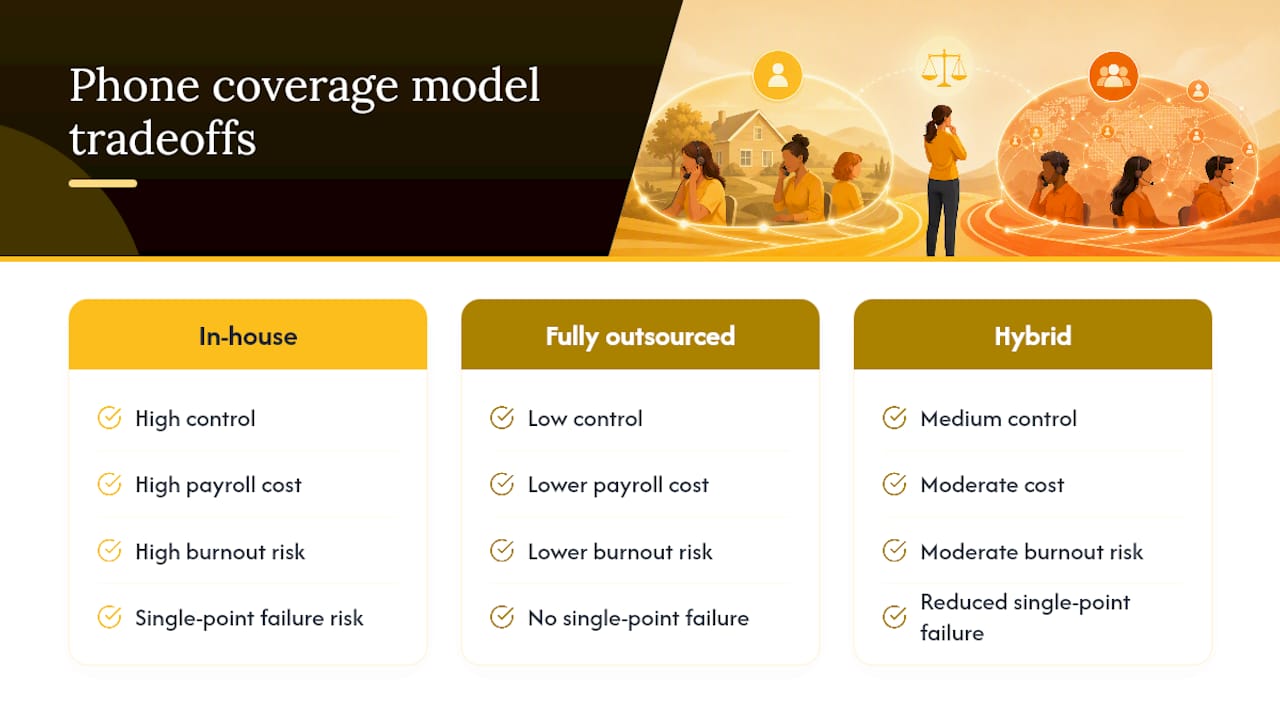
In-house coverage means an employee, or a rotation of employees, carries the after-hours phone. This gives you direct control over training and culture, but it also means you are absorbing every payroll cost, every burnout risk, and every single point of failure if that person is unreachable.
Fully outsourced coverage hands the phones to an external team around the clock. Done well, this eliminates the single-point-of-failure problem and reduces payroll overhead significantly. Done poorly, with a vendor that does not understand home care workflows, it can create a disconnect between what the vendor logs and what your clinical team actually needs to know.
Hybrid coverage splits the load: daytime calls stay in-house with your existing office staff, while nights, weekends, and holidays route to an outsourced team. Many agencies land here first, treating it as a lower-risk way to test outsourcing before shifting daytime coordination as well.
None of these models is universally correct. An agency with a large, well-staffed office might only need overnight and weekend backup. A smaller agency running lean might benefit from outsourcing the entire function so the owner and office manager can focus on growth instead of phone triage.
What Technology Powers Reliable Office Phone Coverage?
The technology behind office phone coverage matters less than the people using it, but the wrong stack can undermine even a well-trained team. Call forwarding routes after-hours calls from your main line to the coverage team without the caller ever knowing they left your office. Automated attendants can triage simple requests, like confirming an address or office hours, before a live person picks up anything involving a client or caregiver.
VoIP systems give the coverage team the flexibility to log, transfer, and record calls without being tied to a physical location, which matters when your after-hours partner is not sitting in your building. Integration with your scheduling and documentation software is the piece agencies most often overlook. A coverage team that answers well but cannot see your roster, or cannot enter notes directly into your system of record, creates a second system you have to reconcile every morning.
The practical standard to hold any vendor to: can the coverage team see what they need to see, document where you need it documented, and hand off cleanly to your morning staff without someone having to translate a separate log into your actual records? If the answer involves a spreadsheet emailed at 8 a.m., the technology is not doing its job.
How Do You Ensure Call Quality Stays High?
Call quality in home care is not about polish. It is about whether the person answering understands what a family is actually asking for and responds with the right urgency. Consistency matters more than eloquence here.
QA reviews should sample actual calls, not just log summaries, so you can hear tone alongside content. A coordinator who logs “caregiver called off, backfill in progress” accurately but sounds rushed or dismissive on the actual call is still a problem your families will notice.
Reliability comes down to redundancy. A team model with a named lead and backup staff avoids the single point of failure that plagues one-person on-call arrangements. Ask any vendor how they measure their own missed-call rate and average hold time, and compare those numbers against your own baseline before and after switching.
Pro Tip: Request a monthly QA sample, even a handful of recorded or transcribed calls, so you can independently verify tone and accuracy rather than relying entirely on the vendor’s self-reported metrics.
What Compliance Issues Go Beyond HIPAA?
HIPAA gets the most attention, but it is not the only regulatory layer covering after-hours phone work. State licensure rules frequently dictate their own requirements for on-call supervisory availability and backup staffing. Illinois, for example, sets specific staffing and supervision requirements for in-home service providers that any outsourced coverage arrangement needs to satisfy, not just federal privacy law.
Payer contracts, particularly Medicare-certified home health arrangements, layer on additional documentation and communication expectations tied to care coordination, separate from privacy protections. An agency operating in multiple states needs to confirm that its coverage vendor’s workflow can flex to each state’s specific supervisory and reporting rules, rather than assuming one national process satisfies every jurisdiction.
Data retention requirements can also differ by state and by payer type, affecting how long call logs, documentation, and escalation records need to be kept and in what format. None of this replaces a HIPAA-focused review, but treating HIPAA compliance as the only box to check leaves real regulatory exposure on the table. Map any vendor’s stated workflow against your specific state’s rules before assuming coverage is fully compliant.
How Should Urgent and Non-Urgent Calls Be Handled Differently?
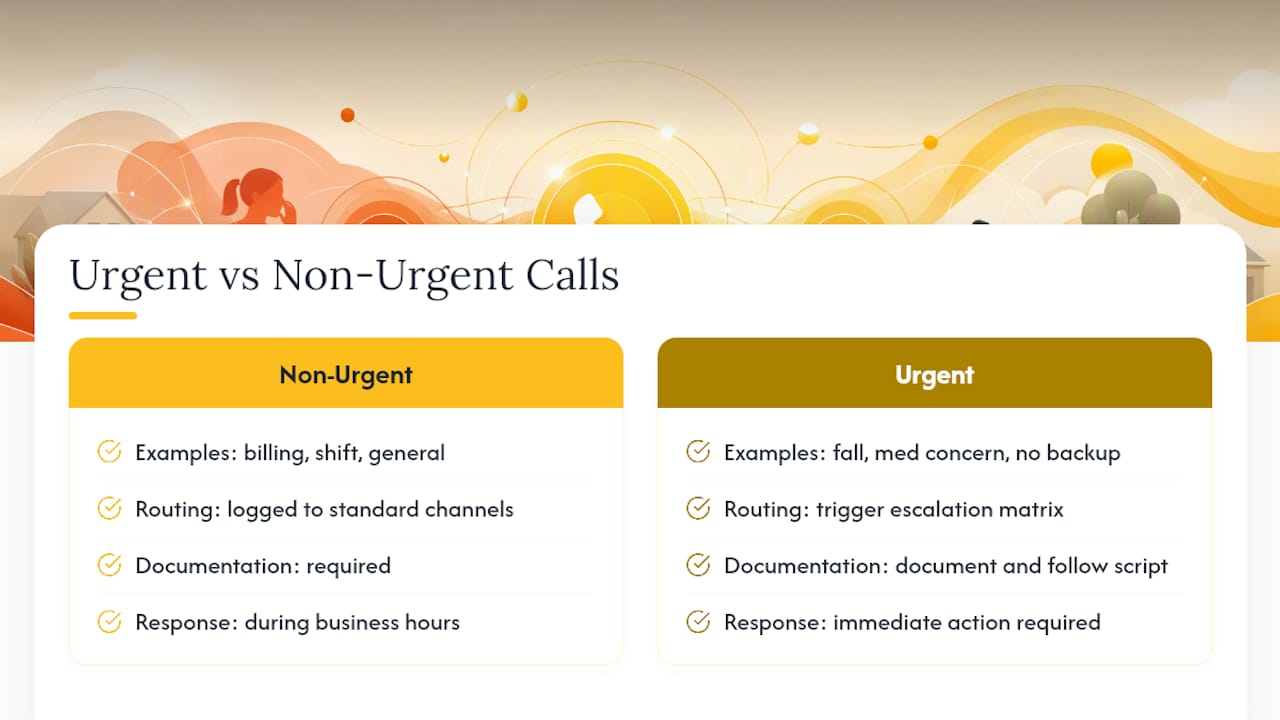
Not every call deserves the same response speed or the same escalation path, and treating them identically wastes both time and trust. A clear triage framework at the point of answer prevents a routine scheduling question from consuming the same attention as a reported fall.
Non-urgent calls, such as a family asking about billing, a caregiver confirming a shift time, or a general inquiry about services, should be logged and routed through standard channels without pulling the owner or clinical team into the loop. These calls still need documentation, but the response window can reasonably stretch to normal business hours in most cases.
Urgent calls demand immediate, defined action. A caregiver call-off with no immediate backup available, a client reporting a fall, or a family describing a medication concern needs to trigger the escalation matrix instantly, with the coverage team following a pre-built script rather than improvising. The team should know, without hesitation, which situations require them to advise calling 911 directly rather than waiting for a callback from anyone at the agency.
The dividing line between these two categories needs to be written down and tested, not left to a coordinator’s judgment in the moment. A written protocol defining what counts as urgent, who gets notified for each tier, and what the target response time is for each category removes the guesswork exactly when guesswork is most dangerous.
Publisher Perspective: Why The BOSS System Built the Command Center Pod Around a Team, Not a Person
Most vendors selling office phone coverage have never run a home care agency. The BOSS System was built by owners who have, and that shows up in one design decision more than any other: the Command Center Pod is structured as a team with a named lead and built-in backup, not a single on-call employee an agency has to hope shows up.
That structure exists because the founders lived the alternative. A one-person on-call model fails exactly when an agency needs it most, at 2 a.m., when the primary responder is unreachable and there is no fallback. Every element in the checklists above, trained coordinators, documentation that lands in your own system of record, redundancy tested before go-live, traces back to gaps the founders saw firsthand running their own agency.
None of that replaces your own diligence. Verify the BAA. Verify the training hours. Verify the escalation matrix names real people, not a placeholder. A well-designed team model still requires an owner who checks the paperwork before trusting the phones to anyone.
— Ian Dwight Abejo
How to Evaluate The BOSS System for Your Agency’s Phone Coverage
The BOSS System replaces the single-employee on-call model with a trained team built specifically for home care workflows, covering after-hours phone answering, care coordination, and staffing support without the payroll taxes, benefits, or turnover risk of an in-house hire.
The Command Center Pod handles the exact scenarios covered in this article: a caregiver call-off at 2 a.m., a family needing a calm voice while a shift gets backfilled, and documentation that lands directly in your system of record so your morning team is not reconstructing the night from a separate log. Beyond after-hours coverage, BOSS Virtual Professional roles extend into staffing, credentialing, and billing, staffed by people already trained in home care software and compliance.
Requesting a trial is straightforward. Bring your current onboarding packet, a rough KPI baseline (missed-call rate, average response time, current backfill success rate), and your questions about the escalation matrix and training hours. During any demo, confirm three things directly: a signed BAA is standard practice, ongoing training hours meet or exceed the 8-hour onboarding, 12-hour ongoing benchmark, and documentation integrates into your existing software rather than a separate portal. Start that conversation on the services overview page or request a free trial directly.
Sources
FAQ
Does an After-Hours Phone Vendor Need a BAA?
Yes, in nearly every case. Any vendor that creates, receives, or transmits protected health information while answering calls or coordinating care generally needs a signed business associate agreement covering permitted uses, safeguards, and breach duties.
How Much Training Should an Outsourced Coordinator Have?
Look for at least 8 hours of onboarding and 12 hours of ongoing training, including compliance content, the benchmark tied to better retention and revenue outcomes in Activated Insights’ 2025 report. Ask any vendor to document their actual training curriculum, not just state a number.
What Does The BOSS System Charge for Coverage?
BOSS Virtual Professional roles start from $8 per hour, according to the client’s trial page. Pricing for the full Command Center Pod is not published and requires a direct conversation with the provider.
Should Coverage Be a Team or a Single On-Call Person?
A team model with a named lead and built-in backup is the safer choice. A single on-call person creates one point of failure that breaks down exactly when a caregiver call-off happens at an inconvenient hour.
How Does Escalation Work for a True Emergency?
A well-designed system routes routine calls, like a shift confirmation, through standard documentation, while urgent calls, like a reported fall, trigger immediate notification to the owner or clinical supervisor. Federal home health rules require that escalation connect to the client’s actual care plan, not sit in an isolated log.
Recommended


Comments