


How to Write a No Call No Show Policy That Holds Up


A defensible no call/no show policy names the contact method, documents every contact attempt, and applies a progressive three-strike ladder within a rolling 12-month window, with explicit carve-outs for protected leave. That’s the whole job in one sentence. The rest is execution.
Three things to do this week:
Name a single acknowledged contact method (a phone number someone actually answers, not a group text)
Require managers to log two documented call attempts before marking a shift a no-show
Attach a signed acknowledgement page to your handbook so every employee confirms they’ve read it
Pro Tip: Most wrongful-termination disputes over attendance don’t hinge on whether the policy was fair. They hinge on whether you can prove you followed it consistently.
Key Takeaways
An enforceable no call/no show policy combines a named acknowledged contact method, timestamped documentation of every attempt, a three-strike rolling 12-month discipline ladder, and explicit protected-leave carve-outs.
Point | Details |
Define terms precisely | Separate no-show, call-out, and tardy so managers apply discipline consistently. |
Use a rolling window | Apply three strikes within 12 months rather than a one-strike or calendar-year reset. |
Carve out protected leave | Exclude FMLA, ADA, and state sick leave from discipline counts, with a documentation window. |
Document same-day | Log call attempts, client-safety checks, and shift-fill actions the day the incident occurs. |
Staff the contact line | An acknowledged, always-answered contact method closes the biggest gap in most policies. |
Table of Contents
What Counts as a No Call No Show vs. Job Abandonment?
A no call/no show (NCNS) happens when an employee misses a scheduled shift start time with zero contact through any approved channel. That’s distinct from a call-out, where the employee notifies you but late, or a tardy, where they show up after the shift starts. Treating these the same way in your policy is a common mistake that erodes trust and invites grievance disputes.
Job abandonment is the escalated version: most employers, per CDA’s guidance on employee separations, define it as three consecutive no-show days, treated as a voluntary resignation. Some industries shorten that window for safety-critical roles.
Your policy needs to explicitly address:
Split shifts: does a no-show on the second half of a split shift count as a separate incident?
Remote workers: what replaces “showing up” when there’s no physical location?
On-call staff: does a missed callback within the response window trigger the same rule as a missed shift?
What Should a No Call No Show Policy Actually Say?
The clauses that make a policy enforceable, not just aspirational:
Accepted notification methods. Phone call to a named number is the gold standard. Text or voicemail should only count if your system explicitly acknowledges receipt. Otherwise, per FirstHR’s call-out policy guidance, an unanswered text is legally indistinguishable from silence.
Notice windows. Two hours before a shift is standard where feasible. Early morning shifts need their own rule (night-before notice, for example) since a 5 AM call-off with two hours’ notice means calling at 3 AM.
Documentation requirements. Every attempt gets a timestamp. If the role involves client contact, verify client safety before anything else.
Signed acknowledgement. Attach the policy to your handbook and require a signature confirming the employee has read the notification procedure and discipline ladder.
Pro Tip: Write the named contact number directly into the policy text, not just the employee handbook cover page. Employees lose handbooks. They don’t lose a number they’ve called before.
How Many No Shows Before Termination?
Most employers land on three strikes within a rolling 12-month window, and there’s a reason it’s become the default rather than an accident of copy-paste HR templates.
A sample matrix:
First occurrence: documented verbal warning, signed by both parties
Second occurrence: written warning, placed in the personnel file
Third occurrence: final written warning or suspension, with termination on a fourth within the same 12 months
According to CDA’s employment law analysis, rolling 12-month windows are the norm because they prevent an employee from resetting their record by simply outlasting a calendar year, while still giving genuine improvement credit over time.
One-strike termination policies carry more legal exposure than employers expect. Without a documented pattern, you have less to point to if a termination gets challenged. Higher-stakes roles, like a caregiver alone with a vulnerable client or a machine operator on a safety-critical line, can justify a shorter ladder, but state that reasoning in the policy itself. Multiple consecutive no-shows in close succession should trigger your job-abandonment clause regardless of where someone sits on the strike matrix. Spaced-out infractions over months warrant a return-to-work conversation before further discipline, not an automatic escalation.
Does a No Call No Show Policy Apply to FMLA or ADA Leave?
It shouldn’t, and if yours doesn’t say so in writing, you have a compliance gap. Incidents covered by the Family and Medical Leave Act or by ADA accommodations must be excluded from your discipline count entirely. State leave laws add another layer employers frequently overlook.
Build these carve-outs into the policy text directly:
FMLA-qualifying absences, even when notice arrives after the fact
ADA-related accommodations, including intermittent leave tied to a documented condition
State and local paid sick leave, which varies significantly by jurisdiction
Verification matters here. When an employee claims protected leave after an NCNS, give them a defined window (commonly three business days) to produce documentation before the discipline count is finalized. The Fair Labor Standards Act framework doesn’t dictate NCNS handling directly, which is exactly why consistent application of your own written policy is what protects you legally. When a case looks ambiguous, that’s the moment to loop in legal counsel or your leave administrator rather than let a scheduler make the call. For a side-by-side breakdown of what each protection actually covers, FMLA and ADA differ in scope in ways that matter for exactly this kind of edge case.
What Should Happen the Moment a Shift Goes Unfilled?
Speed matters more than paperwork in the first fifteen minutes. Here’s the sequence:
Confirm the no-show. Two call attempts within the first 10 to 15 minutes past shift start, both logged with timestamps.
Check the system. Review timecard or EVV data for a missed clock-in attempt before assuming zero contact.
Verify safety. If the shift involves a client, especially in home care, place a wellness call to the client or family immediately.
Broadcast the open shift. Push it to qualified staff and lock it to the first qualified acceptor.
Notify the client. Confirm the replacement caregiver or worker before the original shift start time if at all possible.
Document everything. Timestamps, actions taken, and outcome go into the employee file the same day.
Step | Timeframe | Owner |
Two call attempts | Within 10-15 minutes of shift start | Scheduler/manager |
Client/family wellness check | Immediately after failed contact | On-call coordinator |
Open-shift broadcast | Within 15 minutes | Scheduler |
File documentation | Same day | HR/manager |
Medicaid-billed or EVV-tracked visits need extra rigor since a documentation gap can trigger a billing dispute on top of a staffing one, a pattern AveeCare’s coverage protocol outlines in detail for home care specifically.
Sample Policy Language You Can Adapt
Here’s language you can lift directly into a handbook, adjusted for your operation:
Definition: A no call/no show occurs when an employee fails to report for a scheduled shift and fails to notify their supervisor or the designated on-call contact by phone before the shift start time. Text or voicemail notification is accepted only when acknowledged by staff within 30 minutes. Job abandonment: Three consecutive no call/no show occurrences will be treated as voluntary resignation, effective the date of the third occurrence. Acknowledgement: I have read and understand this policy, including the notification procedure and progressive discipline structure. [Signature/Date]
SHRM’s policy template library offers additional sample language if you need a starting draft for a specific industry. Retail operations typically need less client-safety language than home care, where a missed visit can mean a vulnerable person goes unchecked, so adjust the verification steps accordingly rather than copying either version wholesale.
How Do You Roll Out a No Call No Show Policy Successfully?
Publishing the policy is the easy part. Making it stick requires a rollout plan:
Publish and distribute the policy through your handbook and require a signed acknowledgement from every employee, not just new hires.
Train managers on the exact documentation standard before the first incident, not after.
Hold an employee Q&A so questions surface before enforcement, not during a dispute.
Track KPIs monthly: no-show rate, repeat-offender rate, average shift-fill time, and client-impact incidents.
Schedule instability is one of the biggest drivers of no-shows in the first place. GrowCare’s research on caregiver reliability points to publishing schedules two or more weeks out and keeping consistent client-caregiver pairings as levers that reduce call-offs before discipline ever enters the picture. A first-three-shifts check-in protocol, where a new hire gets a call after each of their first three shifts, catches disengagement early.
Pro Tip: Review your NCNS policy annually, or immediately after any incident that exposes a gap, like an employee who claimed they texted a number nobody was monitoring.
How a Staffed On-Call Line Meets the “Acknowledged Contact” Requirement

Your policy can require an acknowledged contact method, but that clause is only as good as who’s answering the phone at 2 AM. A manual phone tree run by whoever’s on-call that week routinely produces the exact gap that gets employers in trouble: an employee claims they called, nobody confirms it, and the documentation trail is empty.
A structured on-call command center solves this differently. Every call gets answered by a trained team, logged with a timestamp, and routed into a documented record the moment it happens. That’s not a claim about what any single agency experienced. It’s how the structure is built to function.
Faster shift-fill time because the open shift gets broadcast immediately, not after a manager wakes up
A built-in audit trail for every contact attempt, which is exactly what protects you in a disputed termination
Fewer 3 AM calls landing on an owner’s personal phone
Why Most No Call No Show Policies Fail Before They’re Tested
The policies that fall apart under real scrutiny almost never fail on the discipline ladder. They fail on the acknowledged contact requirement, because most employers write “call your supervisor” into the handbook without asking what happens when the supervisor doesn’t pick up at 4 AM.
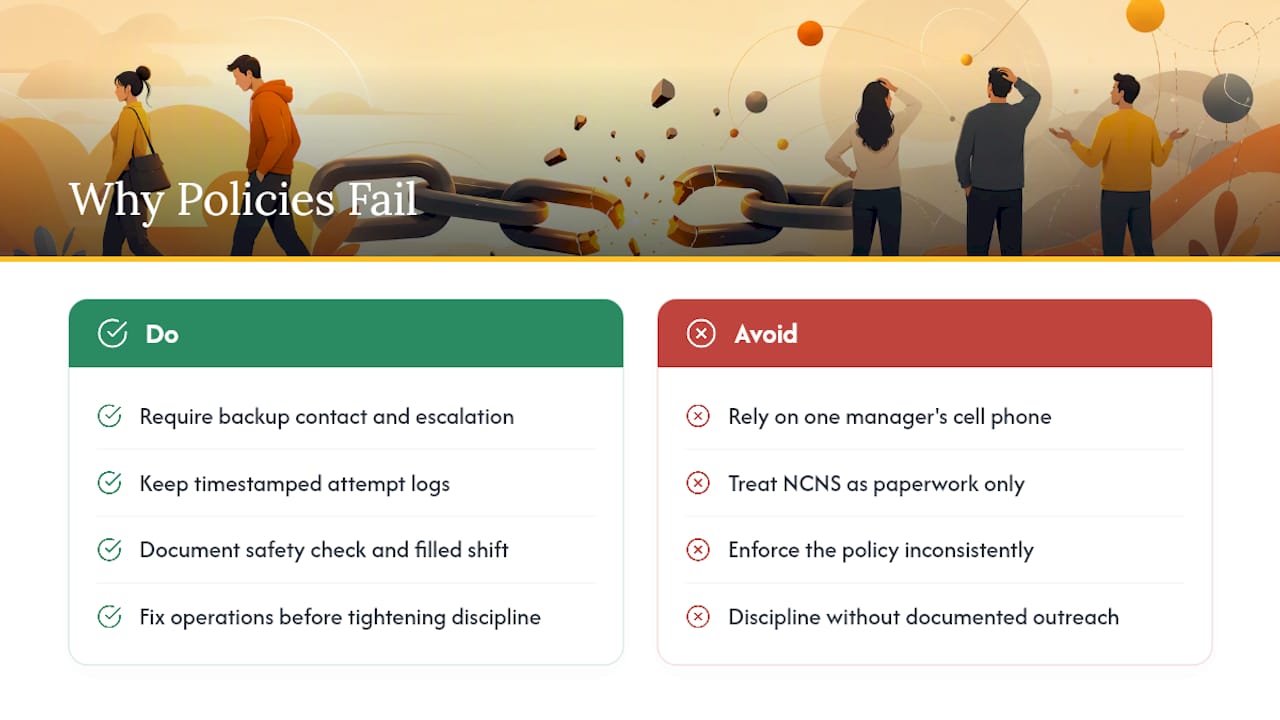
That’s the gap I’d fix first if I were rewriting a handbook today. A three-strike matrix is table stakes at this point. What separates a policy that survives a wrongful-termination claim from one that doesn’t is whether you can produce a timestamped log showing you tried to reach the employee, checked on client safety, and filled the shift, all before anyone got disciplined.
The conventional advice treats NCNS policy as a paperwork problem. It’s actually an operations problem wearing a paperwork costume. If your on-call coverage depends on one manager’s cell phone, your policy is only as strong as that person’s sleep schedule. Fix the operational gap before you tighten the discipline language. A perfectly worded policy enforced inconsistently is worse than no policy at all, because it creates a paper trail proving you didn’t follow your own rules.
— Ian Dwight Abejo
Sources
Recommended


Comments