


Fix 30–90 Day Claim Gaps: Home Care Audit for Small US Agencies


A home care audit is an internal review of your billing, documentation, staffing files, and policies, run before a payer or regulator ever asks to see them. The single highest-impact move you can make this week is a targeted pre-billing reconciliation of the last 30 to 90 days of claims against your visit logs. Get that right, and the rest of your audit process, built around the CMS HCBS internal records review job aid and supported by outsourced help from The BOSS System, becomes a lot more manageable.
TL;DR:
Performing a weekly reconciliation of billed units against visit logs and EVV timestamps can catch most discrepancies before claims are submitted.
Focusing on the highest-volume payer sources yields the greatest financial return by addressing the most impactful documentation gaps early.
Checking staff credentials, license status, and personnel files regularly prevents common audit risks related to expired certifications and incomplete records.
Implementing a recurring audit process that tracks findings and fixes through measurable KPIs minimizes repeat issues and demonstrates self-monitoring to regulators.
Outsourcing operational tasks such as care coordination, documentation support, and after-hours coverage significantly reduces internal errors and audit vulnerabilities.
Table of Contents
What Does a Home Care Audit Actually Check?
Auditors and reviewers, whether internal or external, tend to test the same six evidence pools. Knowing them ahead of time turns a vague fear of “getting audited” into a concrete checklist you can run against your own files this afternoon.
Care plans and service authorizations: active dates, required signatures, scope and units authorized, and whether the plan actually lines up with what got billed.
Progress notes and visit logs: legible entries, accurate in and out times, the caregiver’s identity, units delivered, and signatures on every page.
Billing records: claim details, modifiers, and a clean reconciliation against both documentation and Electronic Visit Verification (EVV) logs.
Staff files: background check results, training completion records, competency verifications, and current licensure.
Policies and version control: one dated, current source of truth, with proof staff acknowledged the version in effect.
Incident reports and corrective action history: evidence you caught problems and fixed them, including any prior Plan of Correction.
The CMS HCBS job aid specifically flags beneficiary identification on every page and current person-centered plans as recurring weak points. If your files can’t answer “does this note match this claim, on this date, with this signature,” that’s your starting gap.
How Do You Run an Internal Home Care Audit?
Running your own audit doesn’t require a big consulting engagement. It requires a defined scope, a sample, and someone willing to follow through on what the sample turns up.
Pick one primary risk area first. Billing accuracy, documentation completeness, or staffing compliance. Trying to audit everything at once is how audits die halfway through.
Choose your sampling method. Random sampling catches things you’re not looking for; targeted sampling (say, every client with a recent authorization renewal) catches known risk. A rolling sample, reviewing a small batch every month rather than everything once a year, spreads the workload and builds continuous improvement instead of one exhausting sprint.
Set your sample size. For a small or mid-size agency, 20 to 50 records, or 5% to 10% of your active client roster, is a reasonable starting point. The CMS job aid itself suggests a pace of roughly twenty records reviewed over a week, dedicating about an hour each day.
Assign roles and a timeline. One person collects records, a second reviews against the checklist, and a third signs off on findings. A one-week sprint works for a focused review; a rolling monthly cadence works better as a permanent habit.
Rate each finding by severity. A missing signature is not the same risk as a billed service with no supporting note. Triage before you panic.
Write a Plan of Correction for every finding, with an owner, a completion date, a verification step, and a metric you’ll track going forward.
Decide: retrain or redesign? If one caregiver keeps missing timestamps, that’s coaching. If half your staff make the same error, the process itself is broken and needs a rebuild.
Pro Tip: Run your very first audit on your highest-volume payer source. That’s where a documentation gap does the most financial damage, and where fixing it fastest pays you back the most.
Which Pre-Billing Checks Catch the Most Findings?
Most audit findings trace back to the same handful of pre-billing gaps, and nearly all of them are catchable before a claim ever leaves your building.
Reconcile every billed unit against the matching visit log or progress note for a rolling 30 to 90 day window, with a named reviewer signing off on the reconciliation.
If you use EVV, match its timestamps and caregiver IDs against both the claim and the clinical note. A mismatch here is one of the fastest ways to trigger a payer inquiry.
Confirm the service authorization and person-centered plan dates actually cover the dates you billed, per CMS HCBS guidance.
Check that your narrative notes support the procedure code and the intensity of service billed. A code for skilled intervention needs a note that describes skilled intervention, not a generic checkbox.
Build a pre-billing QA gate, a hard stop before submission, and log every exception and correction it catches.
Industry guides consistently point to the same three culprits behind most findings: incomplete clinical documentation, expired credential records, and billing that doesn’t match what the notes actually say. Daily or weekly pre-billing review, rather than a once-a-month scramble, catches narrative-code mismatches before they become denials. If your agency bills in batches, that pre-billing gate is worth more than almost any other single control you can add.
What Staff Records Get Flagged Most Often?
Staff files carry as much audit risk as clinical documentation, and they’re often the last thing an owner thinks to check.
Background checks, license and credential expiration dates, CPR certification, and mandatory training all need current, filed proof, not a manager’s memory that “it’s probably fine.”
Timekeeping accuracy and wage classification deserve their own pass. Misclassifying a caregiver’s hours creates wage-hour exposure that has nothing to do with clinical compliance but can be just as costly.
Personnel files need to be complete: hire paperwork, I-9 forms, tax documents, and any disciplinary or corrective action records, all in one place.
When you find gaps, the fix is straightforward but has to be documented, not just done. Schedule catch-up training and log completion dates. File retroactive paperwork with a clear note explaining the delay. Update your single source of truth so the correction is visible, not buried in an email thread. Keep personnel records retained per your state’s requirements, and organize them so that if an auditor asks for a specific caregiver’s file, you can produce it in minutes, not days.
How Do You Turn Audit Findings Into Lasting Fixes?
A finding that gets fixed once and never checked again isn’t a fix. It’s a delay.
Write the Plan of Correction properly. Root cause first, then the corrective action, a responsible owner by name, a completion timeframe, and a metric that proves the fix held.
Set a recurring cadence. Monthly spot checks on a small sample, a deeper quarterly audit, and one full annual review covers most agencies without burning out your office staff.
Build one dated source of truth for every policy, with automated reminders for license renewals and training expirations so nothing quietly lapses.
Track the small automations that pay off disproportionately: a pre-billing QA gate, routine EVV reconciliation, and version-controlled policies.
Know what to outsource first. Billing QA, after-hours call coverage, and documentation support are usually the highest-friction, most error-prone tasks, and often the easiest to hand off.
Pro Tip: Turn your top three recurring findings into weekly KPIs, like the percentage of claims that pass pre-billing QA clean, and review them at the same meeting every week. Findings that get a number attached to them get fixed. Findings that don’t, repeat.
A documented, recurring quality assurance program does double duty: it fixes your operations and it shows a regulator you self-monitor, which matters if you ever do face an external review.

What Do Founders Learn From Running Audits Inside Their Own Agency?
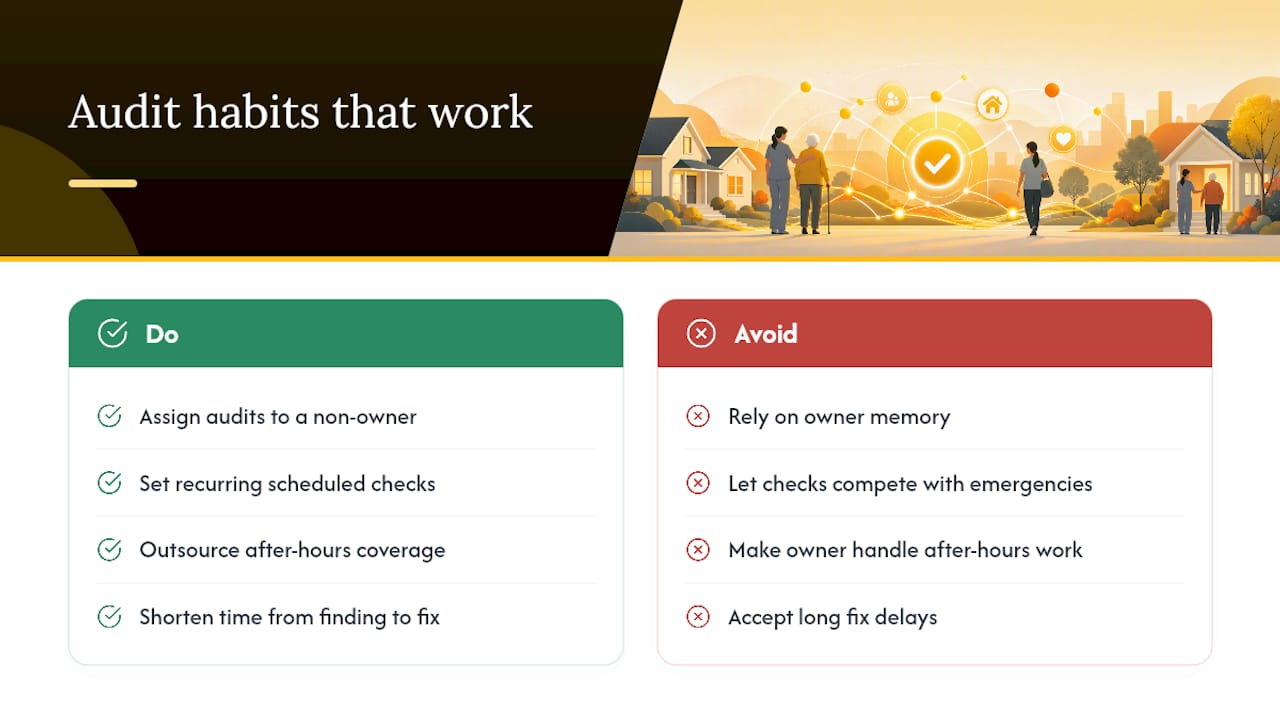
The pattern that shows up again and again is simple: findings don’t drop because owners work harder. They drop because someone besides the owner is responsible for catching them, on a schedule that doesn’t depend on anyone’s memory.
Recurring checks work when they’re not competing with the phone ringing at 2 a.m. Outsourcing after-hours coverage and staffing coordination frees an owner’s attention for the part of an audit program that actually needs a leader’s judgment: governance, follow-up, and deciding when a finding means retraining versus redesigning a process. The agencies that stay audit-ready aren’t the ones with the fewest problems. They’re the ones with the shortest gap between finding a problem and fixing it.
— Ian Dwight Abejo
Where The BOSS System Fits Into Audit Readiness
Most of the findings covered above trace back to the same root cause: something didn’t get documented, followed up on, or covered in time, usually because whoever was supposed to handle it was stretched too thin. The BOSS System exists to take those recurring operational tasks off an owner’s plate at a fraction of the cost of an in-house hire, since a trained coordinator through BOSS runs about 70% less than the same role staffed internally, once payroll taxes, benefits, and equipment are factored in.
The Command Center covers phones and shift backfilling around the clock, so a caregiver call-off at 2 a.m. gets documented and resolved instead of becoming a missed note nobody remembers by morning. The On-Call Program and A.I. Receptionist handle after-hours escalation with a logged trail auditors can actually review. Dedicated coordinators trained in home care workflows handle staffing, credentialing, and billing support, closing the exact gaps, expired trainings, mismatched claims, unfilled shifts, that generate audit findings in the first place. If pre-billing QA or documentation backlog is your biggest exposure, explore The BOSS System’s services and get a straightforward next step toward staffing the parts of your operation that are currently running on hope.
Authoritative Resources and Toolkits
For deeper reference, keep these close at hand:
The CMS HCBS internal records review job aid, the closest thing to an official checklist for documentation sampling and review.
Your state’s Medicaid provider manual, which sets the specific documentation and retention rules for your service area.
Structured-data and schema-audit tools like BabyLoveGrowth’s structured data audit, useful if your agency publishes policy documents or client-facing materials that need to stay organized and machine-readable.
The BOSS System’s blog for ongoing guidance on governance and Pod-based operational support.
Sources
FAQ
What Is Included in a Home Care Audit?
A home care audit reviews care plans, progress notes, billing records, staff credential files, and agency policies to confirm documentation supports every billed service, following the framework in the CMS HCBS job aid.
How Often Should an Agency Run an Internal Audit?
Most audit-readiness guides recommend monthly spot checks on a small sample, a deeper quarterly review, and one full annual audit, a cadence that spreads the workload rather than forcing an annual scramble.
What Sample Size Should a Small Agency Use?
A sample of a moderate number of records or a small percentage of active clients gives a small or mid-size agency a workable starting point, roughly matching the pace CMS suggests in its own internal records review guidance.
What Is a Plan of Correction?
A Plan of Correction documents the root cause of an audit finding, the corrective action taken, the responsible owner, a completion date, and a metric used to verify the fix actually held.
Can Outsourcing Reduce Audit Findings?
Yes. Outsourcing after-hours call coverage and care coordination to a service like The BOSS System reduces the missed documentation and empty shifts that are common root causes of audit exposure.
Recommended


Comments