


You’re Not the Backup: Dedicated Virtual Assistants for Home Care


A managed, dedicated virtual assistant is the fastest way to get reliable, continuous admin support without hiring in-house. It beats a freelancer or a recruiter-only agency on three counts: a team backs up your assistant instead of one person carrying the whole load, the all-in cost undercuts a W2 hire, and the assistant actually specializes in your workflow. The sections below cover how to evaluate providers, what pricing looks like, and how onboarding should run.
TL;DR:
A managed dedicated virtual assistant service provides backup coverage and supervision, reducing operational risks if an assistant is unavailable or leaves.
Costs are typically based on monthly hours, full-time retainer, or bundled team pricing, with the total included services often outweighing lower hourly rates.
Onboarding takes 30 to 90 days and should include access setup, SOP transfer, shadowing, and regular progress check-ins to ensure full productivity.
Businesses that benefit most are those with recurring, high-frequency tasks like scheduling, billing, staffing, and credentialing, especially in regulated fields like home care.
Evaluating providers requires focusing on their contingency plans, replacement guarantees, thorough training documentation, and proven operational systems over initial rates or resumes.
Table of Contents
What Is a Dedicated Virtual Assistant Service, and Why Does “Managed” Matter?
A dedicated virtual assistant is a remote professional assigned exclusively to your business, not shared across a dozen clients on a ticket queue. That’s the baseline definition, and it’s what separates a dedicated virtual assistant from the gig-style freelancer you find on a marketplace.
The word that actually matters is “managed.” A recruiter-only agency finds you a person and disappears. A managed service stays in the relationship: it trains the assistant, supervises their work, tracks performance, and replaces them without you having to start a hiring process from scratch. Buyer guides describe this as a subscription staffing model built around continuity and oversight, not a one-time placement.
Delivery shapes vary by need:
Full-time dedicated (FTE): one assistant, 30 to 40 hours a week, assigned solely to your account.
Fractional hours: a set monthly block, useful when the workload doesn’t justify a full seat.
Pod or command-center support: a small team with a lead, covering shifts, after-hours calls, or specialized functions like billing and credentialing at once.
Each model solves the “who’s covering this today” question differently, and that’s the question worth asking before you sign anything.
What Do You Actually Gain From a Managed Dedicated VA?
The single biggest advantage is that a managed team removes the single-point-of-failure problem. When one freelancer goes on vacation, gets sick, or quits, your operations don’t stall, because a managed provider cross-trains a backup who already knows your accounts and procedures.
The cost math: The BOSS System’s home care staffing model runs significantly lower than the all-in cost of an equivalent in-house coordinator, once you factor in salary, payroll taxes, benefits, and equipment. That’s a brand-specific claim, not an industry average, but it illustrates the shape of the savings a managed remote model can produce.
Beyond cost, the productivity gains show up in specific, unglamorous places:
Calendars stop double-booking because one trained person owns the process.
Staffing coordination gets faster when a specialist, not a generalist, handles shift fills.
Billing and accounts receivable follow-up happens on a schedule instead of when someone finally has time.
For regulated tasks, compliance is not optional. Any VA touching patient information, scheduling, or care coordination needs HIPAA-aware training and documentation practices built into the workflow, not bolted on after a complaint. A managed provider should be able to describe those controls specifically, not just claim “we’re compliant” and move on.
Who Actually Needs a Dedicated Virtual Assistant?
Not every business needs this. A dedicated VA earns its cost when the workload is recurring, not a one-off project, and when continuity failures actually hurt you.
The clearest buyer profiles:
Executives buried in scheduling, inbox triage, and travel logistics.
Small business owners wearing too many operational hats at once.
Home care agency owners managing staffing, intake, billing, and credentialing simultaneously.
Operations leads at growing companies who need a specialist, not another generalist hire.
Task types that benefit most: executive admin, appointment scheduling, intake coordination, billing and A/R, and recruiting or credentialing support. If you need a logo designed once or a database migrated in a weekend, skip the dedicated model entirely. Short projects and DIY automation tools handle those better and cheaper.
How Do You Vet a Dedicated VA Provider Before Signing?
Most buyers ask about hourly rates first. That’s the wrong starting point. The right first question is what happens the day your assistant is unavailable, because that answer tells you whether you’re buying a person or a system.
Here’s a sequence that surfaces the real answer:
Confirm the managed model exists. Ask directly whether the provider assigns backup coverage, cross-trains assistants, and supervises quality, or whether you’re only getting a recruited individual with no organizational support behind them.
Ask about replacement guarantees. “If my assistant is unavailable, who covers, and how fast?” A provider without a clear answer here is asking you to gamble on one person’s attendance.
Ask about handover length. “How long is a typical handover when someone new joins my account?” Days, not weeks, should be the answer if training and SOPs are already standardized.
Ask for documentation practices. “Do you provide written SOPs and knowledge transfer, or does everything live in one assistant’s head?”
Ask about reporting. “What will I see, and how often?” Weekly or biweekly check-ins with measurable output beat vague monthly updates.
Watch for red flags: vague answers about who covers absences, no examples of actual training or quality assurance, and no references or case studies you can check. Review sites consistently flag replacement guarantees and account management as the trust signals that separate serious providers from placement shops.
Pro Tip: Ask a provider to walk you through what happened the last time an assistant left mid-engagement. Their answer reveals more about the managed model than any sales pitch will.
What Does a Dedicated Virtual Assistant Cost?
Pricing shows up in three common shapes, and comparing headline rates across them is misleading.
Monthly hours subscription: you buy a block of hours (say, 40 or 80 a month) that roll over on defined terms, good for fractional needs.
Dedicated FTE retainer: a flat monthly rate for a full-time assistant assigned solely to your account, typically the best value per hour once volume justifies it.
Pod or bundled pricing: a team covering a function (staffing, billing, after-hours calls) for one recurring fee, common in operationally intensive fields like home care.
The number that actually matters isn’t the hourly rate, it’s what’s included underneath it. A cheaper rate with no training, no supervision, and no backup coverage often costs more once you count the hours you spend managing the gaps yourself. Managed staffing models can undercut the all-in cost of a U.S. in-house hire once payroll taxes, benefits, and equipment are factored in, but only when the provider is actually managing performance, not just invoicing hours.
How Long Does Onboarding Take, and What Should It Include?
Expect a working relationship to take 30 to 90 days to reach full productivity, and treat that window as a plan, not a delay to tolerate.
Week one: access and credentials. Set up logins, tools, and communication channels before any real work starts.
Weeks one to two: SOP transfer. Document your existing processes, or review the provider’s draft SOPs built from your input.
Weeks two to three: shadowing. The assistant observes or co-handles tasks with oversight before working independently.
Weeks three to six: priority task ownership. Hand off the highest-value recurring tasks first, keeping edge cases for later.
Days 30, 60, and 90: structured check-ins. Review output against agreed KPIs and adjust scope as needed.
Onboarding quality determines whether you see productivity gains on schedule, and buyer guides consistently point to structured check-ins in that first 30 to 90 day window as the difference between a hire that sticks and one that quietly underperforms. Ask upfront who owns documentation if your assistant is ever replaced. That answer should already exist before you sign, not get improvised later.
How The BOSS System Runs This for Home Care Agencies
Some managed virtual assistant providers build models around the exact continuity problem this article has been describing. Command Center Pods may cover phones 24/7, including nights, weekends, and holidays, so a caregiver call-off at 2 AM gets handled by a trained team rather than waking the owner for every disruption.
Beyond after-hours coverage, dedicated virtual assistants built specifically for home care staff the roles that actually run an agency:
Staffing and scheduling coordinators
Intake coordinators
Recruiters and credentialing specialists
Billing and A/R specialists
Bookkeepers and marketing support
Founded by Ian Dwight Abejo and Amy Abejo, who own and operate their own home care agency, The BOSS System’s staffing model is built by people who’ve run these workflows themselves, not designed from the outside. When one pod member is unavailable, the pod’s lead reassigns coverage immediately, so a shift never goes unfilled because a single employee didn’t show up.
Pro Tip: Ask any home care staffing provider what happens specifically at 2 AM. If the answer isn’t a documented process, you’re still the backup plan.
The Gap Between What Providers Promise and What Continuity Actually Requires
Most advice on hiring a virtual assistant treats the decision like hiring a single employee: find the right person, check references, negotiate a rate. That framing misses the actual risk. The problem isn’t finding one good assistant, it’s what happens the week that assistant is sick, quits, or simply has a bad day during your busiest stretch.
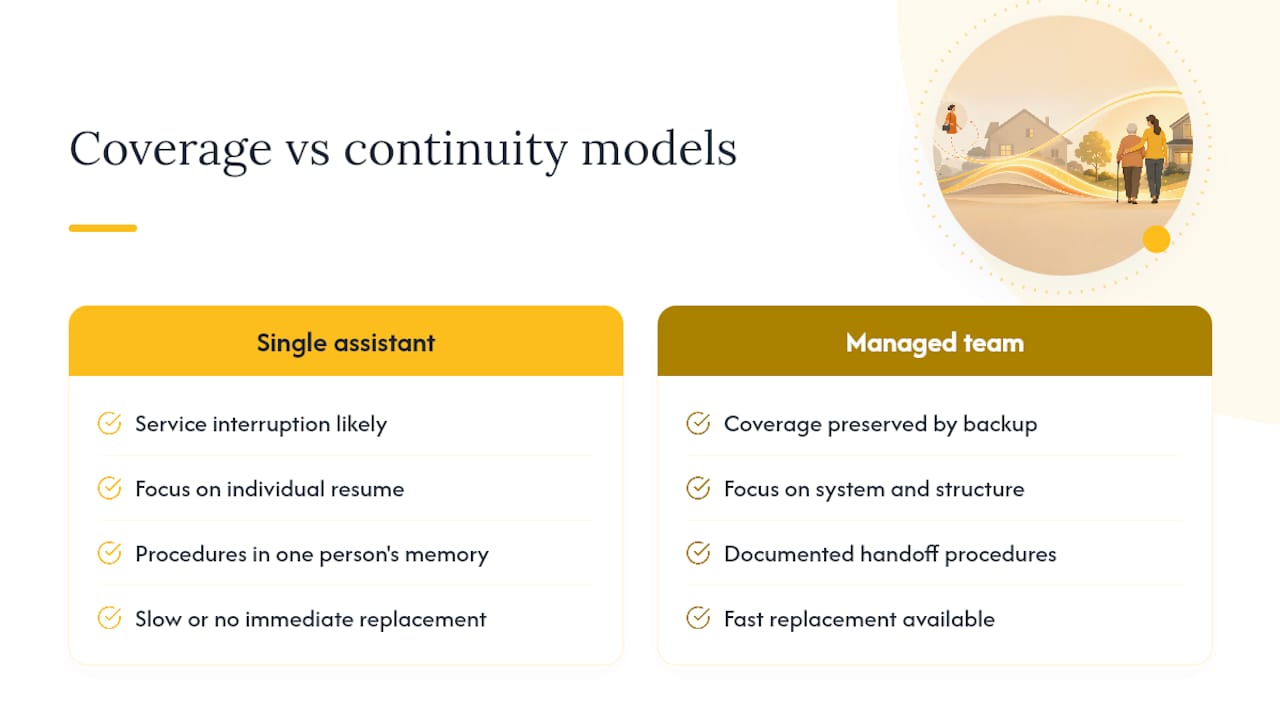
Conventional wisdom overvalues the individual and undervalues the system behind them. A freelancer with excellent skills and zero backup is a bigger operational risk than a mediocre assistant backed by a trained team with documented handoff procedures. That’s counterintuitive to buyers used to thinking about hiring as a talent search rather than a coverage problem.
What should a reader prioritize first? Not the resume. Ask about the organizational structure behind the person: who covers them, how fast a replacement can step in, and whether procedures live in writing instead of one person’s memory. Home care agencies learned this the hard way, because a missed 2 AM call has consequences a missed email doesn’t. Every service business with recurring, time-sensitive work is closer to that reality than most owners admit.
— Ian Dwight Abejo
Ready to Stop Being the Backup Plan?
If you run a home care agency and you’re the one who answers the phone when a caregiver calls off, a managed dedicated VA solves a problem that freelancers and single hires structurally can’t: what happens when one person is unavailable. The BOSS System is built specifically around that gap, with pods that cover 24/7 phone lines and specialists trained in home care workflows from day one, not generalists learning your industry on your dime.
A consult typically starts with a walkthrough of your current coverage gaps, whether that’s after-hours calls, staffing coordination, billing, or credentialing, and ends with a recommendation on which pod or role fits your agency’s size. There’s no obligation to restructure your whole operation at once; most agencies start with the highest-pain gap first. If nights and weekends are where your team is bleeding hours, start with the BOSS Command Center and see what a fully covered on-call line actually looks like.
Sources
FAQ
How much should you pay for a virtual assistant?
Pricing depends on the model: fractional hourly blocks, a dedicated FTE retainer, or bundled pod pricing for specialized functions. Compare what’s included, training, supervision, and backup coverage, rather than the hourly rate alone, since a cheaper rate with no managed support often costs more in the time you spend covering gaps yourself.
What are the top services a VA can offer?
The most commonly requested specializations are executive administrative support, scheduling and calendar management, and billing or accounts receivable follow-up. In home care specifically, staffing coordination, intake, and credentialing round out the highest-demand roles.
How do I know if a virtual assistant job or provider is legit?
Legitimate managed providers can clearly explain their replacement process, show documented training and quality assurance practices, and offer references or case studies on request. Vague answers about backup coverage or an inability to describe onboarding are the clearest red flags.
How much does a VA charge per hour?
Hourly rates vary widely by specialization and whether the provider offers a managed model with training and backup included. Rather than quoting a single figure, compare the total value, oversight, replacement guarantees, and documented SOPs, against the headline rate before deciding.
Recommended


Comments