


Home Care Owners: 7 Step Pilot to Fill Open Shifts and Get Nights Back


The fastest reliable way to fill open shifts is to hand after-hours coordination to a trained, home-care-specific outsourced team. A dedicated coordination team answers every callout, works the backup pool, and confirms a replacement caregiver before the family even starts to worry. Agencies that make this switch typically see fewer empty shifts, calmer clients, fewer 2 AM phone calls to the owner, and real savings on the bottom line. The sections ahead cover the ROI math, the actual workflow, how to vet a vendor, and a low-risk pilot you can run in 30 days.
TL;DR:
Outsourced coordination teams handle caregiver callouts faster, reducing the time-to-fill and minimizing last-minute shift gaps.
A trained external team costs about 70% less than an in-house coordinator when factoring in salaries, taxes, and benefits.
Effective vendors provide documented call logs and clear escalation paths, ensuring compliance and audit readiness.
Running a 30- to 90-day pilot with specific success thresholds helps agencies assess ROI before full implementation.
Geographic clustering and standardized rules streamline shift replacements, cutting travel time and improving coverage speed.
Table of Contents
What Outsourced Shift Filling Actually Looks Like
An outsourced coordination team is not a single answering service employee. It is a small team, usually with a lead and built-in backup, that owns after-hours coverage the way an in-house scheduler would during the day. Scheduling is consistently ranked as the top operational headache for home care providers, and remote coordinators can absorb that late-night callout load without adding a single line to local payroll, according to reporting on how agencies handle after-hours caregiver callouts.
Here’s the sequence a caregiver callout actually triggers:
The call comes in. A coordinator answers, confirms the shift details, and immediately checks the roster for skill and area tags.
Backups get contacted in order. Continuity priority runs first, meaning the caregiver the client already knows gets the first call.
Coverage gets confirmed. The coordinator locks in the replacement, updates the schedule, and calls the family with a status, not a problem.
The event gets documented. Notes flow into your EVV and payroll systems so nothing falls through at billing time.
Skill matching and continuity tagging matter because a rushed swap that ignores certification or a client’s comfort with a new face creates its own risk. The documentation step matters just as much: an audit trail protects you if a state surveyor ever asks who covered a shift and why.
What ROI to Expect When You Outsource Coordination
Three numbers tell you whether outsourced coordination is working: fill rate (the percentage of open shifts covered before they go missed), time-to-fill (minutes or hours from callout to confirmed coverage), and overtime percentage (how often premium rates are paid to plug a gap). Add coordinator hours saved and missed-visit count, and you have a complete before-and-after picture.
Manual scheduling hides its true cost inside coordinator overtime, missed billing, and unfilled-shift revenue loss. Improving fill rate alone can recover meaningful annual revenue that currently disappears into no-shows and last-minute cancellations, according to Arya Health’s scheduling cost analysis. Automated outreach and coordinated backup pools also fill callouts faster than a manual phone tree, with some practitioner estimates putting the speed gain as high as three times faster, per Aveecare’s shift planning guide.
The cost comparison that matters: A trained home care coordinator through an outsourced provider costs roughly 70% less than the same hire in-house, once you account for payroll taxes, benefits, and equipment.¹ Use this as a starting point for your own math, not a guarantee.
What that means practically:
Every recovered visit is billable revenue you were leaving on the table.
Lower overtime spend drops straight to margin, not just to a lighter payroll report.
Fewer missed visits reduce the compliance risk tied to documentation gaps.
¹ Compared to average all-in cost of an in-house coordinator (salary, payroll taxes, benefits, admin costs). Sources: Indeed, IRS, Bureau of Labor Statistics.
How a Same-Day Callout Actually Gets Filled
The playbook behind a filled shift runs on rules, not improvisation. Here’s what happens between the phone ringing and the family knowing everything is handled:
Triage the call. A coordinator determines immediately whether this is a routine callout, a clinical concern, or something that needs the owner or a nurse on the line right now.
Work the backup pool first. Internal PRN staff get contacted before anyone reaches for an external staffing agency, and overtime caps trigger an automatic escalation instead of a quiet rule-bend.
Call the family with a plan, not a problem. The script leads with the solution: “Your caregiver called off, and here’s who’s covering instead,” never a bare apology.
Log everything. The event, the replacement, and the timestamp feed into your EVV and payroll export so billing and compliance stay clean.
Geographic clustering plays into this too. Two-stage assignment models that group visits by area and match lower-cost qualified staff first cut travel time and free your highest-skilled caregivers for the visits that actually need them, according to research on home health scheduling and routing optimization.
Pro Tip: Set a hard overtime ceiling before you outsource anything. If your coordinator doesn’t know the number where OT approval requires your sign-off, you’ll find out the number the hard way, on an invoice.
How to Vet a Shift-Filling Vendor (and the Red Flags to Watch For)
A demo call tells you almost everything. Ask direct operational questions: What are your actual hours? What’s your average time-to-fill for a same-night callout? What’s the escalation path when a shift can’t be filled? How often do you send documentation, and in what format?
Compliance questions come next. Ask how they handle HIPAA-covered information, whether call logs and audit trails export on request, and who reviews their process for gaps.
Commercial terms deserve equal scrutiny:
Pilot length and what “success” is measured against.
Whether pricing is per-Pod, per-hour, or tied to a minimum shift volume.
Cancellation terms and any long-term lock-in.
Red flags show up fast if you’re paying attention:
No home-care-specific training, just generic call-center scripts.
Coverage that depends on one person, with no stated backup.
No documentation trail you can hand to an auditor.
Pricing that’s vague until you’re already signed.
Outsourcing scheduling and intake tends to work best when paired with clear KPIs from day one, not a vague promise of “better coverage,” according to industry guidance on outsourcing administrative processes.
A 7-Step Pilot to Test Outsourced Shift Filling
Run a real pilot before you commit long-term. Here’s the sequence:
Pick a narrow scope. One site, nights only, or weekends only is enough to get a real read.
Set your baseline. Pull your current fill rate, time-to-fill, and OT percentage for the last 60 days.
Define success thresholds. Decide now what “working” looks like, not after you’ve seen the results.
Hand over clean data. A roster with skill tags, continuity notes, and verified emergency contacts.
Map the integration points. Scheduling system access, EVV notes, and payroll export format.
Set a review cadence. Weekly check-ins for the first month, then move to biweekly.
Make a go/no-go call at 30 and 90 days. Compare against your baseline, not against a feeling.
Pilot checkpoint | What to measure | Decision point |
— | Baseline fill rate, OT %, missed visits | Set thresholds |
Day 30 | Time-to-fill trend, coordinator hours saved | Continue or adjust scope |
Day 90 | Full ROI comparison against baseline | Go / no-go on full rollout |
Why We Built a Pod Instead of Hiring Another Coordinator
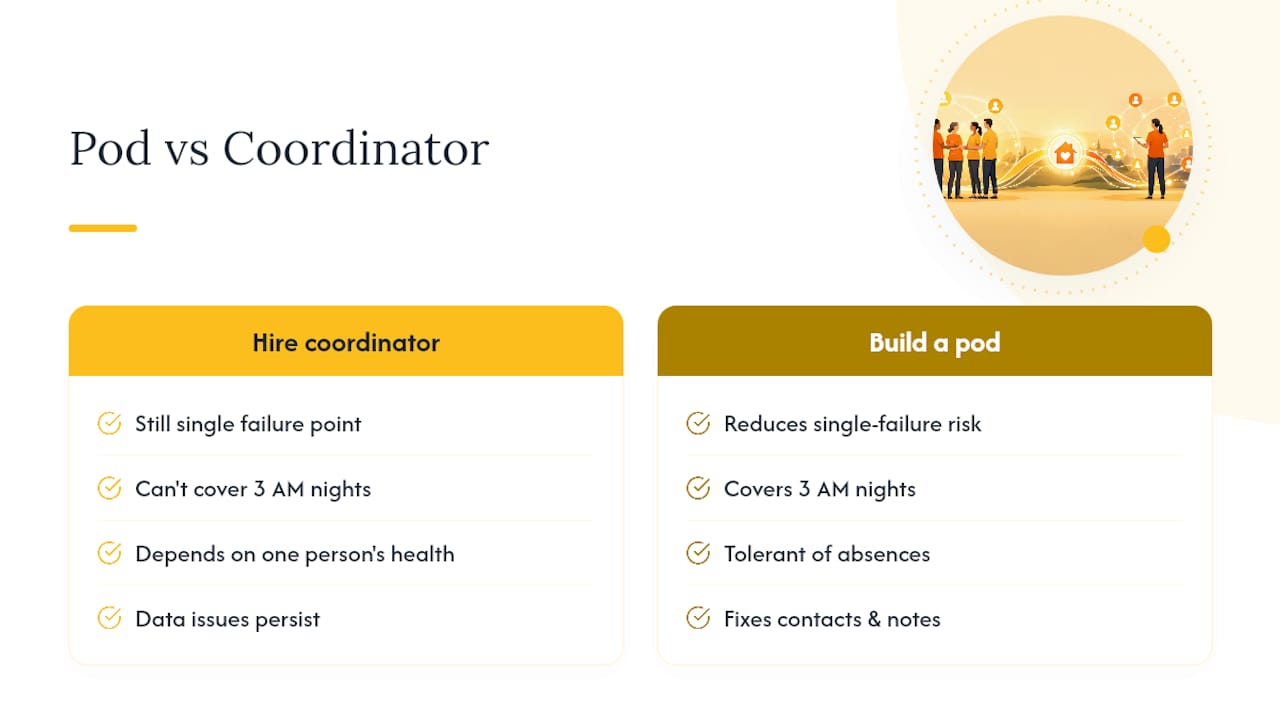
Running a home care agency means the phone owns your evenings whether you want it to or not. We built The BOSS System because hiring one more in-house coordinator doesn’t solve the real problem: one person still gets sick, still takes vacation, and still can’t be awake at 3 AM every night of the year.
The lesson most agencies learn in their first pilot week has nothing to do with the vendor and everything to do with their own data. Contact lists have outdated numbers. Continuity notes live in someone’s head instead of the system. Escalation rules were never written down. Fixing that before day one saves the entire pilot.
Get Nights and Margins Back With The BOSS System
The BOSS System is the alternative to hiring another in-house coordinator for after-hours coverage: a trained Pod costs roughly 70% less than the equivalent local hire, with no payroll taxes, no benefits, and no single point of failure when someone calls in sick.¹
The Command Center Pod covers phones 24/7, so a 2 AM callout gets triaged, backfilled, and documented before you’re even aware it happened. In the first 30 to 90 days of a pilot, agencies often see their fill rate climb, their overtime spend shrink, and their owner get an actual evening off. Beyond after-hours calls, The BOSS System’s workforce includes staffing coordinators, recruiters, and billing specialists trained specifically on home care workflows, not generic call-center scripts.
If you’re ready to see what a real pilot looks like, start with the Command Center Pod on-call program and get a scope and timeline built around your agency’s actual callout volume.
Sources
FAQ
What Does It Mean to “Fill Open Shifts” Through Outsourcing?
It means a trained external coordination team, rather than an in-house employee, handles caregiver callouts, contacts backup staff, and confirms replacement coverage in real time.
How Fast Can an Outsourced Pod Fill a Callout?
Coordinated backup pools and automated outreach can fill a shift up to three times faster than a manual phone tree, according to Aveecare’s coverage guide.
Is Outsourced Coordination Cheaper Than Hiring In-House?
A trained coordinator through The BOSS System runs about 70% less than an equivalent in-house hire once payroll taxes, benefits, and equipment are factored in.¹
What Compliance Records Should a Vendor Provide?
Expect documented call logs, timestamped callout resolution, and an audit trail that exports directly into your EVV and payroll systems for every filled shift.
How Long Should a Pilot Run Before I Decide?
Most agencies set checkpoints at 30 and 90 days, comparing fill rate, time-to-fill, and overtime percentage against a 60-day baseline before committing long-term.
Recommended


Comments