


EVV Compliance for Home Care: A State-by-State Checklist
- Alyana Cabayao
- 2 days ago
- 7 min read


EVV compliance means your agency captures six specific data points on every visit and submits them the way your state requires. Skip the six elements or miss your state’s submission format, and you risk claim denials and, at the state level, reduced federal matching funds. Before you read another word, do three things: check your state’s compliance status, confirm your current EVV method actually captures all six required fields, and pull a 30-day data-quality audit today.
Do this now:
Assign one person to check your state’s Medicaid EVV page this week.
Have your scheduler or IT lead verify all six data elements are being recorded correctly.
Run last month’s visit data through your EVV vendor’s export and scan for gaps.
Who to call internally: your scheduling supervisor and whoever manages vendor relationships.
What to pull: a visit-level exception report from the last 30 days.
Where to look: your state Medicaid or DSHS EVV page, plus the Medicaid.gov compliance table.
Key Takeaways
EVV compliance depends on capturing all six Cures Act data elements correctly and matching your specific state’s submission and validation rules.
Point | Details |
Confirm your state status | Check the Medicaid.gov compliance table and your state Medicaid page this week. |
Audit your six data elements | Verify service type, recipient, date, location, provider, and start/end times are all captured. |
Build a 30/90/180 plan | Sequence vendor confirmation, caregiver training, and audits over six months. |
Watch for FMAP and denial risk | States face FMAP reductions; agencies face claim denials and recoupments for bad data. |
Get operational support | The BOSS System provides trained coordinators for 24/7 EVV monitoring and caregiver troubleshooting. |
Table of Contents
What Does EVV Compliance Actually Require?
Section 12006 of the 21st Century Cures Act sets the federal floor. Every Medicaid-funded visit under Personal Care Services (PCS) or Home Health Care Services (HHCS) needs six minimum data elements captured electronically:
Type of service performed
Individual receiving the service
Date of the service
Location of service delivery
Individual providing the service
Time the service begins and ends
States had to implement EVV for PCS by January 1, 2020, and for HHCS by January 1, 2023. States that never got there face incremental reductions in their Federal Medical Assistance Percentage, the federal share of Medicaid spending. That penalty hits state budgets directly, but agencies feel the downstream effect through tighter claims validation and stricter documentation demands.
One detail trips up a lot of administrators: the federal law never mandates GPS tracking. Start and stop location data satisfies the requirement in most states, and CMS workshop guidance explicitly frames this as a privacy-conscious minimum, not a surveillance mandate.
How Do You Check Your State’s EVV Compliance Status?
Start with the Medicaid.gov compliance table for HHCS, and the companion PCS table for personal care. Each entry shows whether a state reported full compliance, partial compliance, or non-compliance, along with the date CMS made that determination and a link to the actual determination letter.
From there, go to your state’s own Medicaid or DSHS page. Washington State’s DSHS EVV page is a solid model of what a state page should include: federal requirements translated into state-specific instructions.
To check a state properly:
Confirm the implementation model (state-run, open vendor, or aggregator).
Note which EVV methods the state accepts (mobile app, telephony, or fixed device).
Record the aggregator’s contact information and data submission format.
Identify the enforcement threshold and any minimum compliance percentage.
Save the date you checked and screenshot the determination letter.
What Are the Different State EVV Implementation Models?
States chose one of a few basic structures, and which one your state picked determines your entire onboarding process.
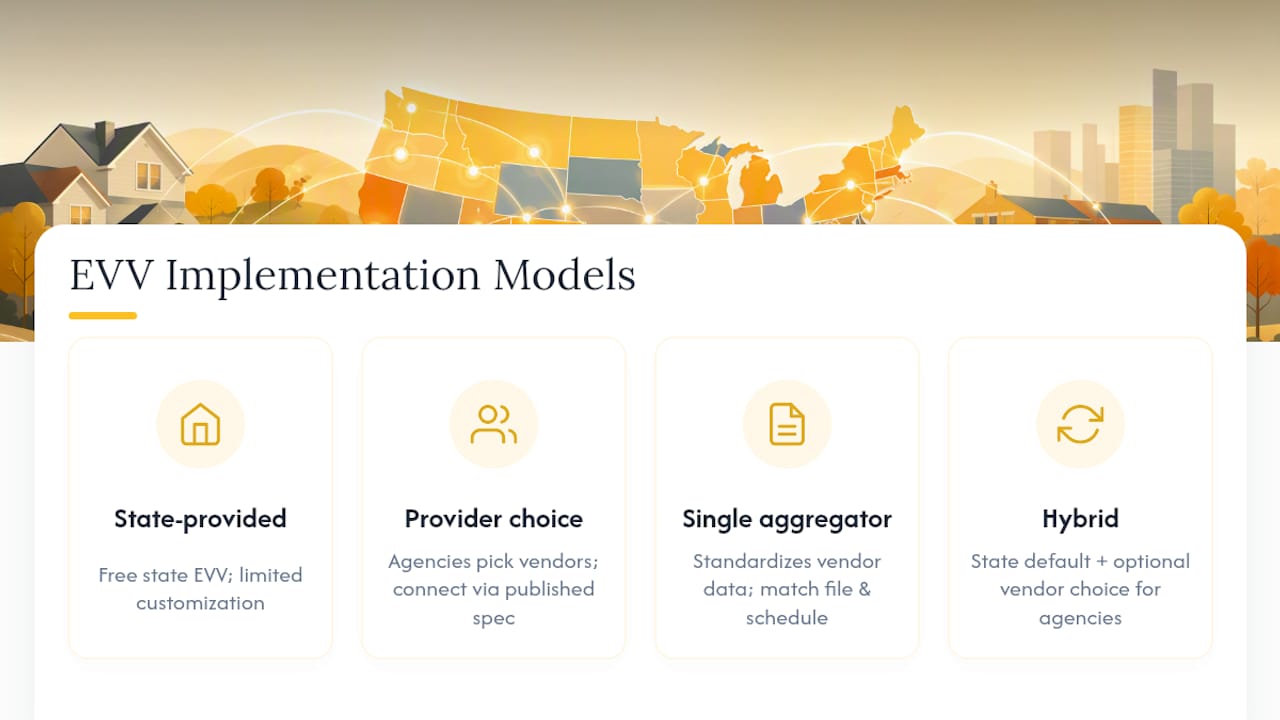
State-provided system. The state offers a free EVV solution, usually for fee-for-service providers. You use what they give you, with limited customization.
Open vendor / provider choice. Agencies pick their own EVV vendor and connect to the state’s aggregator through a published technical spec. Pennsylvania runs this model, giving providers a free DHS option alongside the ability to interface an alternate vendor if they prefer.
Single aggregator. One state-designated aggregator collects data from all approved vendors in a standardized format, regardless of which system agencies use day to day.
Hybrid. Some states run a state-provided default with vendor choice layered on top for agencies that outgrow it.
Provider choice models put integration testing on you. Aggregator models put the burden on matching their file format and submission schedule exactly.
Pro Tip: Before signing any EVV vendor contract, ask directly whether they’ve already been certified to interface with your specific state’s aggregator. A vendor that’s certified in Ohio isn’t automatically certified in Texas.
What’s the Step-by-Step Process to Get EVV Compliant?
Treat compliance like a 30/90/180-day project, not a one-time software install.
Days 1 through 30:
Confirm your state’s current EVV status and implementation model.
Map every service code you bill against EVV requirements. Not all services require it.
Verify your current system captures all six data elements correctly, not just some of them.
Select or confirm your EVV vendor connects properly to your state’s aggregator.
Days 31 through 90:
Run a pilot with a small group of caregivers before rolling out agency-wide.
Train every caregiver on clock-in and clock-out procedures, including what to do when a visit runs long or a phone dies mid-shift.
Build an exception workflow for missed clocks, late visits, and manual overrides.
Set a weekly cadence for pulling data-quality reports.
Days 91 through 180:
Audit a random sample of visits monthly against your submitted EVV records.
Document every training session, corrective action, and communication with your state’s EVV help desk.
Review your exception rate and address recurring patterns caregiver by caregiver.
Reporting cadence: weekly exception reports, monthly full audits.
Documentation to keep: training logs, corrective action notices, any correspondence with state Medicaid staff.
Escalation path: identify who handles a caregiver who repeatedly fails to clock in correctly.
Pro Tip: Phase your rollout by team or region instead of switching every caregiver over on the same day. A staggered rollout means you catch the process errors before they multiply across your entire workforce.
What Are the Most Common EVV Compliance Pitfalls?
Most denials trace back to a handful of recurring mistakes:
Missing or incomplete start and end times
GPS disabled on a caregiver’s phone when the state requires location data
Batch uploads submitted late, past the state’s data submission window
Manual overrides used too often instead of fixing the root cause
Thin documentation that can’t prove good-faith effort during an audit
States typically escalate through stages: technical assistance first, then a corrective action plan, then adverse action including claim denials and recoupments. Some states, like Wyoming, have moved to tiered compliance thresholds, starting near 70% and stepping up toward 85% over time, with enforcement tightening at each stage. Budget for vendor fees, integration development if you’re on an open-vendor model, device provisioning for caregivers without smartphones, training hours, and staff time for ongoing remediation.
What Do Agencies Get Wrong About EVV in Practice?
EVV compliance fails when agencies treat it as an IT problem instead of an agency-wide one. Your scheduler, your trainer, and your QA person all touch data that ends up in a compliance report, and misalignment between them is where exceptions pile up.
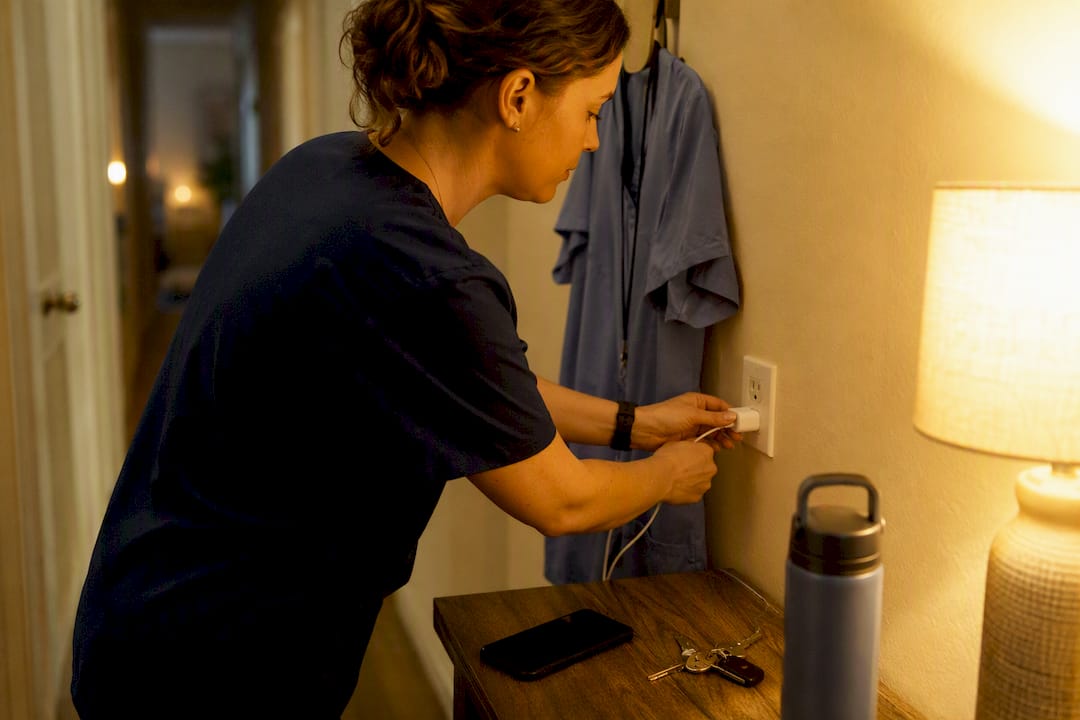
Agencies that stay ahead of enforcement build a daily habit: someone checks the compliance dashboard, flags caregivers with repeated exceptions, and calls them before a pattern becomes a corrective action plan. Scripted troubleshooting for common caregiver mistakes, like a dead phone battery or a missed manual entry, cuts resolution time from days to minutes.
Routine internal monitoring catches issues before external validation tightens further, which several states have already started doing as they turn on stricter claims edits.
Where should agencies focus limited time first?
If I had to pick one lever, it’s caregiver training paired with weekly data audits. Vendor selection matters, but a certified system still fails when caregivers don’t use it consistently. Fix the people problem inside your 30/90/180 plan before you chase a new platform.
Get Operational Support for EVV Compliance
Most agencies don’t have a spare staff member to run weekly EVV audits, chase down caregivers who forgot to clock out, or document every exception for a future state review. The BOSS System gives you trained coordinators who already understand home care workflows, so EVV monitoring becomes part of daily operations instead of a task nobody owns.
Boss’s Command Center covers your phones 24/7, which means when a caregiver calls in confused about a clock-in error at 9 PM on a Saturday, someone trained answers immediately and documents it, instead of the issue surfacing three days later in a denied claim. Boss’s workforce includes coordinators trained specifically on home care compliance workflows, not generalist virtual assistants learning on the job.
Ready to see where your agency’s EVV process has gaps? Visit The BOSS System to schedule a compliance readiness review.
Bookmark These EVV Compliance Resources
Save these pages and check them quarterly, since state rules shift as enforcement tightens.
Medicaid for federal requirements and updates.
The HHCS compliance table and PCS equivalent for your state’s official status and determination letters.
CMS’s outcome-based certification page for vendor certification standards.
Your state’s Medicaid or DSHS EVV page, following Washington State’s model, for technical specs and help desk contacts.
Record the date you checked each page and save any determination letters you find.
Frequently Asked Questions
Does EVV compliance require GPS tracking on caregiver phones? No. Federal law requires location data at the start and end of a visit, not continuous GPS tracking. Some states ask for more, so confirm your specific state’s requirement.
What happens if my agency’s EVV data is incomplete? Incomplete data usually triggers claim denials or recoupments first. States may also flag your agency for technical assistance, and repeated failures can lead to a corrective action plan.
Who faces the FMAP penalty for EVV non-compliance? The state does, not individual agencies. States that fail to implement EVV face reduced federal matching funds, but agencies still bear the operational risk of denied claims tied to bad data.
Can my agency use telephony-based EVV instead of a mobile app? Yes, in many states. Telephony works well where caregivers lack smartphones or reliable connectivity, though it may not satisfy location requirements in every state, so check with your state Medicaid office first.
How often should agencies audit their EVV data? Weekly exception reports plus a monthly full audit catch most problems before they become compliance issues. Documented, regular reviews also demonstrate good-faith effort if a state ever conducts a formal review.
This article is general information, not a substitute for advice from a qualified lawyer. Consult a qualified legal professional about your own circumstances before acting on anything here.
Sources
Recommended


Comments