


Holiday Coverage for Home Care Agencies: A Buyer's Checklist


Outsource holiday coverage to a trained Pod that runs your after-hours line, executes rapid shift backfills, documents every action in your EHR, and escalates clinical events straight to your on-call nurse. That’s the whole recommendation. Everything else in this guide helps you vet whether a provider actually does that.
Before you sign anything, demand two measurable targets on the vendor call: a time-to-answer SLA under 30 seconds (or a clearly configurable one), and minute-one no-show detection paired with a ranked backup caregiver list. Anything vaguer than that is a message-taking service wearing a bigger title.
Ask for their average time-to-answer SLA in writing, not a verbal estimate.
Ask how fast they detect a caregiver no-show and how many backups they can call before your phone rings.
Pro Tip: Pull your after-hours call log and missed-inquiry timeline for the last 90 days before you take a single vendor call. Providers respond very differently once they see your real numbers instead of a hypothetical.
Key Takeaways
Outsourced holiday coverage works when a trained Pod, not a single person, answers every call, fills shifts in minutes, and escalates clinical events on documented protocol.
Point | Details |
Demand a written SLA | Time-to-answer under 30 seconds, stated in writing, not estimated verbally on a sales call. |
Choose a Pod over a single person | Team-based coverage provides redundancy so nobody’s sick day breaks your after-hours line. |
Calculate real ROI | Factor in the hidden cost of more than one thousand six hundred dollars per no-show, not just base coordinator salary. |
Expect a 1 to 2 week launch | Reliable shift-fill performance typically stabilizes by day 30 after go-live. |
The BOSS System’s Pod model | Delivers trained coordination at about 70% below a local hire’s all-in cost, per its published pricing breakdown. |
Table of Contents
What Does Holiday Coverage Actually Include for a Home Care Agency?
What Financial Return Does Outsourcing Holiday Coverage Deliver?
What Contract Terms Should You Negotiate for Holiday Coverage?
What Technology Should Connect to Your Holiday Coverage Team?
How Should Your Staff Work With the Outsourced Coverage Team?
What Do Successful Holiday Coverage Rollouts Have in Common?
What Does Holiday Coverage Actually Include for a Home Care Agency?
“Holiday coverage” in home care means outsourced staffing and on-call services that fill caregiver shifts and answer your phones 24/7, including nights, weekends, and major holidays. It’s not a single answering service. It’s a set of coordinated functions that need to work together.
The core components:
After-hours inbound call answering, live or AI-first-pass with human verification
On-call triage that separates routine coordination from clinical escalation
Rapid shift fill and backfill when a caregiver calls off
Morning handoff reports summarizing overnight activity
EHR and scheduling system integration
Audit-grade documentation of every call and decision
Routine issues, a reschedule, a caregiver running late, a family question, get resolved on protocol. A fall or a sudden change in condition gets escalated to your on-call nurse immediately, not batched for the morning. Staffing models split into two types: a single on-call person, or a dedicated Pod with a team lead and built-in backup. The second model is the only one that survives someone’s sick day.
What Financial Return Does Outsourcing Holiday Coverage Deliver?
Owners who outsource holiday coverage typically see gains in five places: fewer missed inquiries, less coordinator overtime, fewer owner nights-on-call, faster new-client capture, and better family satisfaction because someone always picks up.
The math is more favorable than most owners expect. A trained coordinator through a Pod model can run about 70% less than the all-in cost of hiring the same role locally, once you count salary, payroll taxes, benefits, and admin overhead. That gap alone often justifies the switch before you even factor in what a missed shift costs you.
And missed shifts cost more than most spreadsheets admit. One analysis of caregiver no-shows puts the hidden cost of a single no-show at a hidden cost of more than one thousand six hundred dollars, once you count replacement labor at overtime rates, coordinator time spent scrambling for coverage, and the cancellation risk that follows a bad experience. Multiply that by even a handful of holiday weekends and the case writes itself.
Pro Tip: When you present this to your owner or board, build the ROI case around total cost, not base salary. Overtime, missed-visit penalties, and turnover from burned-out coordinators are the real hidden line items.
How Do You Evaluate a Holiday Coverage Provider?
Score every vendor against the same checklist so you’re comparing apples to apples, not sales decks.
Procurement criteria to check:
Time-to-answer SLA, stated in writing and configurable
Staffing model: dedicated Pod versus single on-call person
Documented protocols and a standard morning handoff format
EHR and scheduling system access
HIPAA compliance and a signed Business Associate Agreement (BAA)
Clear escalation rules for clinical versus routine issues
A specific staffing plan for major U.S. holidays, not just “we’re open”
Built-in redundancy so coverage never depends on one employee
Training specific to home care workflows and software
Sample audit logs you can review before signing
Questions to ask on the demo call:
What’s your average time-to-answer, and can you show me a log?
Walk me through onboarding, day by day, from contract to go-live.
What data access do you need, and how is it role-based?
How do you handle Electronic Visit Verification (EVV) exceptions?
What exactly triggers an escalation to my on-call nurse?
Red flags that should end the conversation:
They only take messages and can’t act on your schedule directly.
No EHR integration, meaning everything gets relayed manually.
No audit logs, or reluctance to show a sample.
No references from other home care agencies.
A vague or nonexistent answer on HIPAA and BAA status.
Weight your scoring toward SLA, staffing model, and compliance posture; a provider that’s fast but sloppy on documentation will eventually cost you an audit.
How Long Does It Take to Launch Holiday Coverage?
Most agencies can move from signed contract to live after-hours coverage within a few weeks, with shift-fill reliability stabilizing shortly thereafter.
Week 0, intake and mapping: the vendor learns your caregivers, your escalation contacts, and your client roster.
Days 1 to 7, access and playbook build: you grant EHR and scheduling access under a signed BAA, and the vendor builds your specific escalation playbook.
Days 8 to 14, shadowing and validation: the team shadows live calls, tests the backup-list logic, and confirms handoff formatting.
Week 3, go-live and daily monitoring: the after-hours line goes live, with daily check-ins on call volume and resolution.
Day 30, review and SLA tuning: you review the first month’s metrics and adjust staffing or escalation rules as needed.
Compliance essentials that need to be locked in before go-live: a signed BAA, role-based access to your systems, a documented audit trail for every call, a retention policy for records, and training specific to your clinical escalation protocols.
Metric | How It’s Measured | Early Target |
Time-to-answer | Seconds from ring to live pickup | Under 30 seconds |
First-contact resolution | Calls closed without a callback | Rising weekly by day 30 |
Missed-visit rate | Shifts unfilled after a call-off | Declining from baseline |
Fill time for no-shows | Minutes from detection to backup contacted | Under 30 seconds |
Owner interruption frequency | True emergencies escalated to owner | Near zero for routine calls |
What Does a Real Holiday Coverage Rollout Look Like?
Picture a mid-size agency losing after-hours inquiries to voicemail and scrambling every Saturday morning when a caregiver doesn’t show. That’s the starting point for most agencies that call The BOSS System.
The intervention pairs an AI-first-pass system, which answers every ring so nothing goes to voicemail, with a dedicated coordinator backed by the Command Center Pod. Routine calls get resolved on protocol. Clinical concerns get escalated immediately. No-shows get flagged and backfilled from a ranked list instead of a coordinator’s personal phone tree.
Outcomes agencies typically report:
Overnight inquiries convert into booked assessments instead of disappearing into voicemail
Missed visits drop as backfill happens in minutes, not hours
Owners stop getting woken for anything short of a true emergency
On cost and timing, the pricing breakdown from The BOSS System shows trained coordinators running at roughly 70% below a local hire’s all-in cost, with after-hours coverage typically live in one to two weeks and rapid-fill reliability stabilizing within a month. Results vary with call volume and region, and any vendor should be willing to show you their own numbers before you commit.
What Contract Terms Should You Negotiate for Holiday Coverage?
Most holiday coverage contracts run month-to-month or on short initial terms, three to six months is common, rather than locking you into a full year before you’ve seen a single holiday weekend in action. Push back hard on anything longer for a first engagement.
Look closely at three things: minimum term, termination notice, and penalty clauses. A fair contract lets you exit with 30 days’ written notice and no early-termination fee once you’re past an initial trial window. Anything that penalizes you for leaving inside the first 90 days is a sign the vendor expects you to be unhappy.
Also confirm what happens to your data and documentation on exit. You should retain full access to call logs, audit trails, and handoff notes generated during the contract, not just a summary. If a vendor is vague about data portability, that’s a negotiating point, not a footnote.
Finally, ask what triggers a rate change. Flat weekly or monthly pricing should stay flat for the contract term unless your call volume changes materially, and any adjustment clause should require advance notice, not a surprise on next month’s invoice.
How Do You Monitor Quality After Onboarding?
Signing a contract isn’t the finish line. The agencies that get the most out of holiday coverage build a rhythm of review into the first 90 days and keep it going.
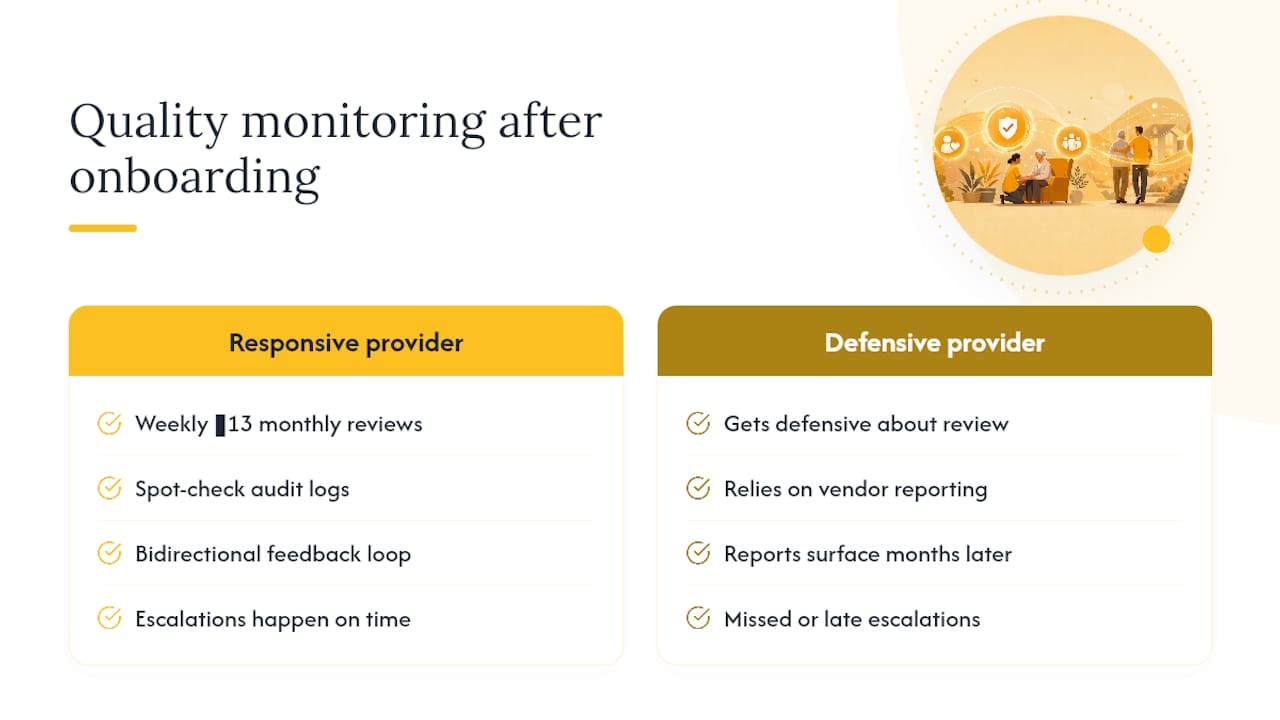
Ask your provider for a weekly call log review during the first month, then move to monthly once volume patterns stabilize. Spot-check a sample of audit logs yourself rather than relying entirely on the vendor’s own reporting. You’re looking for consistency: are escalations happening on time, are handoff notes complete, is the tone with families appropriate.
Build a feedback loop that runs both directions. If a caregiver reports a rough interaction with the after-hours line, that needs to reach the vendor within days, not surface three months later in a renewal conversation. Good providers welcome this; providers who get defensive about it are telling you something.
Track issue resolution time as its own metric. When something does go wrong, a coverage lapse, a wrong callback number, a missed escalation, how fast does the vendor acknowledge it and show you the fix? A provider that treats every hiccup as a learning moment for their team, documented and shared with you, is a very different partner than one that treats it as a one-off apology.
What Technology Should Connect to Your Holiday Coverage Team?
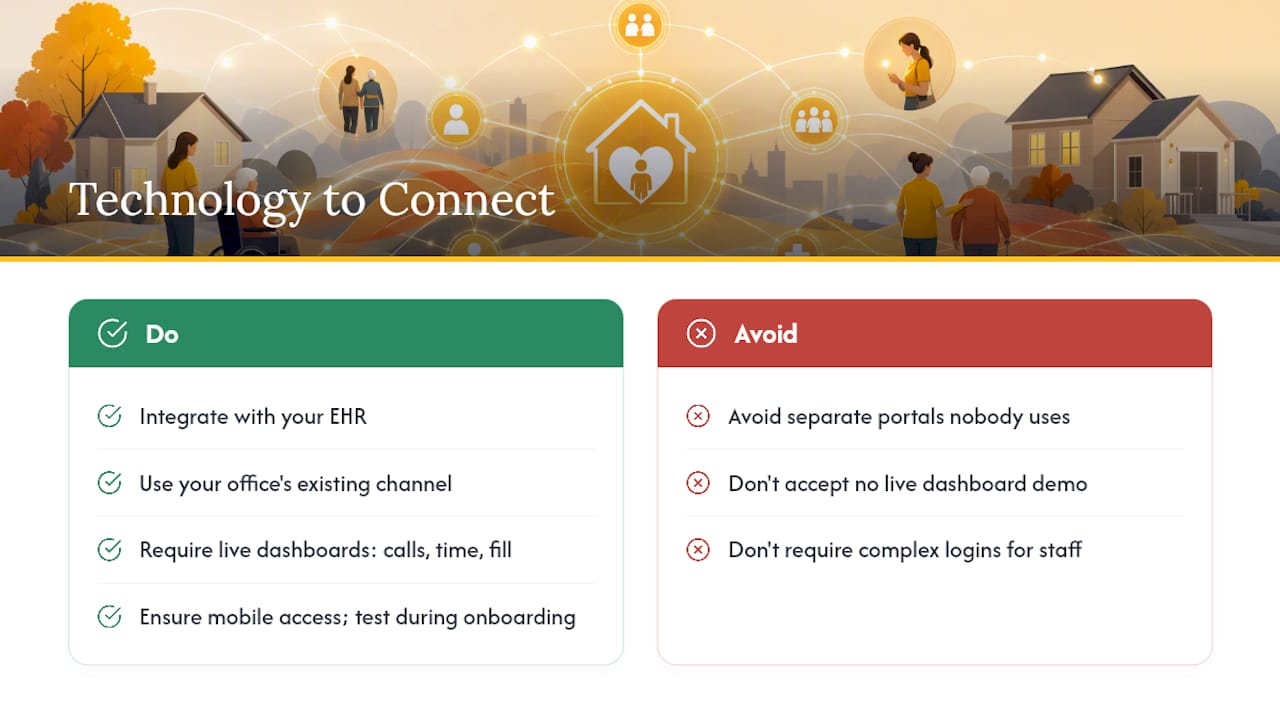
EHR integration gets most of the attention in vendor pitches, but it’s not the only system that matters. A holiday coverage partner also needs reliable communication tools, visibility dashboards, and mobile access that matches how your team actually works.
Communication should run through a channel your office staff already checks, not a separate portal nobody logs into. Whether that’s a shared messaging tool or a dedicated line for handoffs, the format matters less than the consistency.
Reporting dashboards give you visibility without requiring a phone call every morning. You want to see call volume, resolution time, and fill rates without asking someone to compile them manually. If a vendor can’t show you a live dashboard during the sales process, ask what you’d actually see on day one.
Mobile access matters for your on-call clinician, not just the vendor’s team. When an escalation happens at 2 AM, your nurse needs to see the same information the coverage team is looking at, on their phone, without a login struggle. Test this during onboarding, not after the first real emergency. Good scheduling infrastructure across your whole operation, not just the after-hours piece, tends to make every other integration easier.
How Should Your Staff Work With the Outsourced Coverage Team?
The biggest failure point in holiday coverage isn’t the vendor. It’s internal staff who don’t know the outsourced team exists, or don’t trust it enough to hand off real decisions.
Brief your daytime coordinators on exactly what the after-hours team can and can’t do before go-live. If your own staff still tries to field weekend calls out of habit, you’re paying for redundant coverage instead of relief.
Set a single source of truth for caregiver contact lists and backup rankings, and keep it current on both sides. A coverage team working from a stale list is the fastest way to turn a five-minute backfill into a two-hour scramble.
Establish a standing morning handoff review, five minutes, not a meeting, where your office staff reads the overnight report and flags anything that needs same-day follow-up. This is also where you catch small documentation gaps before they become audit problems. Treat the outsourced team as an extension of your operation, not a separate vendor you check in on occasionally, and the handoffs get smoother every week.
What Do Successful Holiday Coverage Rollouts Have in Common?
Agencies that get real value from outsourced holiday coverage tend to share a few habits, regardless of size or region.
They start with clean data. Before go-live, they pull real call logs and no-show history instead of guessing at volume, which lets the vendor build backup lists and escalation rules around actual patterns rather than assumptions.
They treat the first 30 days as a tuning period, not a verdict. Response times and fill rates typically improve week over week as the coverage team learns caregiver quirks and family preferences, so agencies that judge results after three days often walk away from a system that was about to work.
They also keep their own staff engaged in the transition rather than treating outsourcing as something that happens to them. Coordinators who understand why the after-hours line changed, and what it means for their own workload, adopt the new system faster and flag issues earlier.
The common thread across agencies that succeed: they measure before they switch, review often in the first month, and hold the vendor to the same documentation standard they’d hold an employee to.
Why This Matters More Than Most Owners Realize
Owners chronically underestimate how much of their own bandwidth goes to problems that never should have reached them. A caregiver call-off at 11 PM on a holiday weekend isn’t a crisis that needs the owner. It’s a staffing problem that needs a system with backups already in place. Every hour an owner spends fielding routine calls is an hour not spent on referrals, retention, or the parts of the business only they can run. The agencies that thrive aren’t the ones with the most heroic owners. They’re the ones who built redundancy before they needed it.
Get Holiday Coverage Running Without the Overtime Bill
The Command Center Pod staffs a team, not a single person, so your after-hours line never depends on one employee showing up on a holiday weekend. Every call gets documented, every no-show triggers a backup call within minutes, and your on-call nurse only hears about the emergencies that actually need a nurse. Pricing runs as a flat weekly rate covering defined hours, so you know the cost before the invoice arrives, not after a surprise overtime run.
Before you sign with anyone, including The BOSS System, request a sample SLA, a signed BAA, a realistic onboarding timeline, and references from other home care agencies. Start that conversation through the ON-CALL PROGRAM page and see what a real weekly rate looks like for your call volume.
Frequently Asked Questions
What does “holiday coverage” mean for a home care agency? It means outsourced staffing and on-call services that answer your phones and fill caregiver shifts 24/7, including nights, weekends, and major holidays, so your office isn’t running the phone line yourself.
How much does outsourced holiday coverage typically cost compared to hiring in-house? Trained coordination through a Pod model can run about 70% less than the all-in cost of a local hire, once payroll taxes, benefits, and admin overhead are counted.
How fast can an agency go live with holiday coverage? Most agencies get after-hours coverage live within one to two weeks, with shift-fill reliability typically stabilizing by the 30-day mark.
What’s the biggest red flag when evaluating a holiday coverage vendor? A provider that only takes messages without authority to act on your schedule, or one with no EHR integration and no visible audit logs.
Do these providers handle both routine coordination and clinical emergencies? Yes, but they should handle each differently: routine issues get resolved on protocol, while clinical events get escalated immediately to your on-call nurse.
Sources
Caregiver No-Shows: How to Reduce Call-Offs and Build Shift Reliability | GrowCare Team
Recommended


Comments