


Caregiver Recruiting in 2026: A Playbook That Actually Fills Shifts


Six levers move the needle on caregiver recruiting right now: speed-to-contact, local sourcing, pay transparency, predictable scheduling, structured onboarding, and next-day pay access. Agencies that run all six at once close the gap between “we posted the job” and “someone showed up for the shift.”
Here’s what to do this week:
Call every applicant within 24 hours — same-day is better. Speed beats almost every other variable.
Pull your service radius into the job post. Most people you hire will live nearby, so say so.
Put the pay range in the headline. Vague postings get skipped by people comparing five offers at once.
Promise a real schedule, not “flexible hours.” Unpredictability is a hidden reason caregivers quit.
Build a 30/60/90-day onboarding sequence with a named contact for week one.
Offer next-day or on-demand pay if you can swing it, even as a pilot.
Watch one number above all others: time-to-fill from application to accepted offer. Target under 10 days, and track whether new hires are still on shift at 90 days.
Key Takeaways
Caregiver recruiting succeeds when speed-to-contact, local sourcing, pay transparency, and structured onboarding operate together, not as isolated fixes.
Point | Details |
Speed decides hires | Interview within 96 hours; candidates apply to multiple agencies the same day. |
Local sourcing works | Most hires live within 20 miles, so geography should shape ad targeting. |
Pay transparency filters better | Listing wage ranges upfront reduces mismatched applications and speeds decisions. |
Onboarding prevents 90-day churn | Weekly check-ins and near-peer coaching cut early turnover by roughly 25 to 40%. |
Outsourcing closes coverage gaps | The BOSS System provides trained recruiters and 24/7 call coverage at about 70% less than an in-house hire. |
Table of Contents
Why Caregiver Recruiting Is Unusually Hard Right Now
Turnover is the root problem. One benchmarking report put caregiver turnover at a very high turnover rate in 2025, meaning the average agency effectively rehires three-quarters of its workforce every year. That’s not a hiring inconvenience. It’s a structural drain on margin, training time, and client trust.
Replacing one caregiver typically costs between $2,600 and $5,000 once you count job board fees, training hours, supervisor time, and the client visits that get missed or reassigned while the seat is empty.
Multiply that by a 75% turnover rate across a 40-person roster, and recruiting stops being an HR task. It becomes the biggest line item nobody budgeted for.
Turnover, in dollars: a 40-caregiver agency replacing 30 people a year at $3,500 average cost is looking at roughly $105,000 annually in pure replacement expense, before counting the revenue lost to unfilled shifts.
The supply side compounds the problem. Most people who end up hired live close to the agency, which means recruiting that ignores geography wastes money chasing candidates who will never accept the commute. And attrition often starts before day one, driven by scheduling that changes week to week, pay that arrives on a cadence caregivers can’t plan around, and Electronic Visit Verification (EVV) systems that feel punitive instead of routine. Fix the operational friction and you fix a chunk of the recruiting math before you ever post a job.
Where to Recruit Caregivers Now
Not all channels perform the same way, and treating them as interchangeable is how agencies burn budget chasing volume instead of fit. Rank them by what they’re actually good for.
Primary channels deserve the bulk of your effort:
Your own agency website and career page. Hires sourced here tend to stick around longer than hires from third-party boards, because they already chose you specifically rather than applying to five agencies at once.
Indeed. It’s the single most-used source for caregiver applications, appearing in the top two channels for 43.3% of agencies. Ignoring it means ignoring where the largest applicant pool already looks.
Local in-person events — job fairs, community college healthcare programs, senior centers. These convert well because most hired caregivers live near the agency’s service area of the agency’s service area. Proximity predicts acceptance more than almost any other factor.
Employee referrals. Current caregivers already know who’s reliable in their own network, and referred hires arrive with a built-in social contract to not embarrass the person who vouched for them.
Secondary channels fill gaps once the primary three are running:
Community organizations — churches, immigrant resource centers, vocational schools.
Social media, particularly Facebook groups built around local caregiving, nursing assistant certification, or career changes.
LinkedIn and ZipRecruiter, useful for recruiting coordinators, RN case managers, or agency leadership roles rather than direct-care staff.
Specialized care boards like Care.com, which work best for private-pay families but can supplement agency pipelines in tight labor markets.
Channel | Cost-per-hire | Time-to-fill | Candidate fit | Retention probability |
Agency website | Low | Moderate | High | High |
Indeed | Moderate | Fast | Mixed | Moderate |
Local events | Low to moderate | Slow to moderate | High | High |
Employee referrals | Low | Fast | High | High |
Facebook/Meta | Low | Moderate | Mixed | Moderate |
Moderate | Moderate | Mixed | Moderate |
Pro Tip: Run your career page through a basic local SEO check every quarter. Applicants who find you through search rather than a marketplace listing tend to be more deliberate about wanting your agency specifically, not just any caregiving job.
Operationalizing this mix means giving each channel a distinct message. Your website should sell culture and career growth. Indeed should sell pay and shift availability in the first line, because that’s what gets scanned. Local events need a one-page leave-behind with your phone number, starting pay, and a QR code to the application, because most attendees won’t apply on-site.
Job Posts and Ad Copy That Convert Caregivers
A caregiver scanning job boards on their phone gives your post about four seconds before deciding whether to tap it. Vague titles like “Caregiver Needed” lose to specific ones every time.
Here’s the checklist that separates job posts that convert from ones that get scrolled past:
Pay range in the first line, not buried in paragraph three.
Exact shift pattern — days, hours, weekend rotation — instead of “flexible.”
Travel radius or service area stated plainly, since most applicants are weighing commute distance first.
Benefits and perks, even modest ones like mileage reimbursement or referral bonuses.
A training or career path line, since more than half of applicants have no prior paid caregiving experience and need reassurance that inexperience isn’t disqualifying.
A one-step or two-step application process. Every added form field loses candidates.
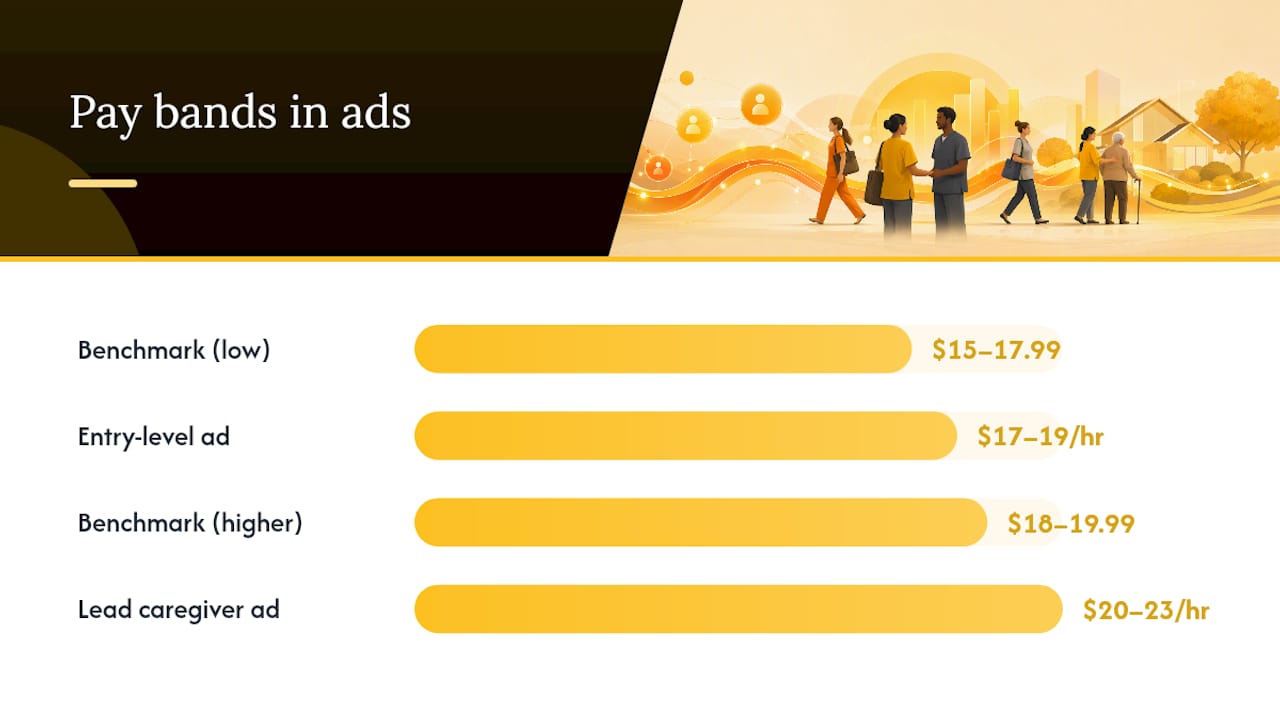
One benchmark found that moving a starting wage from the $15 to $17.99 range up to $18 to $19.99 an hour was associated with a 31-point drop in turnover. Pay transparency in the ad isn’t just about attracting applicants. It’s about attracting the ones who stay.
Template 1: Entry-level caregiver
“Caregiver, No Experience Required — $17 to $19/hr, Paid Training. Weekday and weekend shifts available within 15 miles of [City]. We train you on personal care, medication reminders, and safety protocols. Apply in under 3 minutes, we call back within 24 hours.”
Template 2: Experienced or lead caregiver
“Lead Caregiver, $20 to $23/hr — Set Schedule, Career Path to Care Coordinator. 3+ years of hands-on experience preferred. Mentor new hires, take on complex care plans, and grow into a supervisory role within 12 months. Full benefits, mileage reimbursement, and referral bonuses.”
Pro Tip: A/B test two versions of the same posting where the only difference is whether the pay range appears in the headline or three lines down. The version with pay up front usually gets more applications faster, and it filters out mismatched candidates before they waste your recruiter’s time.
Screening, Interviews, and Offers That Move Fast
Speed decides more hires than almost any other recruiting variable. Candidates apply to multiple agencies the same day, and more than 55% of eventual hires get interviewed within four days of applying. Wait a week, and you’re often competing against an offer someone already accepted.
Run background and eligibility checks in parallel with the interview stage rather than after it. Waiting for a clean background check before scheduling the first interview adds days you don’t have. Employers still need to follow wage and hour rules and nondiscrimination hiring standards throughout this process, regardless of how fast the timeline moves.
Scenario-based prompts reveal more than resume questions. Ask: “A client refuses to take their medication. What do you do in the next five minutes?” or “You’re running 20 minutes late to a shift. Walk me through what you do.” The answers surface judgment and communication habits that predict whether someone lasts 90 days.
Onboarding and Coaching That Cut Early Turnover
Most caregiver attrition happens in the first 90 days, which means onboarding is a retention tool, not paperwork. A structured onboarding sequence with weekly check-ins can cut 90-day turnover by roughly 25 to 40% compared to agencies that just hand someone a schedule and hope.
A workable 30/60/90 sequence looks like this:
Week 1: Buddy shift with an experienced caregiver, plus a check-in call from a named supervisor, not a generic office line.
Day 30: Skills checkpoint covering medication reminders, mobility assistance, and documentation habits.
Day 60: Career conversation. Where does this person want to be in a year? Lead caregiver, coordinator, something else?
Day 90: Formal retention check, including a direct ask about scheduling satisfaction and pay cadence.
Near-peer coaching, where a tenured caregiver mentors a new hire through their first real cases, shows up repeatedly in provider leadership interviews as one of the most effective early-attrition inoculators. It costs almost nothing beyond the mentor’s time and works because new hires get real answers from someone who’s lived the job, not a manual.
Retention drivers matter more than pay alone. Research applying expectancy theory to long-term care caregivers found that organizational commitment and intrinsic work motivation predict retention intention as strongly as extrinsic rewards. Translation: caregivers stay when the effort they put in visibly connects to outcomes they value, whether that’s client relationships, recognition, or a clear next step in their career.
Structured onboarding, quantified: agencies running weekly check-ins during the first 90 days see meaningfully lower early turnover than agencies with informal or no onboarding process.
Pro Tip: Assign every new hire a buddy caregiver for their first two weeks, and pay the buddy a small stipend for the extra time. It’s cheap insurance against the exact window where most people quit.
Scheduling stability, predictable pay cadence, and low-friction EVV check-ins round out the non-pay levers. A caregiver who can plan their week and trusts their paycheck timing is a caregiver who doesn’t spend their commute scrolling other job boards. For agencies looking to strengthen the caregiver-client match that keeps people engaged long-term, pairing recruitment with relationship-building practices tends to reinforce both retention and referrals at once.

Technology and Outsourcing Options for Recruiting Operations
Some of caregiver recruiting is a tooling problem. Some of it is a staffing problem that no tool fixes on its own.
On the tooling side, a lean stack usually includes:
A lightweight applicant tracking system (ATS) built for high-volume, hourly hiring, not one designed for corporate roles with six-week hiring cycles.
Texting or CRM tools that let recruiters follow up by text within minutes of an application, since phone tag kills speed-to-contact.
Scheduling software with EVV integration so shift changes don’t require three phone calls to sort out.
Next-day pay or on-demand pay partners, which increasingly show up as a retention lever as much as a recruiting one.
Tools solve the mechanics. They don’t solve what happens when a caregiver calls off at 2 a.m. and nobody’s awake to answer, or when your one recruiter goes on vacation and the pipeline goes quiet for a week. That’s where outsourcing recruiting operations, staffing coordination, or after-hours coverage to a dedicated team changes the math.
A single in-house hire is a single point of failure. When that person is out, sick, or simply overwhelmed, the whole pipeline stalls. A structured team with backup coverage doesn’t have that failure point.
Running a pilot is straightforward: pick one function, usually after-hours call coverage or initial candidate screening, and measure it against your current in-house cost and fill rate for 60 days. Track cost-per-hire, time-to-fill, and 90-day retention on the pilot cohort versus your historical baseline. If the outsourced pilot matches or beats those numbers at lower cost, scale it. Agencies exploring this route often start by handing off administrative and recruiting tasks to trained virtual assistants before expanding into full after-hours coverage.
Pro Tip: Don’t pilot everything at once. Isolate one function, run it for a full 60 days, and compare it against a clean baseline before deciding whether to expand.
The Recruiting Numbers Every Agency Should Track
Guessing whether recruiting is “working” is how agencies keep repeating the same expensive mistakes. Five numbers tell you the truth.
Metric | Formula | Realistic target |
Time-to-fill | Days from posting to accepted offer | Under 10 days |
Cost-per-hire | Total recruiting spend ÷ hires made | $2,600 to $5,000 per hire as a ceiling to beat |
90-day retention rate | Caregivers still employed at day 90 ÷ total hired | Above 70% |
Interview-to-offer ratio | Offers extended ÷ interviews conducted | 1 in 3 to 1 in 4 |
Offer-acceptance rate | Offers accepted ÷ offers extended | A majority |
Benchmarks shift by market. A rural agency competing with one other provider will see different numbers than an urban agency competing with a dozen. Track the trend line, not the absolute number.
Watch for early warning signs on your dashboard: a rising interview-to-offer ratio (meaning you’re interviewing too many people who don’t convert), a falling offer-acceptance rate (meaning your pay or scheduling isn’t competitive), or 90-day retention slipping below 60%, which usually points back to onboarding gaps rather than recruiting gaps.
A 30/60/90-Day Plan to Stabilize Hiring
Fixing caregiver recruiting isn’t a one-week sprint. It’s a sequence, and trying to do everything at once usually means doing nothing well.
Timeframe | Priorities |
Days 1 to 30 | Cut speed-to-contact to under 24 hours; audit and strengthen local sourcing channels; pilot next-day pay with a small cohort |
Days 31 to 60 | Launch structured 30/60/90 onboarding with weekly check-ins; pilot near-peer coaching with 2 to 3 mentor pairs; measure 30-day retention against baseline |
Days — to 90 | Scale the channel mix that performed best; formalize a caregiver-to-coordinator career path; evaluate results of any outsourcing pilot and decide whether to expand it |
The first 30 days are about removing friction, not adding programs. The next 30 build structure around the hires you already made. The final 30 are where you decide what to scale and what to cut, based on actual retention numbers rather than gut feel.
10 Quick Wins for Caregiver Hiring and Retention
Interview within 96 hours of application to beat competing offers.
Lead job ad headlines with pay and flexible scheduling, since that’s what gets scanned first.
Text applicants instead of calling first — response rates are faster.
Ask current caregivers for referrals every month, not just when you’re desperate.
Post on your own career page before third-party boards.
Offer a small signing bonus paid in two installments to reward 90-day survival.
Assign a buddy caregiver for every new hire’s first two weeks.
Give recruiters same-day authority to extend conditional offers.
Run background checks in parallel with interviews, not after them.
Review job ad performance monthly and kill underperforming channels fast.
Speed and local hiring cost the least and return the most. Coaching pilots and pay increases require real investment, but they pay for themselves in reduced replacement costs.
Legal Compliance and Regulations Specific to Caregiver Recruitment
Recruiting fast doesn’t mean recruiting loosely. Every job post, interview, and offer sits inside federal wage and hour law and anti-discrimination rules that apply regardless of how urgently you need to fill a shift.
The Fair Labor Standards Act (FLSA) governs minimum wage, overtime eligibility, and how home care workers are classified and paid. Misclassifying caregivers as independent contractors when they function as employees is one of the most common and costly mistakes agencies make, and it invites Department of Labor scrutiny that can outlast any hiring push.
Equal Employment Opportunity Commission (EEOC) guidance prohibits discrimination in hiring based on age, disability, national origin, and other protected categories. Job ads that inadvertently signal a preference (for instance, language implying only younger applicants “with energy” need apply) create legal exposure even when unintentional.
Background checks carry their own layer of compliance. Fair Credit Reporting Act (FCRA) requirements govern how you notify candidates before running a background check and how you handle adverse findings. State-level caregiver registries, home health aide certification requirements, and Medicaid provider screening rules add another layer that varies by state and by whether your agency bills Medicaid or Medicare.
None of this should slow down a well-run hiring process. Building compliance checkpoints into your existing screening workflow, rather than treating them as a separate late-stage hurdle, is what lets agencies move fast without cutting corners that come back as liability later.
Running Recruiting Through an Outsourced Pod: A Perspective
The biggest misconception agency owners have about recruiting is that it needs a person. It needs a system with backup, and that’s a different thing entirely. One recruiter, however good, gets sick, takes vacation, and eventually leaves. When that happens, the pipeline doesn’t slow down. It stops.
A pilot worth running: hand off screening and initial outreach to an outsourced team for 60 days, and compare cost-per-hire, time-to-fill, and 90-day retention against your historical numbers. Keep recruiting in-house if your volume is low and one dedicated person can genuinely stay ahead of it. Scale outsourcing when volume, after-hours demand, or turnover has outpaced what one person can sustainably cover.
Let The BOSS System Handle Recruiting While You Handle the Business
If you’ve read this far, you already know the six levers work, but running all of them consistently, every week, on top of intake calls, billing, and after-hours emergencies, is where most agency owners burn out. The BOSS System exists for exactly that gap: a trained recruiter and credentialing specialist who already knows home care workflows costs roughly 70% less than the same hire in-house, once you strip out payroll taxes, benefits, and equipment.
Beyond recruiting, the Command Center Pod covers your phones nights, weekends, and holidays, so a 2 a.m. call-off gets a shift backfilled and a documented resolution instead of a missed shift and an angry family. That’s the difference between recruiting that fills gaps reactively and a system that prevents them from becoming crises in the first place. Explore the Command Center Pod or start with a free trial to see how a dedicated recruiting specialist changes your fill rate within the first 60 days.
Frequently Asked Questions
What is the average time-to-fill for a caregiver position? Agencies running an efficient process should target under 10 days from application to accepted offer. Agencies without a structured screening workflow often take three to four weeks, losing candidates to faster competitors along the way.
How much does it cost to replace a caregiver? Replacement costs typically run $2,600 to $5,000 per caregiver once you factor in job posting fees, training hours, supervisor time, and missed client visits during the vacancy.
What’s the best channel for caregiver recruiting? Your own agency website tends to produce the most stable hires, while Indeed delivers the largest applicant volume. The strongest results come from running both together rather than relying on either alone.
Do caregivers need prior experience to be hired? Not necessarily. More than half of applicants in recent benchmarks report no paid caregiving experience, so agencies that build training-first hiring pipelines expand their candidate pool significantly.
When should an agency consider outsourcing recruiting? Outsourcing makes sense once call volume, after-hours demand, or turnover has outpaced what one in-house recruiter can sustainably manage. A 60-day pilot comparing cost-per-hire and 90-day retention against your current baseline is the clearest way to decide.
Sources
Recommended


Comments