


Launch After Hours Coverage Fast: Save 70% for Home Care Agencies

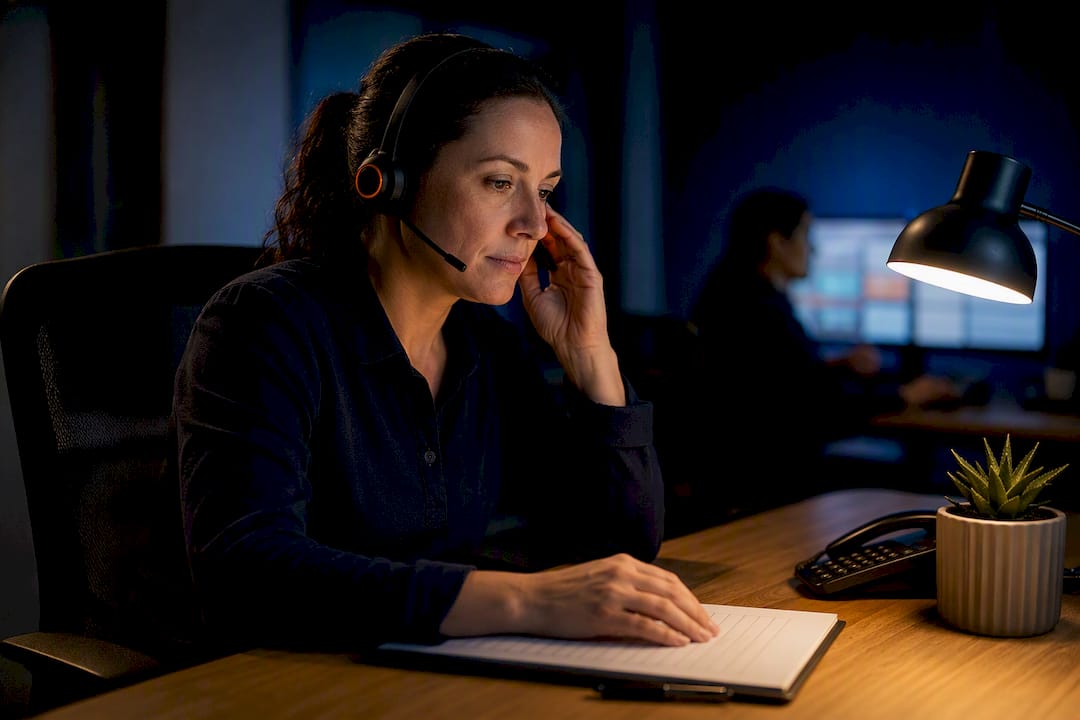
Outsourcing after hours coverage is usually the fastest way for a home care agency to get an owner’s nights back, stop losing referrals to voicemail, and cut total staffing cost. It means a trained outside team answers every night, weekend, and holiday call, triages caregiver call offs, backfills shifts, and documents everything for the morning. Providers like The BOSS System build entire teams around this single job, which tends to outperform the patchwork of rotating on-call staff most agencies default to.
TL;DR:
Outsourcing after hours coverage reduces costs by approximately 70 percent compared to in-house staffing, accounting for payroll, benefits, and equipment.
Reliable coverage requires a team structure, clear protocols, documented authority, and integration with existing scheduling or EHR systems.
Key performance metrics to verify include speed to answer, first-call resolution, escalation response time, and detailed morning reports with timestamps.
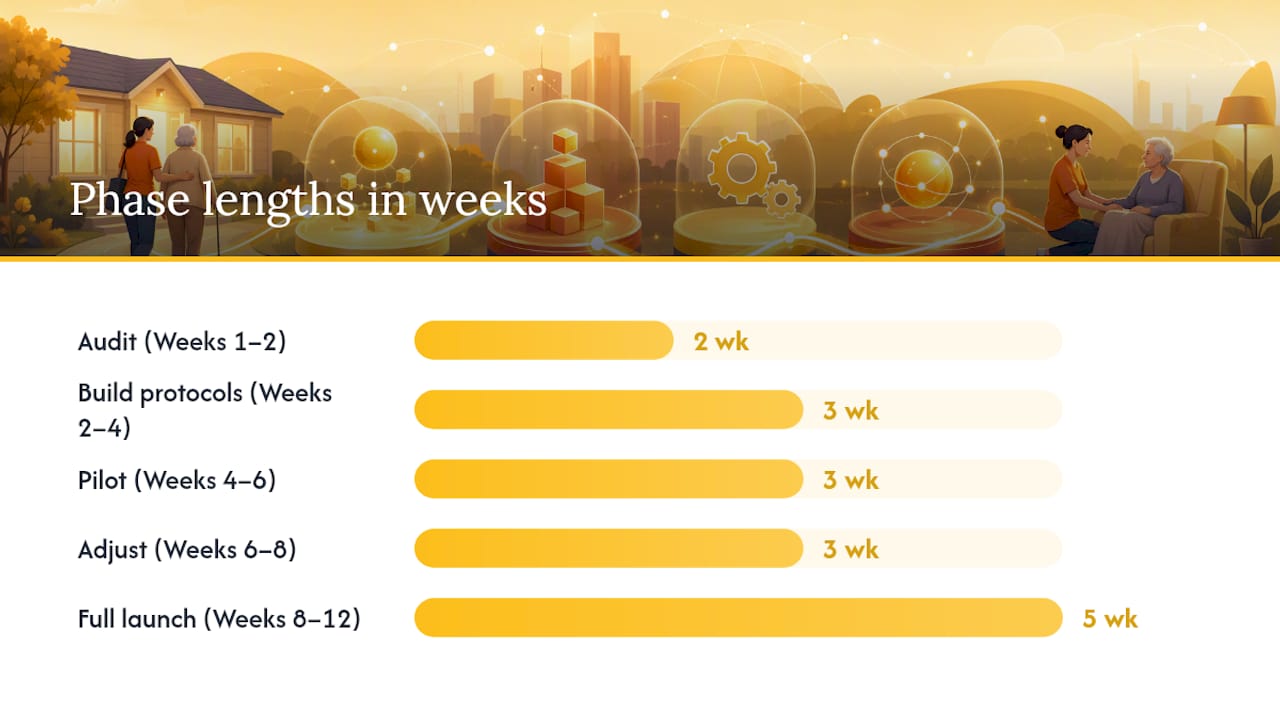
Effective setup involves a phased rollout over 8 to 12 weeks, starting with call pattern audits, protocol development, pilot testing, and full implementation.
Ongoing governance, such as periodic audits and training, is essential to maintain system integrity and avoid common mistakes like vague reports or unclear escalation thresholds.
Table of Contents
What Does After Hours Coverage Include for a Home Care Agency?
After hours coverage is not just a phone that rings into an answering service. Done right, it replaces an entire slice of your operational workload during the hours nobody wants to work.
Live answering: every call gets picked up by a real person, not a recording, at 2 AM as reliably as 2 PM.
Inquiry intake and qualification: a prospective client calling on a Saturday gets screened and scheduled for an assessment instead of hitting voicemail, which is exactly when most inquiries get lost.
Caregiver call-out handling: when a caregiver cancels a shift at midnight, the team starts working the replacement list immediately.
Clinician escalation: calls that involve a health change or safety concern route to whoever holds clinical authority, following rules you set in advance.
Shift backfill coordination: the team calls down your availability list, confirms coverage, and updates the schedule before your office opens.
Morning reports and documentation: every call, decision, and outcome shows up in a log waiting for you at 8 AM.
The integration points matter as much as the services themselves. Phone routing has to forward correctly after hours, the team needs visibility into your scheduling software or EHR, and any AI receptionist layer used for first contact should hand off to a human the moment a call gets complicated. Automation is good for capturing the call and logging basic intake. It is a poor substitute for judgment when a caregiver is in crisis or a client’s family is scared.
Why Do Agencies Outsource After Hours Instead of Staffing It In-House?
The sticker price of an internal on-call rotation looks deceptively small until you add up everything around it. Most agencies calculate the hourly rate for the on-call employee and stop there, missing the categories that actually drive the number up.
Overtime and shift-differential premiums for nights, weekends, and holidays
Payroll taxes and benefits load on top of base pay
On-call stipends paid whether or not the phone rings
Turnover and replacement costs when burned-out staff quit
Administrative overhead for scheduling the rotation itself
Technology, phone systems, and documentation tools maintained in-house
Beyond payroll, internal after-hours triage carries real compliance risk when documentation is inconsistent or escalation decisions aren’t recorded anywhere auditable.
The cost angle isn’t just about saving money. Outsourced models convert a fixed staffing cost into a variable one, and that same shift toward dedicated after-hours infrastructure tends to improve speed to answer and first call resolution while cutting scheduler burnout.
The operational upside compounds the financial one. Agencies that move after hours off their internal staff report fewer missed inquiries, faster shift fills, and daytime schedulers who show up rested instead of running on four hours of sleep from a midnight call-out.
How Does Outsourced After Hours Coverage Actually Work?
A real after-hours partner runs on a team, not a hero. Here’s the operational shape that separates a genuine coverage partner from a glorified answering service:
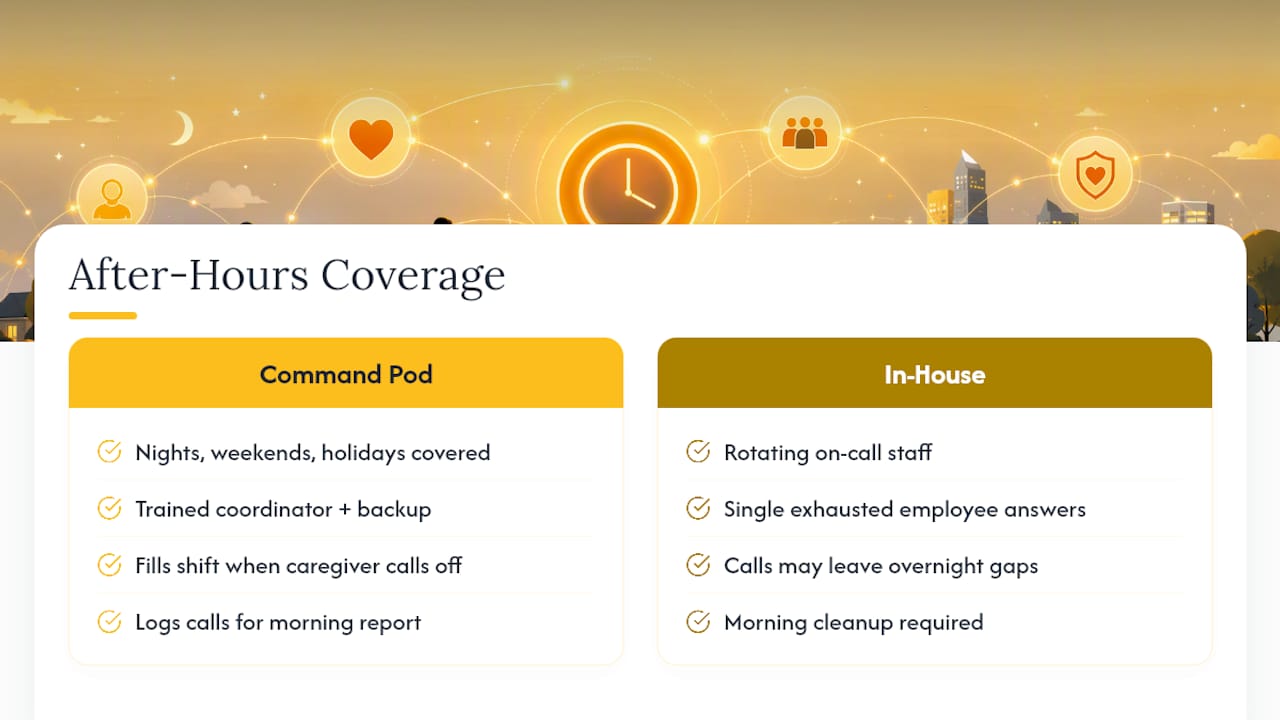
Pod structure over solo on-call. A trained coordinator handles the call, backed by a team lead and a documented backup, so coverage never depends on one person’s phone being charged. Removing that single point of failure is the difference between reliable coverage and a gamble.
Agency-specific protocols. Your triage categories, escalation thresholds, and approved stabilization steps get documented in advance, not improvised at 3 AM.
Documented activation authority. The team knows exactly who can approve what, and next-day verification confirms every call before it’s closed out.
AI as a front door, humans as the filter. Voice automation can capture basic intake fast, but a trained person verifies anything involving a health change, a safety issue, or an angry family member.
Pro Tip: Ask any prospective partner to show you a sample morning report before you sign anything. If it’s a vague summary instead of a call-by-call log with timestamps and outcomes, keep looking.
When you’re comparing options, request four numbers up front: speed to answer, first-call resolution rate, escalation response time, and what exactly lands in the morning report. Vague answers on any of these four are a signal to walk.
What Questions Should You Ask Before Hiring an After Hours Partner?
Vetting an after-hours partner takes more than a sales call and a handshake. Run through these three categories before you commit.
Operational questions:
What’s your staffing model? Team pod or single on-call person?
Who provides clinical oversight, and how are they trained in home care workflows specifically?
Who has documented authority to escalate, and what happens if that person is unreachable?
Performance questions:
What’s your average speed to answer, and can you show historical data?
Can I see a sample morning report before signing?
Do I get direct access to call logs, or only a summary?
Have you integrated with agencies using my scheduling or EHR system before?
Commercial questions:
What’s the pricing model, and are there onboarding or setup fees?
What’s the contract term, and what does the exit clause look like?
What’s your HIPAA compliance posture, and how is data secured?
A few red flags should end the conversation immediately: a service that only takes messages and forwards them to you, a single-person on-call arrangement with no documented backup, no auditable call logs, and no willingness to integrate with your existing software.
How Do You Roll Out After Hours Coverage in 30 to 90 Days?
A phased rollout beats flipping a switch overnight. Here’s a realistic sequence:
Weeks 1-2: audit your call patterns. Pull your actual after-hours call volume, note the peak windows, and categorize what kinds of calls come in.
Weeks 2-4: build protocols. Document escalation rules, triage categories, and who gets contacted for what, then hand this to your partner for training.
Weeks 4-6: pilot. Run a one to two week pilot covering a limited window (weekends only, for example) before going fully live.
Weeks 6-8: adjust. Review the pilot’s morning reports, tighten unclear protocols, and fix any integration gaps with your phone system or CRM.
Weeks 8-12: full launch. Expand to complete 24/7 coverage across nights, weekends, and holidays.
Watch dropped calls, answered inquiries, speed to answer, and how complete the morning reports are during the pilot. Ask your daytime scheduler directly whether their workload actually dropped. That answer tells you more than any dashboard.
On cost, The BOSS System has documented that a trained home care coordinator staffed virtually runs significantly less expensive than the same hire in-house, once you account for payroll taxes, benefits, and equipment.
What Agency Owners Learn After Moving After Hours Off Their Schedulers
Pulling on-call duty off daytime staff is the single change that improves retention fastest. Schedulers who aren’t dreading a midnight call-out show up sharper, and turnover on that role tends to drop.
The most common pilot mistake isn’t picking the wrong partner. It’s launching without clear escalation thresholds, which forces the partner to guess and either escalates too much or too little. The second mistake is accepting a thin morning report that hides exactly what happened overnight.
Governance doesn’t stop after launch. Periodic audits of call logs, refresher training when protocols change, and a next-day verification task on anything unusual keep the system honest months after the new-service excitement fades.
— Ian Dwight Abejo
The BOSS System’s Approach to After Hours Coverage
The Command Center Pod covers your phones every night, every weekend, and every holiday, with a trained coordinator and backup answering instead of one exhausted employee. When a caregiver calls off at 2 AM, the team fills the shift, calms the family, and logs the entire call for your morning report, waking you only for a true emergency.
That model runs on the same ON-CALL PROGRAM structure that trains coordinators specifically in home care workflows, not generic call-center scripts. On cost, a coordinator staffed through The BOSS System runs about 70% less than the equivalent in-house hire once payroll taxes, benefits, and equipment are factored in.¹ That’s not a rounding error. It’s the difference between coverage that drains your margin and coverage that protects it.
If your schedulers are burning out on rotating on-call shifts, or your morning routine starts with cleaning up overnight chaos, take a look at the BOSS Command Center and book a walkthrough of how the Pod handles a live night.
¹ Compared to average all-in cost of an in-house coordinator (salary, payroll taxes, benefits, admin costs). Sources: Indeed, IRS, Bureau of Labor Statistics.
Sources
FAQ
What Does “After Hours Coverage” Mean for a Home Care Agency?
It means an outside team answers calls, triages caregiver call-outs, backfills shifts, and documents everything during nights, weekends, and holidays, so your internal staff isn’t on call around the clock.
How Much Does Outsourced After Hours Coverage Cost Compared to Internal Staffing?
A trained coordinator staffed through a provider like The BOSS System runs about 70% less than the same hire in-house, once payroll taxes, benefits, and equipment costs are counted.
What’s the Difference Between an Answering Service and True After Hours Coverage?
An answering service takes messages and forwards them. True coverage triages the call, follows agency-specific escalation protocols, backfills shifts, and produces an auditable morning report.
How Fast Should an After Hours Partner Answer Calls?
Ask any prospective partner for their average speed-to-answer data before signing. Slow or vague answers on this metric are a warning sign about their staffing model.
Can AI Handle After Hours Calls for a Home Care Agency Alone?
AI tools can capture basic intake quickly, but calls involving a health change or safety concern need a trained human to verify and escalate them correctly.
Recommended


Comments