


Weekend Coverage for Home Care: What It Means and How to Set It Up


Weekend coverage means outsourced, team-based after-hours care coordination and call handling. It removes the on-call burden from your daytime staff by putting a trained desk on the phones from Friday evening through Monday morning, handling caregiver call-offs, family questions, and clinical escalations without waking an owner for routine issues.
The recommended approach is a team-based outsourced Command Center rather than a single on-call employee or a message-taking answering service. A team model means backup exists when one person is sick, and it means every call gets documented, not just remembered.
What this actually gets you:
Fewer missed calls from families and referral sources on Saturday afternoons
Fewer empty shifts because a real person is filling call-offs in real time
Lower admin cost than adding a coordinator to payroll
No single point of failure when the on-call person’s phone dies at 11 PM
TL;DR:
Outsourcing weekend coverage using a team-based command center reduces missed calls, improves shift-fill rates, and lowers overall costs compared to in-house staffing.
Implementing structured protocols and clear escalation paths ensures clinical issues are promptly directed to licensed clinicians and routine calls are efficiently resolved.
A pilot test of one or two weekends can validate the process, test escalation procedures, and refine morning reporting before full deployment.
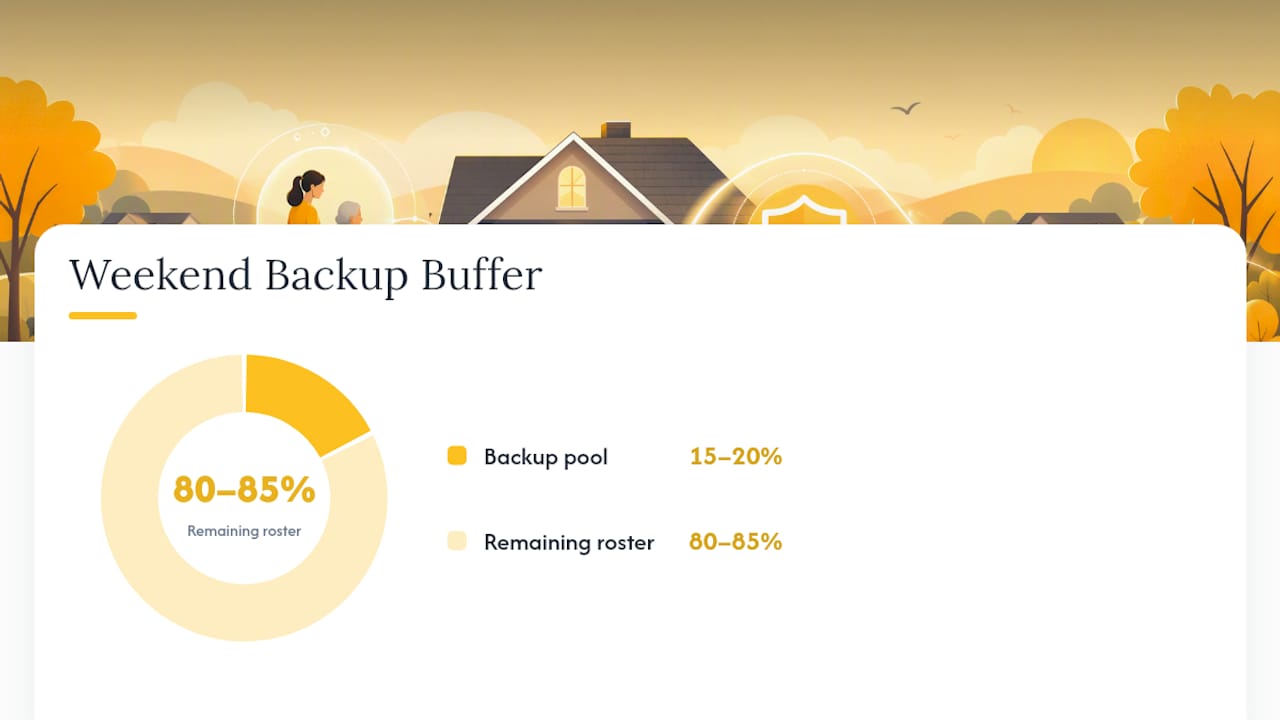
Planning for a caregiver backup pool of 15 to 20% of active staff helps manage capacity gaps and maintain reliable coverage during weekends.
The BOSS System offers rapid onboarding, HIPAA-compliant documentation, and 24/7 team coverage, typically going live within one to two weeks.
Table of Contents
Why Agencies Outsource Weekend Coverage
The math behind outsourcing weekend coverage usually comes down to burnout math before it comes down to dollar math. When one office manager carries the on-call phone every Friday through Sunday, turnover follows within a year. Taking that rotation off daytime staff and handing it to a dedicated desk is often the single biggest retention move an agency makes, because the person who used to dread Saturday now just works Saturday like any other day off.
Shift-fill rates improve for a specific reason: a dedicated team can start dialing backup caregivers the moment a call-off comes in, instead of waiting for a manager to check voicemail. Structured after-hours coordination reduces the scramble that turns a single callout into an unpaid shift and an angry family.

The gap agencies underestimate: every unfilled overnight or weekend shift risks a bad review, a lost client, or a state complaint, and the cost of that risk rarely shows up on a P&L until it becomes a pattern.
Track these numbers before and after the switch:
Missed-call rate on nights and weekends
Shift-fill rate within 60 minutes of a callout
Owner or manager hours reclaimed per week
Overtime hours tied to last-minute scrambling
How Does Outsourced Weekend Coverage Actually Work?
A dedicated after-hours desk answers using your agency’s own protocols, so callers hear your agency name, your scheduling rules, and your escalation triggers, not a generic script. That is the difference between a real coverage partner and a basic answering service, which only takes messages and still leaves your on-call person to sort out what mattered.
Here is the typical flow when the phone rings at 2 AM:
The desk answers on your protocol and identifies the call type: caregiver callout, family concern, or clinical issue.
Routine issues get resolved on the spot, using scripts you approved during setup.
AI-assisted triage flags the call type first, then a trained human verifies it before any action is taken.
Genuine clinical concerns, like a fall or a medication issue, escalate immediately to your on-call nurse.
If a caregiver calls off, the team starts working the backup list right away, confirming a replacement before the shift starts.
Everything gets logged, and your office receives a morning report showing what happened overnight.
That morning report is what preserves continuity. It feeds back into your scheduling and EHR systems so Monday’s team isn’t reconstructing Saturday night from memory.
Pro Tip: Ask any prospective provider to walk you through exactly what triggers a call to the on-call nurse versus a call that gets resolved on the desk. If they can’t give you a clear answer, that’s a sign their escalation rules aren’t actually documented.
What Does Weekend Coverage Cost Compared to an In-House Coordinator?
Providers price weekend coverage a few different ways: a flat weekly or subscription rate, a per-hour or per-shift rate, or a blended model that combines a base fee with overage charges for high call volume. Flat weekly pricing is the most common because it lets an agency budget predictably instead of guessing at hourly totals every month.
Here’s how the math tends to work out. One commonly cited example converts a flat weekly rate into an effective hourly figure: a $399 weekly rate works out to roughly $8.87 per hour once you divide the annualized cost across all weekend and after-hours coverage hours in a year. Compare that to what an in-house coordinator actually costs once you add payroll taxes, benefits, and equipment on top of salary.
What outsourcing typically avoids paying for:
Payroll taxes and workers’ compensation on a new hire
Health benefits and paid time off
Recruiting and background check costs
A phone system, laptop, and desk setup
Overtime when the single on-call person can’t take a night off
A trained coordinator through The BOSS System costs significantly less than the same role hired in-house, once you strip out payroll taxes, benefits, and equipment.[^1] Building a simple ROI model just means comparing your current all-in coordinator cost against a flat weekly rate multiplied by 52 weeks.
How to Roll Out Weekend Coverage in Two Weeks
Getting live coverage running is a short project, not a quarter-long initiative, if you sequence it correctly.
Before signing anything, document your existing after-hours protocols: who gets called for what, and at what threshold a clinical issue escalates.
Pick your integration points early, meaning phone routing, your EHR, and your scheduling software, so the vendor can connect on day one instead of week three.
Onboard the desk by mapping call scripts, granting system access, and signing a Business Associate Agreement to keep everything HIPAA-compliant.
Run a pilot for one or two weekends, simulating call-offs and family calls to see if morning reports actually reflect what happened.
Validate the escalation path by confirming a real clinical scenario reaches your on-call nurse within your target response window.
Scale to full coverage and set up a KPI dashboard, reviewing shift-fill rate and missed-call rate monthly against your service-level agreement.
Pro Tip: During your pilot weekend, have someone deliberately call in a scenario that should escalate to a nurse. If it doesn’t escalate correctly, you’ve found the gap before a real emergency does.
Plan your backup caregiver pool at roughly 15 to 20% of your active caregiver roster, since weekend capacity typically runs lower than weekday capacity and last-minute fills depend on that buffer existing.
What Should You Ask Before Choosing a Weekend Coverage Provider?
Not every after-hours vendor is built the same way, and the difference shows up the first time a real emergency happens.
Look for these capabilities before signing:
Team-based staffing with a documented leader and backup, not one person answering the phone
A written escalation path to a licensed clinician, not a vague “we’ll call someone”
Experience integrating with EHR and scheduling systems you already use
HIPAA compliance backed by a signed Business Associate Agreement
A track record of morning reporting that daytime staff can actually use
Your service-level agreement should spell out response time targets, a shift-fill rate benchmark, reporting cadence, and coverage hours including holidays.
Watch for these red flags: a service that only takes messages instead of resolving routine calls, a single point-of-contact model with no backup, no morning report, or a vendor unwilling to run a pilot with defined exit criteria. A provider confident in its process will offer a trial period with clear KPIs upfront, not push you straight to a long-term contract.
An Owner’s Take on Fixing Weekend Coverage
Most advice on this topic treats after-hours coverage like a phone-answering problem. It isn’t. It’s a staffing continuity problem wearing a phone system costume.
The conventional fix, hiring one dedicated on-call coordinator, just relocates the burnout instead of solving it. One person still can’t take a real weekend off, still gets sick, still eventually quits, and the agency is back to square one in twelve months. The single biggest thing owners get wrong is treating “who answers the phone” as the whole question, when the real question is “what happens when that person is unavailable.”
What I’d prioritize first isn’t the technology or the AI triage layer, useful as those are. It’s the backup structure. Before evaluating any vendor, ask what happens on the one weekend their primary person is out. If the answer is vague, everything else about their pitch is secondary.
Agencies that treat this as an operational partnership, with real protocols and morning reporting, adopt faster and keep the arrangement longer than agencies that view it as just outsourcing a chore.
— Ian Dwight Abejo
Get Your Nights and Weekends Back With The BOSS System
The BOSS System is the direct route to team-based weekend coverage without the twelve-month hiring slog or the burnout cycle of a single on-call employee. The Command Center runs 24/7 with a full team, AI-assisted first-pass triage backed by human verification, and HIPAA-compliant documentation on every call, and it can go live in one to two weeks.
The savings shows up directly in your margins, not in a slide deck.
If you’re ready to see what a live weekend actually looks like on the other side, start with the free virtual assistant trial or explore the full Command Center program to map out your onboarding timeline.
[^1]: Compared to average all-in cost of an in-house coordinator (salary, payroll taxes, benefits, admin costs). Sources: Indeed, IRS, Bureau of Labor Statistics.
Key Takeaways
Point | Details |
Team beats solo on-call | A backup-equipped team removes the single point of failure that sinks one-person coverage models. |
Escalation must be documented | Require a written path from routine call to licensed clinician before signing any contract. |
Pilot before you scale | Test call simulations and morning reports over one or two weekends before committing long-term. |
Backup pool sizing matters | Plan caregiver backup at roughly 15 to 20% of your active roster to cover weekend capacity gaps. |
The BOSS System delivers fast | Its Command Center combines 24/7 team coverage with HIPAA documentation and a 1 to 2 week go-live. |
Sources
Recommended


Comments