


Staffing Coordinator Training: What Every Agency Needs


A trained staffing coordinator must do four things without waking you up: staff open shifts, build a workable schedule, handle after-hours calls with a calm voice, and document every one of those actions in a way that survives an audit. That’s the whole job, stripped of jargon. The fastest way to get there is one of two paths: build a focused, four-part curriculum in-house, or pilot a trained coordinator through a Command Center Pod like The BOSS System and get 24/7 coverage on day one.
Either path works. Neither works halfway.
The training outcome: a coordinator who staffs, schedules, documents HIPAA-compliantly, and fills a 2 AM shift call-off without you finding out until morning.
The fastest route: run the curriculum below, or skip the ramp-up and pilot a Pod that already knows home care software workflows.
Statistic to know: outsourced coordinators through The BOSS System run about 70% less than the all-in cost of an in-house hire, once you count salary, payroll taxes, benefits, and equipment. That’s not a marketing number pulled from nowhere. It’s the difference between one full-time salary line and a fraction of it going straight back into your margin.
Key Takeaways
A trained staffing coordinator must staff shifts, build schedules, handle after-hours calls, and document HIPAA-compliantly, and agencies get there fastest by training against a structured curriculum or piloting an outsourced Pod.
Point | Details |
Train seven core modules | Cover policies, phone communication, documentation, scheduling, matching, escalation, and software from day one. |
Screen for judgment, not just charm | Use scheduling puzzles and mock calls to test how candidates think under pressure. |
Follow a 90-day onboarding arc | Move from shadowing to graded live calls to full independence with scored simulations at each stage. |
Track KPIs weekly | Watch fill rate, time-to-fill, owner-wakened incidents, and documentation completeness to catch gaps early. |
Consider a Pod pilot | The BOSS System offers trained coordinators and 24/7 Command Center coverage at about 70% less than an in-house hire. |
Table of Contents
What Does Staffing Coordinator Training Actually Cover?
Scheduling isn’t clerical work. Coordinators who understand plan-of-care basics catch problems a calendar app never will, and industry reporting on home health operations calls the scheduler role the hidden backbone of a well-run agency. Train for that, not for data entry.
Here’s the module list we’d put in front of any new coordinator, whether you’re training in-house or specifying requirements for an outsourced hire:
Policies and protocols. What the agency will and won’t do, escalation chains, and where the line sits between a coordinator’s call and an owner’s call.
Phone and family communication. Tone under pressure, what to say to a worried family member at 11 PM, and how to de-escalate without over-promising.
Intake and documentation. HIPAA basics, EVV and eMAR fundamentals, and what “documented” actually means when a state auditor asks.
Scheduling and route optimization. Reading a map like a dispatcher, not just a calendar. Geography-aware scheduling cuts drive time and burnout in ways a random fill never does.
Caregiver matching and credentialing basics. Matching skill sets and personalities to client needs, plus knowing which credentials expire when.
Crisis escalation and after-hours SOPs. What counts as a true emergency versus a solvable problem, and the exact steps for each.
Software workflows. Live two-way chat, drag-and-drop scheduling, and EVV systems. Coordinators who start on the software from day one ramp up faster than those who learn it as an afterthought.
Each module needs an observable skill attached to it, not a vague “understands X.” A coordinator finishing the phone module should be able to run a scripted call-off scenario and hit every required step: acknowledge, assess urgency, find a backfill, document, and follow up.
Pro Tip: Run every module as a short lesson followed immediately by a role-play. Coordinators who read a policy and then act it out within the same session retain it three times longer than those who read it and move on.
Delivery matters as much as content. Micro-learning sessions of 15 to 20 minutes beat all-day training marathons. Shadow shifts, where a trainee sits beside an experienced coordinator for real calls, build instinct faster than any manual. Simulation should happen weekly during the first month, then monthly after that.
Who Makes a Good Staffing Coordinator?
Not everyone with good phone manners can do this job. The best coordinators share a specific mix of traits, and screening for them upfront saves you months of retraining later.
A sense of urgency without panic. They treat a 2 AM call-off as a puzzle to solve, not a crisis to survive.
Geographic and logistical thinking. They can picture a map of caregivers and clients and see the gaps before they become no-shows.
Software comfort. Someone intimidated by a new system will slow down every shift they touch.
A clear, steady phone voice. Families remember how someone sounded far more than what was said.
Reliability under repetition. The job is the same crisis in different clothes, day after day. People who get bored fast don’t last.
Screen for these with scenario tests, not just interviews. Give a candidate a scheduling puzzle: three call-offs, two overlapping client windows, one caregiver over-time limit. Watch how they think out loud. Run a mock call where a “family member” is upset about a late caregiver. Job postings for this role consistently list scheduling, recruitment support, and after-hours responsiveness as baseline expectations, which tells you those are the exact things to test for, not assume.
You’ll also face a build-versus-buy tradeoff on the candidate side. Hiring someone with agency experience costs more but skips months of ramp-up. Training someone from scratch is cheaper up front but demands a real 90-day plan, which is exactly what comes next.
How Long Does It Take to Onboard a New Coordinator?
Ninety days, structured tightly, turns a green hire into someone you trust with the phone at midnight. Loosely structured, ninety days turns into six months of hand-holding.
Week 0-1: Orientation and shadowing. New coordinators sit beside an experienced one, observe every call type, and start learning the software without touching live calls.
Weeks 2-4: Graded live handling. They take real calls with a supervisor listening in, scored against a rubric after each one.
Month 2: Independent handling with audits. They run their own shift, but a supervisor reviews a sample of their documentation and calls each week.
Month 3: Full autonomy. Coaching shifts from daily correction to a weekly or biweekly cadence focused on refinement, not survival.
Four scenarios should get repeated practice throughout: a late-night caregiver call-off with no backup lined up, a short-notice new client needing same-week scheduling, a complex match between a difficult client and a limited caregiver pool, and a software outage forcing a manual fallback.
Pro Tip: Score simulations on a simple seven-point rubric: calm tone, correct escalation, documented shift-fill, timely documentation, correct software entry, client reassurance, and a follow-up plan. A coordinator hitting six of seven consistently by week four is ready for independent shifts.
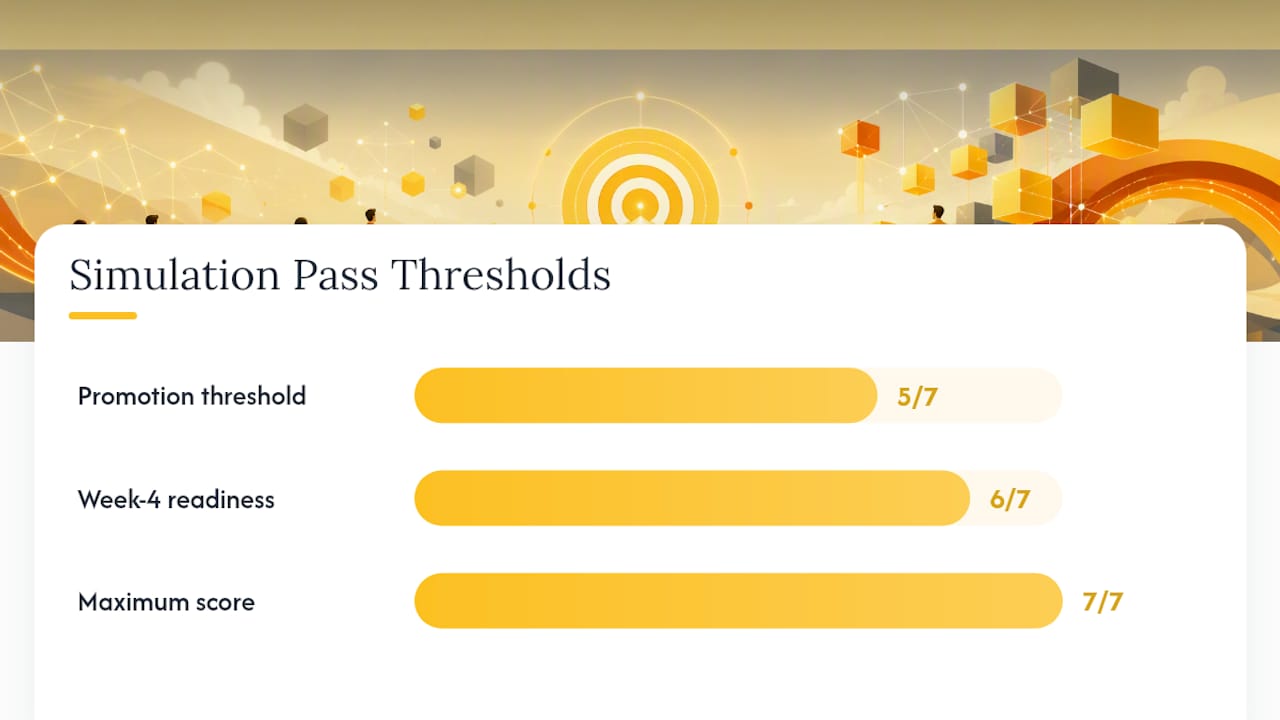
Set a real pass threshold before you start, not after someone fails. Five out of seven points on three consecutive simulations is a reasonable bar for moving from shadowing to live calls. Anything lower means more shadowing, not a promotion to solo duty.
Which Metrics Prove the Training Worked?
Training that doesn’t move the numbers wasn’t training, it was a meeting. Track these from week one:
Shift fill rate. The percentage of open shifts filled before they become a no-show.
Time-to-fill. How fast a call-off gets a replacement caregiver confirmed.
Owner-wakened incidents. How often you personally get pulled into something that should have stayed with the coordinator.
First-call resolution. Whether a family’s issue gets solved on the first call or bounces around.
Documentation completeness. Whether every call has a corresponding, audit-ready record.
Caregiver retention tied to scheduling quality. Coordinators who schedule thoughtfully, respecting drive time and preferences, directly affect how long caregivers stay.
Statistic to know: flexible staffing and clean digital onboarding are directly linked to lower caregiver turnover, which means your scheduling quality isn’t just an operations metric. It’s a retention lever.
Check fill rate daily. Sample QA calls weekly. Run a full coaching review monthly, and use what the numbers show to adjust the curriculum itself, not just the individual coordinator.
How Do You Launch Training or Pilot an Outsourced Coordinator?
Decide first whether you have the time and internal bandwidth to run a 90-day training program, or whether a pilot with an outsourced Pod gets you coverage faster.
Run the decision checklist. Weigh available training time, budget for a dedicated trainer, and how much day-to-day control you want to retain.
Set a pilot length. Thirty days for a quick gut check, 60 for a real performance read, 90 for a full evaluation against the KPIs above.
Lock down contract essentials before signing anything with an outsourced provider. Require a written SLA for 24/7 coverage, defined KPIs, HIPAA compliance language, a backup staffing guarantee so coverage never depends on one person, clear data access and software integration terms, and a straightforward termination and transition clause.
Plan the handoff. At the end of any pilot, you should walk away with documented SOPs, a knowledge transfer session, and a formal KPI sign-off, whether you keep the arrangement or bring it in-house.
What I’ve Learned Running an Agency Myself
The hardest lesson in home care isn’t finding good coordinators. It’s realizing that one person, no matter how good, is a single point of failure. Vacation, illness, a bad night’s sleep, and suddenly the phone rings with no one steady behind it.
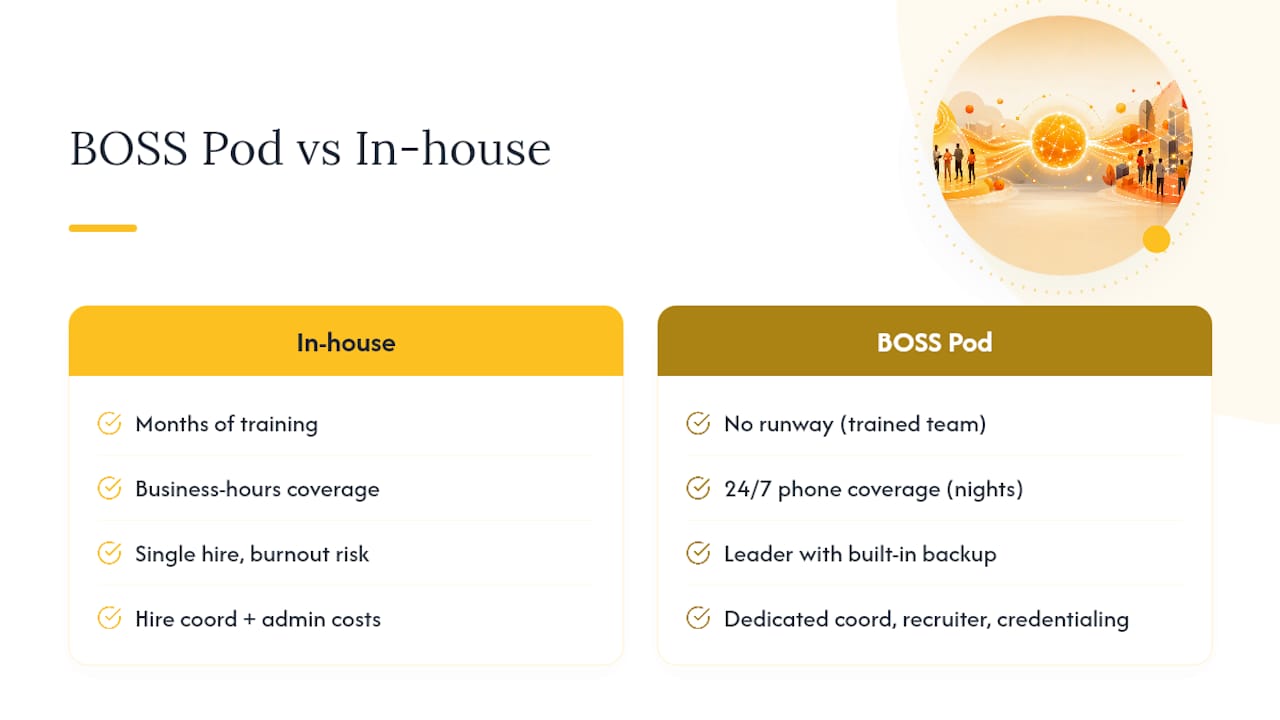
Training fixes skill gaps. It doesn’t fix a coverage gap caused by staffing one person to do a team’s job. If your coordinator burns out every quarter, more training isn’t the answer. A team with a leader and built-in backup is.
— Ian Dwight Abejo
Get Trained Coordinators Without the Six-Month Ramp-Up
You’ve just read what it takes to build a coordinator from scratch: months of curriculum, shadow shifts, scored simulations, and a coach watching every call. The BOSS System skips that runway entirely. Instead of training one person and hoping they don’t burn out, you get a Command Center Pod, a team with a leader and built-in backup, covering your phones 24/7 including nights, weekends, and holidays.
When a caregiver calls off at 2 AM, a trained team already knows your protocols: the shift gets filled, the family gets a calm voice, and every call gets documented the way an auditor expects. You’re only woken for a true emergency. Beyond after-hours coverage, BOSS staffs dedicated coordinators, recruiters, and credentialing specialists already fluent in home care software and compliance, at roughly 70% less than the all-in cost of hiring the same roles in-house.[^1]
Explore the on-call program details and ask about a 30 or 60-day pilot to see the coverage difference for yourself.
[^1]: Compared to average all-in cost of an in-house coordinator (salary, payroll taxes, benefits, admin costs). Sources: Indeed, IRS, Bureau of Labor Statistics.
Where to Go for More on Coordinator Training
Sources
Recommended


Comments