


Save 70% and Fill Shifts: Pod Based Phone Triage for Home Care

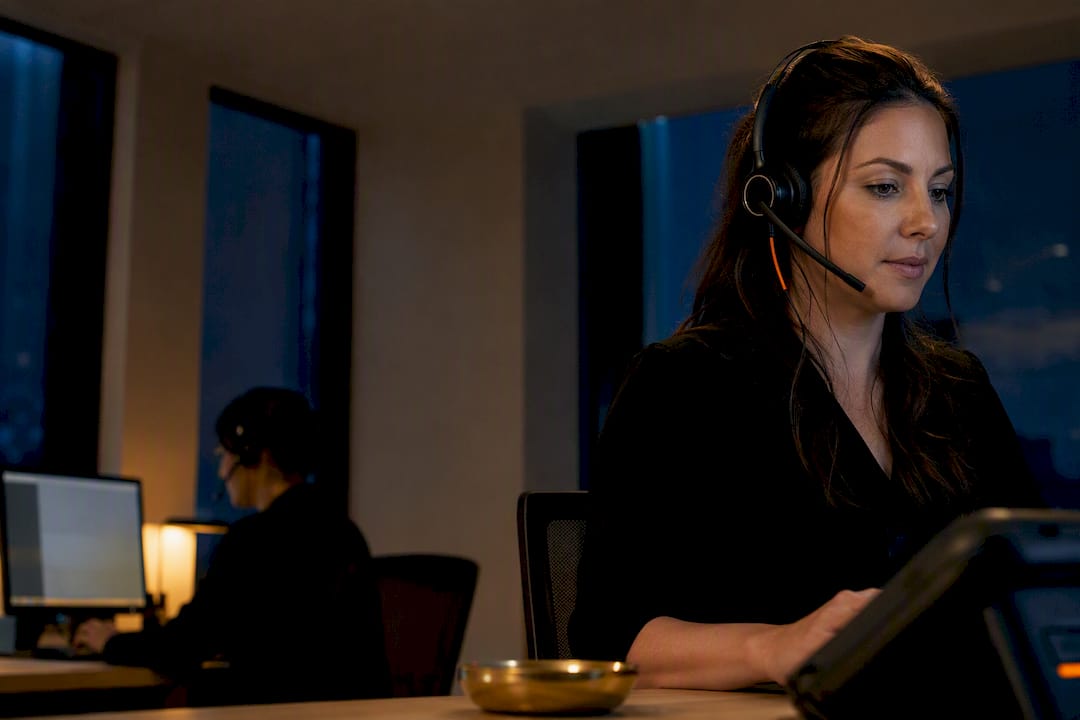
For home care agencies, phone triage means outsourcing non-clinical, after-hours call handling: capturing caregiver call-offs, backfilling shifts, answering family questions, and documenting everything for the morning office. It does not mean nurse-led clinical assessment. The right move is a protocol-driven operational pod, not a generic answering service or a burned-out rotating on-call schedule, because protocol-driven desks triage routine issues on the spot and escalate real clinical concerns to a nurse.
TL;DR:
Properly structured phone triage handles routine calls and shift backfilling, but escalates only urgent clinical concerns to licensed nurses.
Combining AI voice layers with trained pods improves call-answering rates, reduces missed calls, and lowers costs by up to 70% compared to in-house staff.
Successful vendor relationships rely on clear, agency-specific protocols, real-time data access, credential verification, and detailed morning reports.
Piloting a new triage vendor for 2 to 6 weeks allows agencies to measure call handling, shift fill times, and documentation accuracy before full deployment.
Using a team-based pod model ensures continuous night coverage, minimizes burnout, and enhances overall operational reliability.
Table of Contents
What Does Outsourced Phone Triage Actually Cover?
The scope is narrower than most owners assume, and that narrowness is the point. A properly built after-hours desk handles intake calls from prospective clients, caregiver call-outs, visit rescheduling, family questions about a shift, and the paperwork trail those calls generate. What it does not do is clinical assessment. Symptom evaluation, medication questions, and anything touching a patient’s condition belongs with a licensed on-call nurse, not a coordinator, and structured intake with chart context is what keeps that handoff clean instead of guesswork.
Here is the practical split agencies should build into their protocols:
Routine, handled directly: a caregiver calling off at 11 PM, a family asking when tomorrow’s aide arrives, a new referral calling after hours.
Clinical, escalated immediately: a fall, a medication reaction, a change in a patient’s condition, anything a caregiver flags as urgent.
Gray zone, documented and flagged: ambiguous symptom mentions that get logged and routed to the on-call nurse for a callback rather than guessed at over the phone.
Why Reliable After-Hours Coverage Pays for Itself
Missed calls after hours are not a minor inconvenience. They are lost referrals. When a prospective client calls at 9 PM and hits voicemail, a real share of those families call the next agency on their list instead of waiting. Pairing an AI voice layer with a trained intake team means every call gets answered live, routine inquiries get logged into the agency’s system immediately, and only complex situations get escalated to a human coordinator.
The same logic applies to shifts. A caregiver calling off at 2 AM is a crisis only if nobody’s watching the phone. A pod that can see the schedule in real time can start working the backfill the moment the call comes in, instead of waiting for a scheduler to wake up at 7 AM to a problem that has already cost the agency a visit.
Cost is the other half of the equation. Compared to the all-in cost of an in-house coordinator once you count salary, payroll taxes, benefits, and admin overhead, a trained coordinator through a pod model can run about 70% less, based on Indeed, IRS, and Bureau of Labor Statistics benchmarks for comparable in-house hires.
Fewer missed calls means more booked assessments.
Faster backfilling means fewer empty, unbilled shifts.
Shared on-call burden means less coordinator burnout and lower turnover.
What Should You Demand From an After-Hours Vendor?
A message-taking answering service and a real operational partner look similar on a sales call and behave nothing alike at 2 AM. Ask for these capabilities before you sign anything.
Agency-specific written protocols. Not a generic script. Your escalation rules, your on-call nurse contacts, your specific policies for call-offs and rescheduling, documented in writing and reviewed with your team.
A clear clinical escalation path. The vendor should be able to articulate, in one sentence, exactly what triggers an immediate call to your on-call nurse versus what gets handled and logged.
Scheduling and EHR context. The team answering your phones needs to see caregiver availability and client details in real time. Platforms with credential enforcement and real-time notifications make this possible without extra manual lookups.
Real-time, credential-aware backfilling. The vendor should check that a replacement caregiver is actually certified for the visit type before offering the shift, not just warm and available.
A pod structure, not a single point of failure. A team with a leader and a trained backup, so coverage never disappears because one person is sick or quit.
Automated documentation and a morning report. Every call logged, every action taken, delivered to the office before the day shift starts.
Pro Tip: Ask the vendor to show you an actual sample morning report from another client, not a mockup. If they can’t produce one, they probably aren’t generating one.
How Do You Evaluate and Pilot a Phone Triage Partner?
Vetting this correctly takes one sales call and one short pilot, not months of research. Ask direct questions and demand direct answers.
Questions worth asking on the first call:
What is your average time to answer, and what happens if that’s missed?
Walk me through exactly what triggers an escalation to my on-call nurse.
How fast does the morning report land in my inbox, and in what format?
Which scheduling or EHR systems have you integrated with before?
Push for a written service-level commitment on answer time and escalation speed. A vendor that won’t put response expectations in writing is telling you something.
The lowest-risk way to validate a vendor is a short parallel pilot, typically 2 to 6 weeks, running alongside your existing on-call process rather than replacing it outright.
Metric | What to track during the pilot |
Missed-call rate | Calls answered live vs. sent to voicemail |
Shift-fill speed | Time from call-off to confirmed replacement |
Owner wake-ups | Number of after-hours calls escalated to leadership |
Documentation accuracy | Morning reports matching what actually happened overnight |
How Do You Roll This Out Without Disrupting Operations?
Go-live works best as a staged process, not a flip of a switch.
Map every call type and write the escalation rules. Sit down with your current on-call staff and document what actually happens on a typical bad night, then formalize it.
Connect the integrations. Scheduling software, EHR access, any AI voice layer, and a secure channel for documentation all need to be live before the first real call.
Run a parallel period. Let the new pod shadow calls or handle a limited set of hours while your existing process stays as backup.
Expand to limited, then full, coverage. Move from a few overnight hours to full weekend and holiday coverage once escalation rules are tested against real scenarios.
Build a feedback loop. Weekly check-ins on the morning reports in the first month catch protocol gaps before they become client complaints.
Early ROI shows up fast, usually in fewer empty shifts and fewer 3 AM calls to the owner’s cell phone within the first two weeks.
Why Pod-Based Coverage Outperforms a Single On-Call Person
Treating after-hours coverage as an operational function, not a favor someone on staff does between shifts, is what separates agencies that scale from agencies that burn out their best coordinators. A single rotating on-call employee is a liability by design: one person, one phone, no backup, and eventually one very tired coordinator who starts missing details or quits.
A pod with a leader and a trained backup means coverage never depends on one person answering their phone at 2 AM. That structural redundancy is what a solo on-call rotation can never replicate.
Overnight coverage works best as a team function with documented protocols, not a single overworked employee holding the whole agency’s reputation in one phone.
Consistent coverage every night, weekend, and holiday, regardless of any one person’s schedule.
A trained team following your protocols instead of an ad hoc greeting.
Cost savings benchmarked against Indeed, IRS, and BLS figures for comparable in-house hires.
What Data Security Standards Matter Beyond HIPAA?
HIPAA compliance is the baseline, not the ceiling. Any vendor handling caregiver and client information after hours needs documented safeguards for how that data is stored, transmitted, and accessed, not just a verbal assurance that “we’re HIPAA compliant.”
Ask specifically about encryption in transit and at rest for call logs and documentation, access controls limiting who on the vendor’s team can view client records, and how long call data is retained before it’s purged or archived. A vendor should be able to name their documentation platform and explain, in plain terms, who can see what.
If your agency serves clients or has staff outside the United States, GDPR-style data protection rules can apply even to a domestic operation, depending on where the vendor’s systems and staff are located. That’s worth a direct question on the sales call rather than an assumption. Data breach notification timelines also matter: ask how fast the vendor commits to informing you if something goes wrong, not just whether something could.
The safest posture is to treat every after-hours vendor conversation, escalation, and morning report as protected health information, and to require the same documentation standard you’d expect from an in-house employee handling those same calls. A vendor unwilling to put security practices in writing is a vendor unwilling to be held accountable for a breach.
What Do Measurable Outcomes From Outsourced Coverage Look Like?
The clearest signal that outsourced phone triage is working shows up in three numbers agencies track before and after switching: missed-call rate, shift-fill speed, and how often the owner’s phone rings after midnight.
Agencies that move from a rotating in-house on-call model to a dedicated pod typically see the shift-fill window shrink because the team handling the call-off can see the schedule and start working the replacement immediately, instead of waiting for a scheduler to wake up. Referral capture improves for the same reason: a live voice answering at 9 PM converts more prospective clients than a voicemail box that gets checked at 8 AM the next morning.
The retention angle matters just as much, even though it’s less visible in a spreadsheet. Coordinators who aren’t fielding 2 AM calls every third night stay longer, and turnover in that role is expensive to replace given the institutional knowledge a good coordinator builds over time. Owners who stop personally absorbing overnight emergencies report getting real evenings back, not just marginally shorter workdays.
The pattern holds across agencies of different sizes: the benefit isn’t just fewer bad nights, it’s a measurable shift in how much administrative capacity gets freed up for growth work during the day.
What Goes Wrong When Agencies Implement This Poorly?
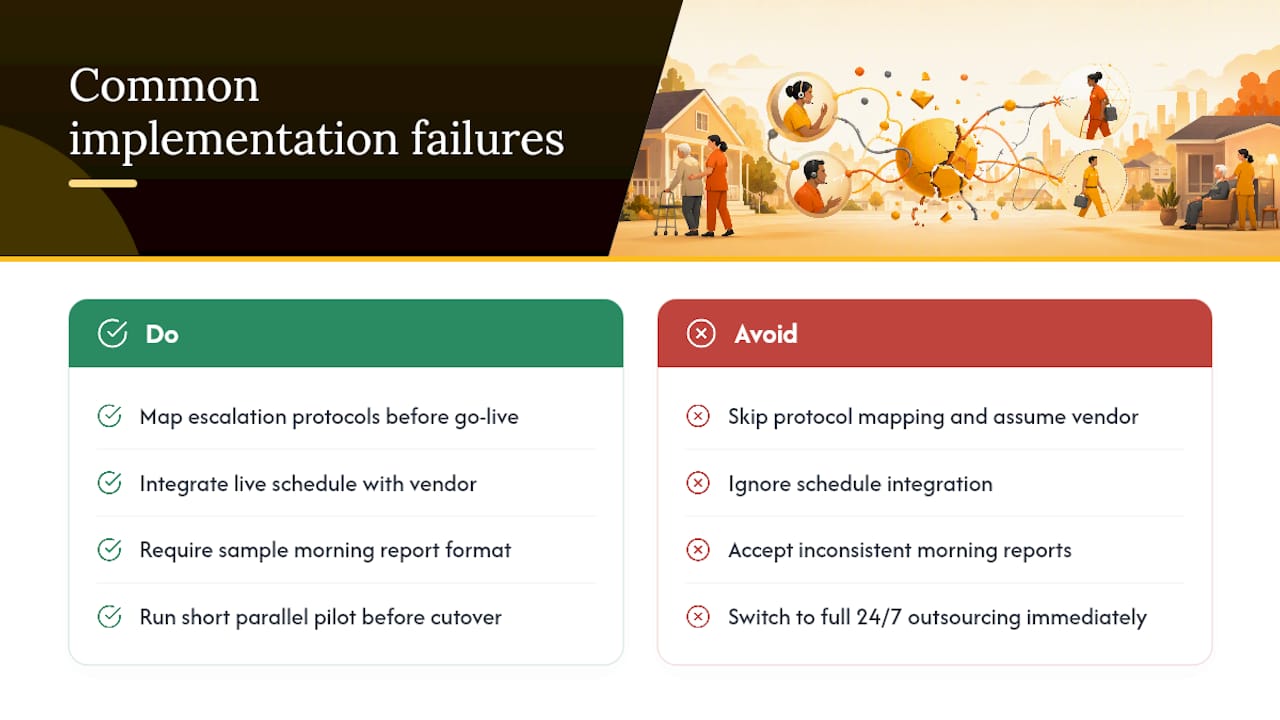
The most common failure is skipping the protocol-mapping step and expecting a vendor to “figure it out.” A vendor without your specific escalation rules will default to either over-escalating everything to your on-call nurse, which defeats the purpose, or under-escalating real clinical concerns, which is dangerous. Both failures trace back to the same root cause: nobody sat down and wrote the actual rules before go-live.
A second common pitfall is treating integration as optional. If the after-hours team can’t see your live schedule, they’re taking messages, not backfilling shifts. That’s the difference between a phone triage partner and a glorified voicemail box with a human voice.
Poor documentation habits during the pilot phase also sink otherwise good vendor relationships. If morning reports arrive inconsistently or without enough detail to act on, the office loses trust fast, even when the overnight handling itself was fine. Fix this by requiring a sample report format upfront and holding the vendor to it from day one.
Finally, agencies sometimes go from zero coverage straight to full 24/7 outsourcing overnight. A short parallel run, where the new pod operates alongside existing on-call staff before taking over completely, catches these problems while the stakes are still low.
In-House vs. Fully Outsourced vs. Hybrid: Which Model Fits?
In-house rotating on-call puts the burden on existing staff, usually a scheduler or nurse manager who takes the phone home on a rotating basis. It costs the least in direct dollars but the highest in burnout, turnover, and inconsistent coverage when that person is sick, on vacation, or simply exhausted after a bad month.
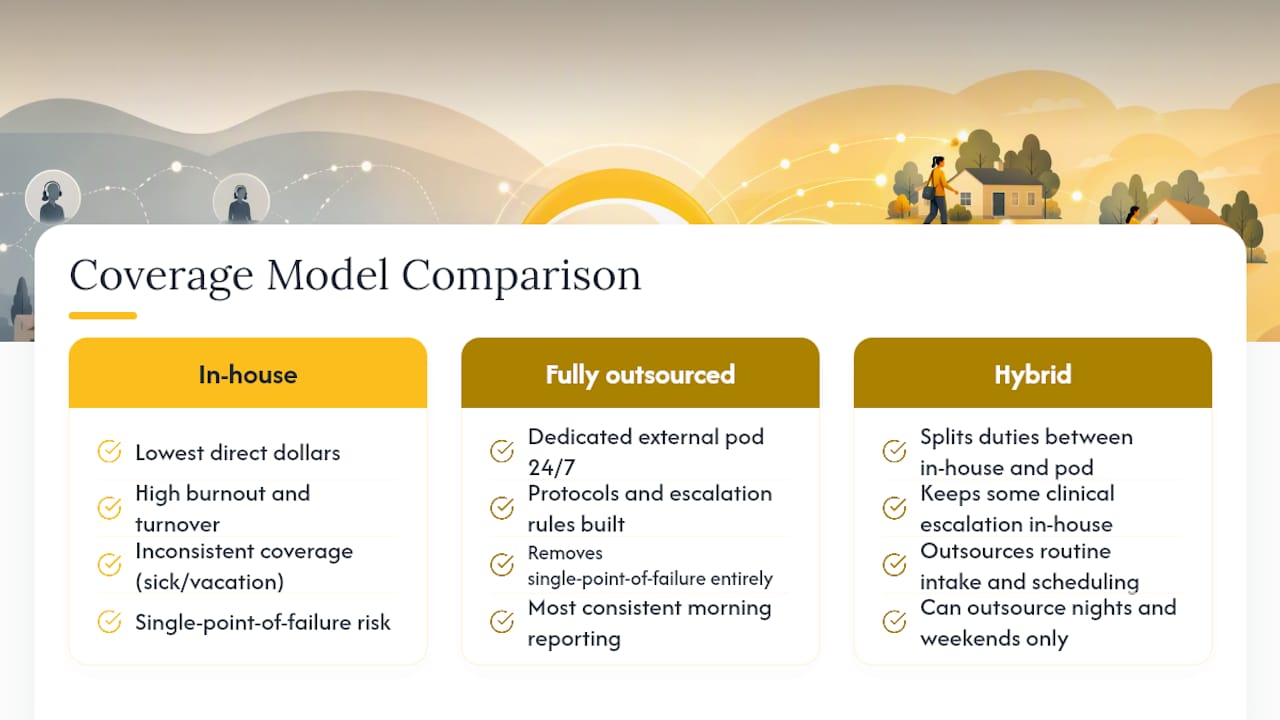
Fully outsourced coverage hands after-hours calls to a dedicated external pod around the clock, every night and weekend, with protocols and escalation rules built specifically for your agency. This model removes the single-point-of-failure risk entirely and tends to deliver the most consistent morning reporting.
Hybrid models split the difference. Some agencies keep clinical escalation in-house with their own on-call nurse while outsourcing the routine intake, scheduling, and call-off handling. Others outsource nights and weekends fully but keep daytime coverage internal. The right fit depends on how much your existing team can absorb without burning out, and how much clinical judgment you want kept entirely in-house versus routed through a documented handoff. For most growing agencies, a fully outsourced pod with a clean escalation path to an in-house or contracted on-call nurse offers the best balance of cost, reliability, and clinical safety.
A Founder’s View on Why Pods Beat Solo On-Call
I’ve watched agencies treat after-hours coverage as a burden to survive rather than infrastructure to build. That’s backward. The relief isn’t just fewer interruptions, it’s knowing a call-off at 2 AM gets a shift filled and a family a calm voice, while leadership only hears about it the next morning unless it’s truly urgent. That’s the whole point of a pod with a backup, not one exhausted person hoping their phone doesn’t ring.
— Ian Dwight Abejo
How The BOSS System Handles Your After-Hours Calls
A command center Pod can cover your phones every night, weekend, and holiday, backed by a team with a leader and built-in backup so coverage never depends on one person showing up. When combined with an escalation structure and live intake, every call, from a caregiver dropout to a new referral, can get handled, documented, and summarized before your morning coffee.
A trained coordinator through the Command Center Pod costs roughly 70% less than an equivalent in-house hire, once payroll taxes, benefits, and admin overhead are factored in. No new payroll line, no equipment, no single point of failure. If you’re ready to see what a night without your phone actually feels like, start a pilot with the On-Call Program and compare your missed-call rate before and after week one.
Sources
Recommended


Comments