


$299/Week Example: On Call Coverage Cost for US Home Care Owners


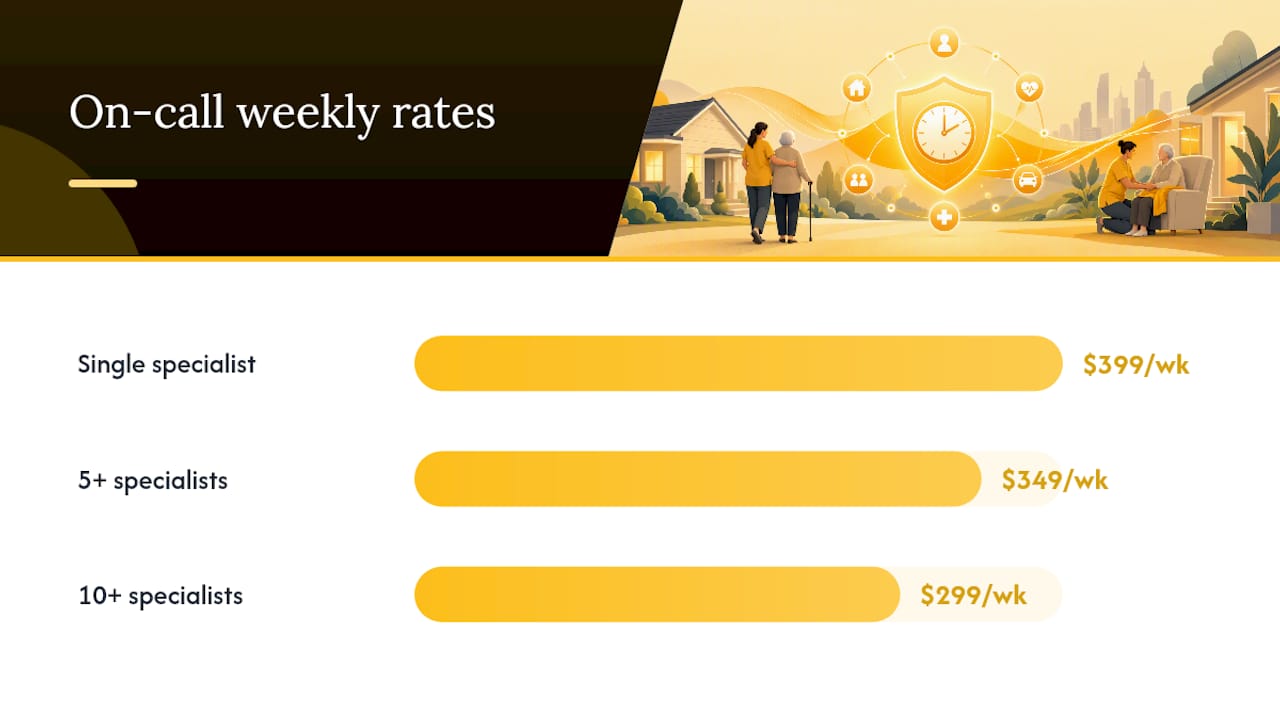
Most outsourced on-call coverage runs on flat weekly per-staff rates or per-Pod subscriptions, with vendor examples landing between roughly $8 and $20 per staffed hour depending on volume and scope. A common flat-rate example is $399 a week for one dedicated specialist, dropping toward $299 with 10 or more staff on contract. Compare that to an in-house coordinator’s all-in cost, and outsourced coverage often runs meaningfully lower once payroll taxes and benefits are factored in.
TL;DR:
Weekly outsourcing rates range from $299 to $399, translating to about $8.87 per hour based on 45 weekly hours, often lower than in-house costs.
Coverage scope and hours, such as basic intake versus full clinical escalation or 24/7 service, significantly impact vendor quotes and overall costs.
In-house coordinator costs, including salary, taxes, benefits, and overhead, typically exceed outsourced options by 70 percent or more.
Successful outsourcing requires clear understanding of backup policies, SLA performance metrics, and integration capabilities before signing a contract.
A trial period of 30 to 90 days helps measure actual call volume, answer rates, and cost savings before committing long-term.
Table of Contents
How Much Does On-Call Coverage Cost Per Week or Hour?
Vendors in this space bill two ways: a flat weekly rate per dedicated scheduler or intake specialist, or a subscription tied to a staffed “Pod” that bundles coverage, backup, and documentation into one recurring line item. Staffingly’s pricing page lists sample brackets that illustrate how volume affects rate:
$399 per week for a single dedicated specialist covering roughly 45 hours weekly
$349 per week when an agency staffs 5 or more specialists
$299 per week at 10 or more staff, the typical volume discount tier
That 45 hour weekly commitment matters for comparison shopping. Multiply it out and you get 2,340 hours a year, which is the basis vendors use to convert a flat weekly number into a per-hour figure.
On a $399 weekly rate spread across 2,340 annual hours, the effective cost works out to about $8.87 per hour — well under what most agencies pay a full-time virtual assistant or in-house scheduler once wages alone are considered.
Annualized, a $399/week contract lands around $20,748 a year before any volume discount. Drop to the 10+ staff bracket at $299/week and the annual number falls closer to $15,548 per specialist. Those figures typically include backup coverage and basic documentation, though AI voice or triage layers sometimes carry a separate line item depending on the vendor. Ask specifically what is bundled before comparing two quotes side by side.
What Drives Your On-Call Coverage Cost?
Coverage hours are the biggest lever. True 24/7/365 coverage requires enough staff rotation to cover nights, weekends, and holidays without gaps, and that rotation cost gets baked into whatever the vendor quotes you. A part-time evening-only window costs less than round-the-clock coverage, for obvious reasons.
Scope changes the number just as much as hours do. A vendor quoting for basic call intake charges differently than one handling intake plus shift-fill plus clinical escalation:
Intake only covers answering the phone, logging the call, and routing it
Intake plus shift-fill adds finding a replacement caregiver in real time
Clinical escalation layers in judgment calls about whether a situation needs a nurse or an owner woken up
Beyond hours and scope, expect quotes to shift based on language requirements (bilingual coverage often costs more), integration needs with your existing scheduling or EMR software, guaranteed answer-time SLAs, and whether holiday or peak-season coverage requires surge staffing. Agency size factors in too. Larger agencies typically unlock the volume discount brackets vendors advertise, while smaller agencies pay closer to standard rate.
Outsourced vs. In-House: How Do You Compare the Real Costs?
A fair comparison means pricing out every cost an in-house on-call coordinator actually carries, not just the base salary. That list includes:
Base salary for whoever staffs your after-hours line
Payroll taxes, which add a meaningful percentage on top of wages
Benefits like health insurance and paid time off
Recruiting and turnover costs every time that position needs refilling
Overtime, since true 24/7 coverage from one person is not legally or practically sustainable
Equipment and software access for phones, scheduling systems, and documentation tools
Run the math on a vendor quote of $399 a week: that converts to roughly $8.87 an hour and about $20,748 a year, per the earlier breakdown. Compare that to a single in-house coordinator’s fully loaded cost, and the gap widens fast once you add payroll tax, benefits, and the reality that one person cannot cover 24/7 alone without overtime or a second hire.
The BOSS System states that a trained coordinator placed through its Command Center Pod costs about 70% less than the equivalent in-house hire, based on comparing all-in costs (salary, payroll taxes, benefits, and admin overhead) against subscription pricing. That figure assumes you’re comparing a full-time equivalent hire against a Pod that includes built-in backup, not a single freelancer against a single employee.
The savings aren’t only financial. Outsourced care coordination reduces missed visits and administrative drag, which shows up as fewer missed referral calls and better referral conversion. Those wins rarely appear on an invoice, but they compound into real payback over a few months.
What Should You Ask an On-Call Vendor Before Signing?
Getting an accurate quote means asking the right questions up front rather than discovering gaps after your first invoice.
How many hours are actually included, and what happens during surge periods or holidays?
Is backup built into the team structure, or does coverage depend on one person showing up?
Can you see sample documentation and how HIPAA-compliant workflows are handled?
Does the platform integrate with your existing scheduling or EMR software?
What are the minimums, onboarding fees, and reporting cadence?
Are there SLA penalties if answer times or shift-fill rates slip?
Push for measurable performance metrics: average answer time, shift-fill rate, and reduction in missed calls compared to your baseline.
Pro Tip: Ask every vendor to define “backup coverage” in writing. A team with a lead and a documented escalation chain behaves very differently at 2 AM than a single contractor who might not pick up.
What Happens in Your First 30 to 90 Days?
Onboarding typically follows a predictable arc:
Weeks 1 to 2: Mapping your intake flow, escalation rules, and call routing so the outsourced team knows exactly when to call you versus handle it themselves
Weeks 3 to 6: Training on your specific documentation standards and a soft-launch period where the vendor shadows or co-handles calls
Weeks 6 to 12: Full handoff, with weekly reporting on answer rate, referral response time, and shift-fill success
A short trial period, often offered without a long-term commitment, lets you compare real evening and weekend call volume against what you were losing to voicemail before.
What I’ve Learned Watching Agencies Price This Wrong
The biggest mistake agencies make isn’t overpaying. It’s under-scoping the quote, then getting surprised when surge pricing or overtime kicks in during a holiday week nobody planned for. Ask vendors to walk through a worst-case week, not just a typical one.
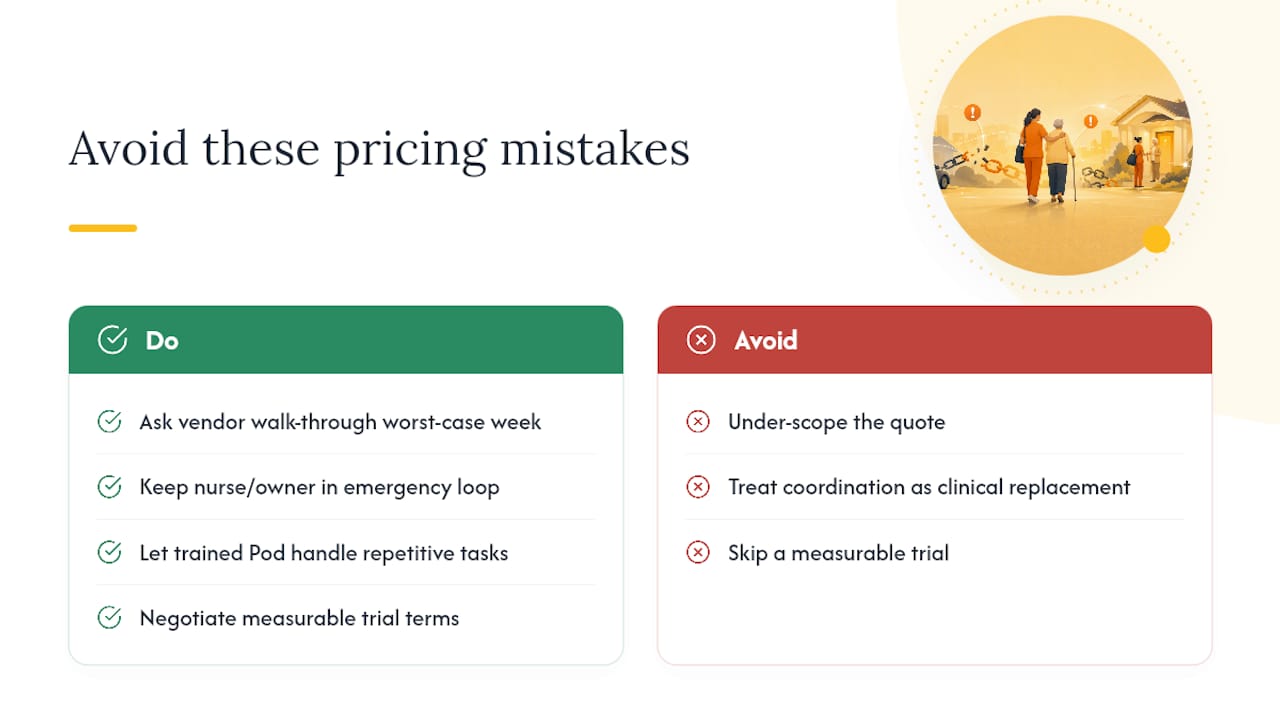
The second mistake is treating outsourced coordination as a replacement for clinical judgment rather than a filter for it. The strongest setups keep a nurse or owner in the loop for true emergencies while letting a trained Pod absorb the repetitive, time-consuming work: logging calls, filling shifts, chasing down documentation. That division of labor is what makes the 70% cost comparison hold up in practice, not just on paper.
Negotiate trial terms hard. A vendor confident in its numbers will let you measure real call volume before you commit to a year.
— Ian Dwight Abejo
How The BOSS System Prices On-Call Coverage
The BOSS System is the alternative to hiring and managing your own after-hours staff. Its Command Center covers phones 24/7 through a Pod, not a single employee, so coverage never depends on one person answering their phone at 3 AM.
Pricing runs on a subscription or per-Pod basis rather than an hourly bill you have to reconcile every month. A pilot typically starts with your agency’s existing call volume as the baseline, then tracks answer rate, shift-fill speed, and missed-call reduction over the first several weeks to show whether the math works for your specific agency.
If you’re ready to see what a Pod would cost for your call volume, the ON-CALL PROGRAM overview walks through how the subscription is structured and what a pilot looks like from week one.
Sources
Recommended


Comments