


How Multi State US Providers Stop 5 Medicaid Waiver Billing Denials


Bill only with a valid, matching prior authorization submitted to the correct payer, whether that’s a state Medicaid Management Information System or a managed care organization, using the codes and modifiers your state manual requires. Three actions protect revenue: verify code, modifier, and unit definitions in the state provider manual before filing; submit electronically through the required 837P format with Electronic Visit Verification attached and the correct provider ID; and reconcile every remittance advice promptly, sorting denials by reason code so fixable errors don’t pile up.
TL;DR:
Verification of active prior authorization, correct payer, and EVV data before billing significantly reduces denial risks and improves claim accuracy.
Mismatched codes, modifier mismatches, and incorrect unit counts are the most common preventable causes of waiver billing denials.
Regularly reviewing authorization details and involving the correct escalation channels can resolve most mismatches quickly, avoiding delays.
Using a flexible, multi-state billing platform that updates in real-time and integrates with EVV is critical for managing managed care and fee-for-service claims efficiently.
Operational support, including after-hours coordination and credentialing management, plays a vital role in preventing billing failures before they reach the claims stage.
Table of Contents
Common Billing Mistakes That Trigger Medicaid Waiver Billing Denials
Most waiver claim denials trace back to the same five failures, and they’re preventable with basic process discipline. A missing or expired prior authorization tops the list, followed by billing the wrong payer entirely (state fee-for-service instead of a managed care organization, or vice versa). Wrong code or modifier combinations, unit counts that don’t match the authorized service plan, and missing EVV data round out the pattern.
No active prior authorization on file for the date of service
Claim sent to the state MMIS when the client is actually enrolled with an MCO
Code or modifier mismatch against state-specific fee schedule requirements
Billed units exceeding or falling short of the authorized amount
Missing or unmatched EVV visit record
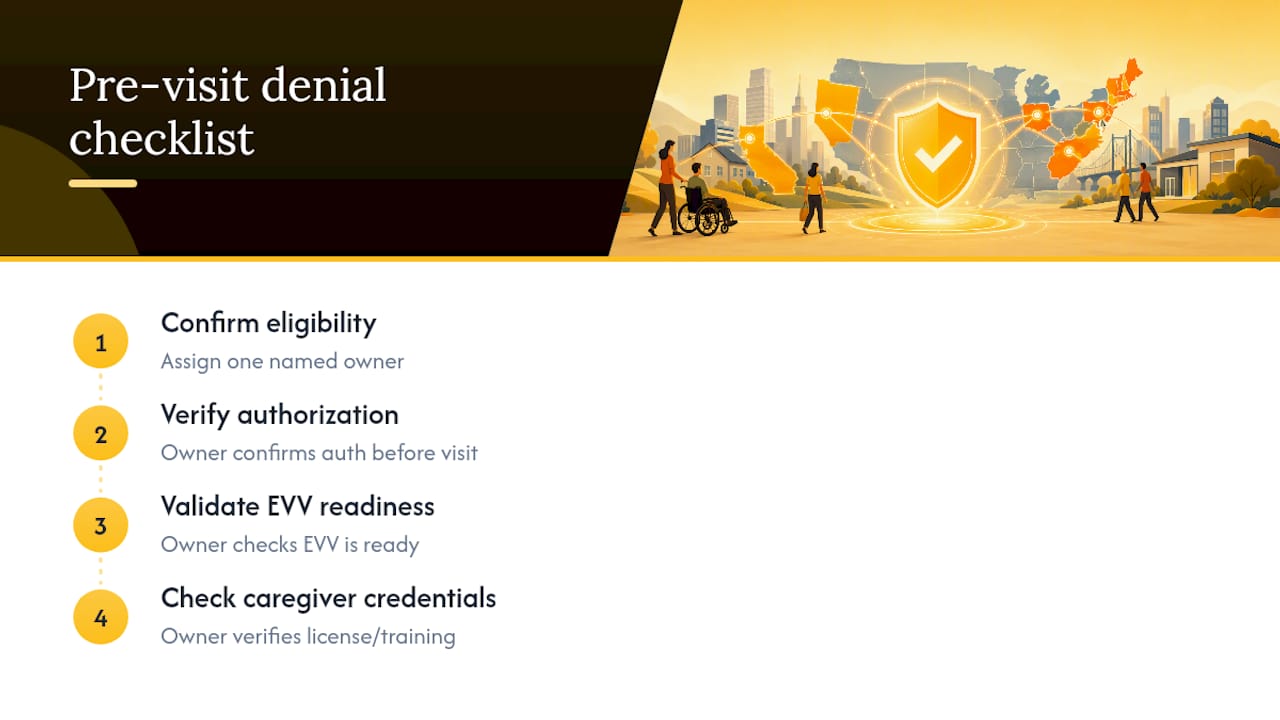
Build a pre-visit checklist that confirms eligibility, authorization status, provider ID validity, taxonomy code accuracy, and EVV clock-in readiness before a caregiver ever walks in the door. Weekly QA should spot-check a sample of claims against these five points; monthly audits should trend denial reasons by payer and by caregiver to catch systemic gaps.
Pro Tip: Assign one person to own the pre-visit checklist as a daily task, not a “when we get to it” habit. Denial prevention dies the moment it becomes optional.
Who Issues Prior Authorization and How Do You Fix a Mismatch?
Fee-for-service waiver authorizations typically come from a state agency or a delegated assessor tied to the person’s approved service plan. Managed care authorizations come from the MCO itself, following its own utilization review process. Prior authorization gates payment regardless of whether care was actually delivered, so a claim with the wrong or expired auth number gets denied even for a legitimate visit.
Before filing, check four things on every authorization:
Service code match — does the authorized code align with what you’re billing?
Unit count — does the authorized quantity cover the billed units for the date range?
Provider match — is your agency listed as the authorized provider, not a different entity?
Modifier requirements — does the auth specify a modifier your claim is missing?
When something doesn’t match, escalate fast. Start with the case or care manager who controls the service plan, since only they can edit it. If that stalls, move to MCO provider relations or, for fee-for-service claims, the state fiscal agent. Bring the client ID, service dates, current authorization number, and a copy of the visit documentation to every escalation call. Waiting on an automated system to self-correct wastes billable days you won’t get back.
Claim Submission: 837P, Portals, EVV, and Reconciliation
Most waiver claims move through the 837P electronic format, the standard for professional and home care services, though some legacy state systems still route paper CMS-1500 forms through Direct Data Entry portals inside the state’s MMIS. Virginia’s Department of Medical Assistance Services, for example, requires DDE submission with the service authorization number embedded in the claim.
EVV data has to be attached or cross-referenced depending on your state’s aggregator model. Federal law under the 21st Century Cures Act mandates EVV for personal care and home health services, and a mismatched clock-in/clock-out record is one of the fastest ways to get an otherwise clean claim kicked back.
Waiver providers sometimes bill with a state-issued provider ID instead of an NPI. Check your state’s atypical provider rules before enrollment.
Taxonomy codes must match your service type exactly, or the claim clears submission but denies on adjudication.
Read the 277CA acknowledgment first. It tells you whether the claim even reached the payer’s system.
Import 835 remittance files and group denials by CARC/RARC code so your team fixes the highest-dollar problems first.
Where to Verify State Rules, Rates, and Filing Deadlines
Every state Medicaid provider manual has a billing chapter and, separately, a waiver-specific chapter. The waiver chapter is where you’ll find the real answers: which modifiers apply to which service, how units are defined, and what documentation the state expects attached to a claim. Don’t rely on the general billing chapter alone.
Read the waiver chapter for your specific program, not just the general provider manual
Cross-check the state’s fee schedule file for current rates and unit definitions
Confirm timely-filing windows; the federal baseline is 12 months from the date of service, but states can set internal deadlines that may be shorter than the federal baseline
Ask about a timely-filing waiver process if a documented authorization delay caused the miss
Rates vary sharply by state and program. Hourly HCBS personal-care rates vary depending on the state, and the code you use, T1019 in one state, S5125 in another, directly affects what you get paid. Confirm your fee schedule before you negotiate anything with a managed care partner.
Denials, Adjustments, and Appeals: A Daily Triage Plan
Every ERA that lands on your desk needs a fast decision: accept it, resubmit with a correction, or appeal. Treat this as a same-day task, not a weekly batch job, because timely-filing clocks don’t pause for your backlog.
Sort by CARC/RARC code the moment the 835 imports, separating simple data errors from substantive payer disputes.
Fix and resubmit anything caused by a wrong modifier, unit count, or provider ID. These are usually same-day corrections.
File a formal appeal only when the denial reflects a payer’s clinical or authorization decision you can document as incorrect.
Void and rebill claims with fundamental errors rather than layering a correction on top of a bad submission.
Appeals carry state-specific deadlines and require the right supporting evidence attached the first time, so build a template packet in advance instead of assembling one under deadline pressure.
Pro Tip: Track appeals in a separate log from routine resubmissions. Mixing the two makes it impossible to see which MCOs are slow-paying versus which are legitimately disputing care.
What Should You Ask a Multi-State Billing Vendor?
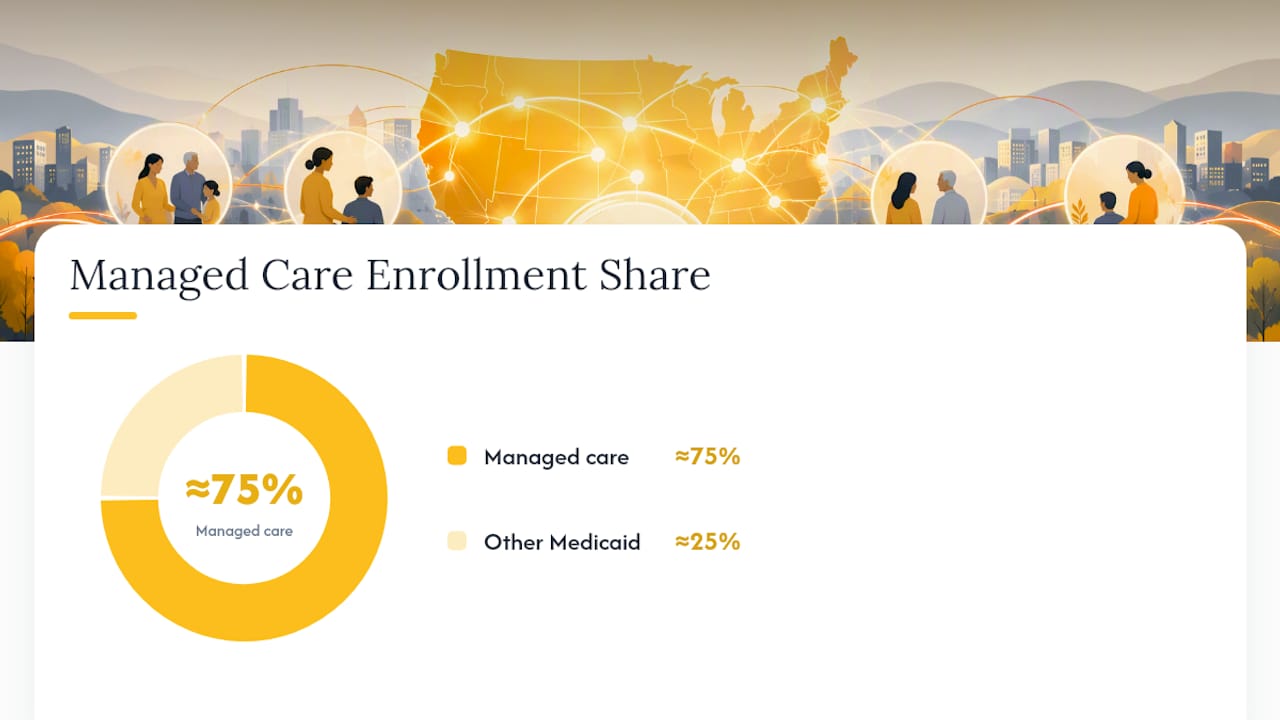
Nearly three-quarters of Medicaid beneficiaries are enrolled in managed care, which means most waiver providers now juggle state MMIS rules alongside several MCO contracts, each with its own routing and authorization logic. A billing platform that can’t flex for both isn’t built for this work.
Ask any vendor these questions before signing:
Who configures new-state fee schedules and modifier logic when your agency expands, us or you?
How fast are rule updates applied when a state changes its billing chapter?
Does the platform integrate directly with state-approved EVV aggregators?
Can it route claims correctly between fee-for-service and multiple MCO contracts without manual rerouting?
A staff-configurable rules engine is the deciding factor for platforms that genuinely support multi-state waiver billing, because state policy changes faster than most software release cycles. An operational partner that handles credentialing, after-hours intake, and visit documentation capture reduces how much of this falls on your billing team in the first place.
Pro Tip: If a vendor can’t tell you who updates state rules and how fast, assume you’ll be the one doing it manually within six months.
What Running a Home Care Agency Taught Us About Waiver Billing
Running a home care agency day to day teaches you fast that billing failures almost never start in the billing department. They start hours or days earlier, when nobody confirmed an authorization before a caregiver clocked in. A short pre-visit checklist, with one named owner for eligibility, one for authorization status, one for EVV, and one for caregiver credentials, closes most of that gap before it becomes a denial.
After-hours call coverage matters more to billing than most owners expect. A caregiver call-off at midnight that gets handled by a trained coordination team, rather than missed entirely, means the replacement visit still has a valid authorization and a documented record. A dedicated pod catching that call is often the difference between a clean claim and a scramble three weeks later.
A simple weekly routine works: reconcile every ERA received that week, group denials by reason code, and ask whether the same code appeared last week. If it did, the fix belongs in the pre-visit checklist, not in another one-off correction.
— Ian Dwight Abejo
How The BOSS System Supports Billing Readiness
Every failure point covered here, missed authorizations, late EVV data, documentation gaps, credentialing lapses, traces back to operational bandwidth, not billing knowledge. Outsourced operational support can help close that gap for home care agencies without adding a full-time hire to payroll. Its dedicated billing and A/R specialists work claims and reconciliation directly, while the 24/7 Command Center catches the 2 AM call-off before it turns into a missed authorization three weeks later.
Credentialing support keeps your provider profiles current with state fiscal agents, which matters given how often a stale provider ID causes denials that take months to unwind. For agencies weighing whether to hire an in-house coordinator or bring in trained support that already knows waiver workflows, the open Clinical Coordinator role outlines exactly what that position covers. If after-hours coverage is the gap costing you claims, start with the On-Call Program and see how it fits your current operation.
Sources
Recommended


Comments