


Home Care Owners: Grow Without Hiring, HIPAA Safe and 70% Lower Costs


Yes, you can grow a home care agency’s capacity and margins without adding a single payroll hire. The path runs through specialized outsourced Pods and home-care-trained virtual staff who take over intake, scheduling, billing, and after-hours coverage. Agencies that do this see fewer missed calls and faster shift fills at a lower all-in admin cost, but only when the vendor handling protected health information signs a proper Business Associate Agreement first.
TL;DR:
Outsourcing core functions like intake, scheduling, and billing using Pods reduces overall labor costs and improves shift fill rates without increasing headcount.
Pods must be built around trained teams with defined backups to ensure continuous coverage and should be contracted only after signing a proper Business Associate Agreement.
Starting with high-frequency, low-risk roles such as after-hours call coverage allows agencies to pilot outsourcing with clear KPIs within 30 to 90 days before expanding.
Vendors handling protected health information require a signed BAA, detailed encryption and breach protocols, and flow-down clauses for subcontractors to ensure HIPAA compliance.
The BOSS System offers specialized Pods including command centers, care coordination, and recruitment, staffed by trained home care professionals from $8 per hour, enabling growth without payroll expansion.
Table of Contents
What are outsourced Pods and home-care-trained virtual staff?
A “Pod” is not one remote worker answering your phone from a script. It’s a small team built around a lead, a trained specialist, and a backup, so coverage never disappears because one person is sick or quit. That structure matters because a single virtual assistant is a single point of failure, while a Pod is designed so the work continues regardless of who’s on shift.
The common Pod types agencies contract include:
Command Center Pods that answer calls nights, weekends, and holidays, and fill call-off shifts in real time.
Care Coordination Pods that manage caregiver-client matching and document every interaction.
Staffing and Scheduling Pods that build schedules, chase confirmations, and track availability.
Recruitment and Credentialing Pods that source caregivers and keep licenses and certifications current.
Billing and A/R Pods that handle claims, collections, and reconciliation.
Intake Pods that field new referrals and move them into service faster.
What separates these from a general call center or freelance VA is training specific to home care software, workflows, and compliance expectations. The people staffing them already know what a plan of care is, how EVV works, and why a missed medication check-in is different from a missed sales call.
What business benefits come from outsourcing instead of hiring?
Adding an in-house coordinator means salary, payroll taxes, benefits, equipment, and training time before that person contributes anything. Outsourcing swaps that fixed cost for predictable operating expense tied to actual coverage, which is why more agency owners treat Pods as a margin lever rather than a stopgap.
Lower all-in labor cost compared to a local hire covering the same hours.
Faster scaling because a Pod can flex up during referral surges without a hiring cycle.
Fewer overtime events since after-hours coverage no longer depends on one exhausted on-call employee.
Better fill rates when shift call-offs get handled the moment they happen instead of the next morning.
BOSS-trained home care coordinators cost significantly less than the equivalent in-house hire, according to The BOSS System’s outsourcing analysis, a client-reported comparison against average salary, payroll taxes, benefits, and admin costs. That gap alone can fund a second Pod or a marketing push without touching headcount.
Owners judging a pilot or an existing vendor should track a short KPI set: fill rate, missed-call rate, average time to fill an open shift, admin FTE equivalents saved, accounts receivable days, and the net margin impact once the vendor invoice is subtracted from the labor cost it replaced. A single avoided overtime shift or one filled referral that would otherwise have gone to a competitor often covers a week of Pod fees.
HIPAA, BAAs, and vendor security before you sign anything
Any vendor that creates, receives, maintains, or transmits protected health information on your agency’s behalf is legally a business associate under HIPAA, and federal guidance requires a signed Business Associate Agreement before that access begins. This applies whether the vendor is a call center, a scheduling Pod, or a cloud platform they use to do the work.

Cloud infrastructure doesn’t get a pass either. Under HHS guidance on cloud computing and HIPAA, a cloud service provider handling electronic PHI is a business associate and needs its own BAA, and encrypted storage alone does not remove that requirement. Mobile and cloud access to ePHI is allowed when appropriate safeguards and agreements are in place, not by default.
Before contracting any Pod, confirm:
A signed BAA exists and names the exact PHI functions the vendor performs.
Subcontractor flow-down clauses require any subcontractor to follow the same safeguards.
Encryption, access control, and breach notification terms are spelled out, not assumed.
Data return or destruction terms apply the moment the contract ends.
You retain audit rights over how PHI is accessed and stored, including in any cloud tools the vendor uses.
Pro Tip: Ask a prospective vendor to show you their BAA template before you ask about pricing. A vendor that hesitates on that document will hesitate on the rest of your compliance program too.
A step-by-step roadmap to add Pods without hiring
Scaling without payroll works best as a sequence, not a single leap. Start narrow, prove the model, then expand.
Pick one low-risk, high-frequency role to pilot, such as after-hours call coverage or intake, where failure is visible fast but the blast radius is small.
Set the pilot scope and SLAs before day one: response time targets, documentation standards, and a 30 to 90-day timeline.
Get the BAA signed and access provisioned with the minimum PHI exposure needed for the role.
Run parallel coverage for the first two weeks, keeping a light internal backstop while the Pod ramps up.
Review KPIs weekly, not monthly, during the pilot window so problems surface while they’re still cheap to fix.
Expand to the next role (scheduling, billing, or recruitment) once the pilot clears its KPI thresholds.
On the technical side, phone routing and scheduling or EHR access should be scoped to exactly what the role needs, nothing broader. Documentation templates and handoff notes need to be standardized before the Pod goes live, not written after the first incident.
Ongoing operations run on a rhythm:
Daily handoffs between shifts, logged in writing.
Weekly KPI reviews against the fill rate, missed-call rate, and time-to-fill targets set in the pilot.
Periodic QA sampling of calls or documentation for accuracy and tone.
A clear escalation path so a true emergency reaches the owner and everything else doesn’t.
Scale to a second or third Pod once the first consistently clears its KPI thresholds and the vendor has shown it can staff a team, not just a person.
Common pitfalls when outsourcing home care operations
The failures that hurt agencies most are structural, not incidental. Watch for these before signing anything:
A vendor that offers a single person instead of a team with a leader and backup.
A missing or vague BAA, or one that skips subcontractor flow-down language.
No visible QA process or ability to integrate with your existing scheduling or EHR system.
Credentialing tracked loosely enough that a lapsed license slips through.
Opaque subcontractor chains where you can’t tell who is actually touching PHI.
Any of these can quietly erode the family experience or your documentation trail long before you notice the pattern.
Pro Tip: Write contractual SLAs with real penalties attached, not just target numbers, and reserve the right to audit performance quarterly. A vendor confident in its own quality has no problem agreeing to either.
An operator’s view on scaling without payroll
Outsourcing night coverage and scheduling gave us our evenings back without lowering the standard families expect. The trade-off is real: you have to invest time upfront in training and QA, accept a short ramp period, and stay involved in governance rather than walking away entirely. When I evaluate a Pod vendor, I ask three things: does the team have a real backup, does the documentation trail hold up under audit, and can I see the KPIs myself instead of taking their word for it.
— Ian Dwight Abejo
How The BOSS System helps agencies grow without adding payroll
The roles covered above, after-hours coverage, care coordination, scheduling, recruitment, and billing, map directly to what The BOSS System builds Pods around. The Command Center Pod answers calls and fills shifts around the clock, the Care Coordination Pod manages matching and documentation, and the Recruitment Engine Pod handles sourcing and credentialing, all staffed by people trained specifically in home care workflows rather than general call center scripts.
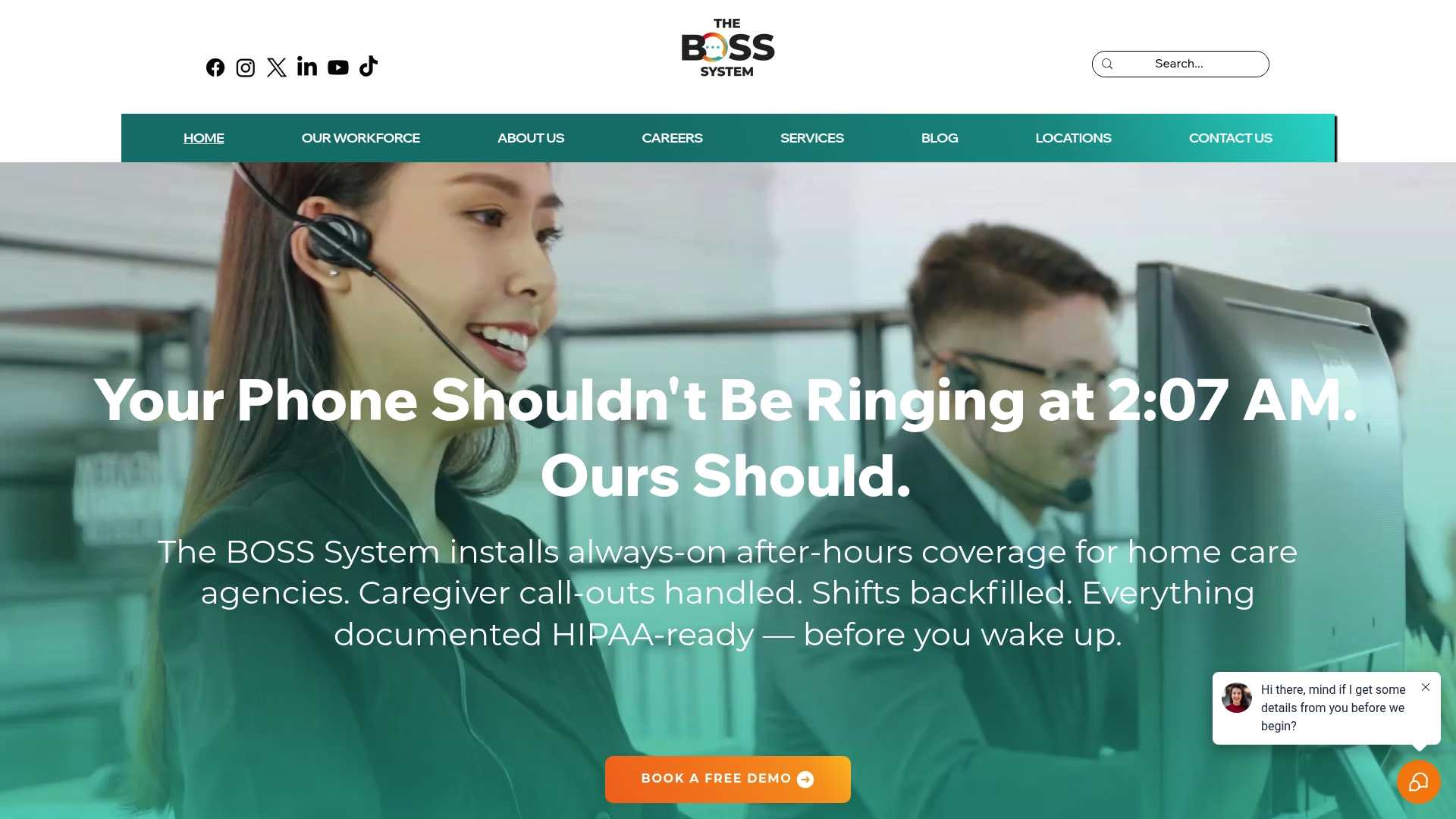
The Command Center Pod covers nights, weekends, and holidays so call-offs get handled before the owner’s phone even rings for anything but a true emergency.
BOSS Virtual Professionals, available from $8 per hour, extend into billing, bookkeeping, and executive support without adding a payroll line.
Trained coordinators can cost about 70% less than an equivalent in-house hire, based on average salary, payroll taxes, benefits, and admin costs, according to public labor statistics.
If you want to see what a Pod looks like running against your own call volume, start a free trial or review the full service lineup to find the role that fits first.
FAQ
Can a home care agency grow without hiring more office staff?
Yes, agencies commonly grow capacity by contracting outsourced Pods and home-care-trained virtual staff for intake, scheduling, billing, and after-hours coverage instead of adding payroll roles. This keeps labor cost variable while still covering the operational functions a growing caseload demands.
Does a virtual staffing vendor need a signed BAA?
Any vendor that creates, receives, maintains, or transmits protected health information on your behalf is a business associate under HIPAA and needs a signed Business Associate Agreement before it gets access. Skipping this step exposes the agency to real compliance liability, regardless of how the vendor markets itself.
What is the fastest role to outsource first?
After-hours call coverage and intake are the roles most agencies pilot first because failures are visible quickly and the scope of PHI access needed is limited. A 30 to 90-day pilot with clear KPIs, such as fill rate and missed-call rate, is enough to judge whether to expand further.
How much does The BOSS System cost?
BOSS Virtual Professionals are available from $8 per hour, while Pod-based services like the Command Center Pod and Care Coordination Pod are priced on request through The BOSS System’s services page.
Is cloud-based scheduling software HIPAA compliant on its own?
Encrypted storage alone does not satisfy HIPAA. Under HHS guidance on cloud computing, the cloud provider is a business associate and needs its own signed BAA along with appropriate administrative and technical safeguards.
Recommended


Comments