


Fill Last Minute Shifts: Caregiver Call Tree and 60 Minute Playbook


A caregiver call tree is an agency-level notification and shift-fill protocol, not a personal emergency device. The fix for chaotic call-offs is a documented phone tree combined with an automated open-shift broadcast and a real on-call coordinator, staffed by your team or outsourced through The BOSS System. Below you’ll find a copy-paste template, a T+0 to T+60 playbook, and the policy language to back it up.
TL;DR:
A documented phone tree with clear roles and scripts is essential to ensure shifts are filled quickly and reliably within the first 30 minutes of a call-off.
Logging every step in multiple systems and following a strict protocol minimizes liability during audits and billing disputes.
Automated broadcast systems typically fill 60 to 70 percent of last-minute openings within 30 minutes, outperforming manual calling methods.
Maintaining a backup staffing pool of 15 to 20 percent and offering shift differentials enhances same-day coverage reliability.
Outsourcing call center coverage to a trained team like The BOSS System can reduce costs by around 70 percent compared to in-house staff and improve overnight reliability.
Table of Contents
How Do You Build a Caregiver Call Tree Template?
A working call tree isn’t a list of phone numbers taped to the office wall. It’s an ordered chain of contacts, each with a job to do and a place to record what happened. Here’s the order that actually gets shifts filled instead of stalling in voicemail.
On-call coordinator (first contact for the calling-off caregiver, day or night)
Qualified backups by proximity and skill match (three to five names, ranked by distance and certification fit)
PRN pool (your standby roster, contacted as a batch if backups don’t answer)
Staffing agency (last resort, used sparingly because of markup costs)
Every call in that chain has a job. When the caregiver calls off, the coordinator confirms three things: intent (are they truly unable to work, or just running late), whether they’ve logged an EVV exit if already clocked in, and whether the client has any same-day safety concerns worth flagging. When a backup accepts, the coordinator confirms replacement details and locks the shift before calling anyone else.
Logging isn’t optional. Every call-off gets recorded in three places: the EVV system, the schedule record showing who covered the shift, and an incident log if the client’s care plan was affected. Skipping the incident log is how agencies get burned during a payer audit.
Three scripts cover almost every call:
Receiving the call-off: “Thanks for letting me know. Can you confirm you won’t be able to make today’s 2 PM shift with [client]? I’ll find coverage and call you back if I need anything else.”
Contacting a replacement: “We have an open shift at [client address] starting at [time]. You’re a certified match. Can you take it?”
Notifying the family: “I wanted to give you a heads up that [caregiver] can’t make it today. We’re arranging a replacement and will confirm the name before the shift starts.”
Pro Tip: Keep the three scripts laminated at the scheduler’s desk. A coordinator working from memory at 11 PM will paraphrase, and paraphrasing is where liability creeps in.
What Happens in the First 60 Minutes After a Call-Off?
Every minute between a call-off and a filled shift is a minute a client sits without care. AveeCare’s same-day coverage protocol breaks that window into four blocks, and mapping roles to each block removes the guesswork that turns a five-minute problem into a two-hour scramble.
T+0 to T+5 minutes:
Confirm the call-off is real, not a scheduling misunderstanding.
Attempt the caregiver twice if they didn’t call and simply no-showed.
Check EVV to see whether they clocked in at all.
Document the call-off timestamp and reason.
T+5 to T+15 minutes:
Place a wellness call to the client or family, letting them know coverage is in progress.
Push the open shift out to every qualified caregiver in the smart broadcast system instead of dialing names one by one.
T+15 to T+30 minutes:
Assign the shift to the first qualified acceptor.
Confirm their ETA and relay it to the family.
If nobody has accepted, widen the broadcast radius or loosen the skill filter slightly.
T+30 to T+60 minutes:
Escalate to the operations manager if the shift is still open.
Offer a shift differential to sweeten same-day acceptance.
If internal options are exhausted, call the backup staffing agency.
Automated broadcast systems fill an estimated 60 to 70% of last-minute gaps within 30 minutes, a fill rate no manual phone tree matches when a coordinator is working through names one at a time. Every action in this window gets logged with a timestamp, since that record is what protects you during an EVV compliance check or a billing dispute later.
What Policies and Backup Staffing Make the Call Tree Actually Work?
A call tree without policy behind it collapses the second a caregiver realizes there’s no consequence for a no-call, no-show. Your written notification policy needs to spell out who caregivers report absences to, how much notice counts as acceptable (two hours minimum for anything short of a true emergency), and what qualifies as a genuine emergency carve-out.
Pair that with a progressive-discipline matrix so nobody’s guessing what happens after a second no-show. A workable structure looks like this:
First occurrence: documented verbal warning within 24 hours.
Second occurrence: written warning plus a coaching conversation.
Third occurrence: suspension from scheduling eligibility pending review.
The other half of a sustainable call tree is having enough hands to actually fill the gaps. Industry guidance points to keeping a PRN backup pool at 15 to 20% of your active roster, onboarded and credentialed so they can deploy same-day instead of needing a week of paperwork first. Build a short onboarding checklist for PRNs: background check on file, EVV app installed and tested, at least one shadow shift completed before they’re eligible for solo assignments.
Pro Tip: Pay a modest shift differential for same-day acceptance rather than relying on overtime. It’s cheaper than repeated overtime and it keeps your most reliable caregivers from burning out.
Track three numbers monthly: time-to-fill, overall fill rate, and open-shift fill percentage within the first hour. Those three tell you faster than anything else whether your call tree is working or just feels like it is.
In-House Coordinator, Software, or Outsourcing: Which Fits Your Agency?
The right operational model depends on who’s actually available to execute the call tree at 2 AM and who’s responsible for getting that call-off into EVV before the audit trail goes cold.
In-house coordinator: works if you have consistent call volume and a night-shift-willing employee, but a single person is a single point of failure.
Scheduling software with broadcast: speeds up matching but still needs a human watching for unfilled shifts and handling family calls.
Outsourced Pod: a staffed team with built-in backup, so coverage doesn’t depend on one person answering the phone.
Run this checklist before deciding: How many after-hours shifts do you cover weekly? How often do call-offs actually happen? Can the owner realistically be unreachable for a full night? Are your EVV and documentation practices audit-ready today?
This is where The BOSS System’s Command Center fits for agencies leaning toward outsourcing. A trained coordinator through BOSS runs about 70% cheaper than an equivalent in-house hire once payroll taxes, benefits, and equipment are counted.* Start with a 30-day pilot tracking time-to-fill, fill rate, and owner wake-up calls before and after.
*Compared to average all-in cost of an in-house coordinator. Sources: Indeed, IRS, Bureau of Labor Statistics.
Why Documented Protocols Beat Owner-Led Firefighting
Most agency owners run their call tree from memory and a cell phone, which works right up until it doesn’t. A coordinator quits, a client calls at 3 AM, and suddenly the entire notification chain lives in one person’s head. That’s not a system. That’s a liability waiting for a bad night.

The agencies that stop the 2 AM phone habit are the ones that write the protocol down, staff it with more than one person, and treat the on-call function like the operational backbone it is, not an afterthought bolted onto someone’s existing job. One pattern shows up again and again: once a staffed command center takes over after-hours calls, owners report fewer overnight wake-ups and faster fills within the first month, simply because someone is always answering and every step is already scripted.
The mistake I see most is undocumented tribal knowledge passed from one office manager to the next. Fix that first, before you fix anything else.
— Ian Dwight Abejo
Let The BOSS System Run Your Call Tree Overnight
The BOSS System is the alternative to burning out your own staff on after-hours coverage: a trained Command Center Pod answers every call-off, wellness-checks the family, fills the shift, and logs it all, so interruptions are minimized to genuine emergencies.
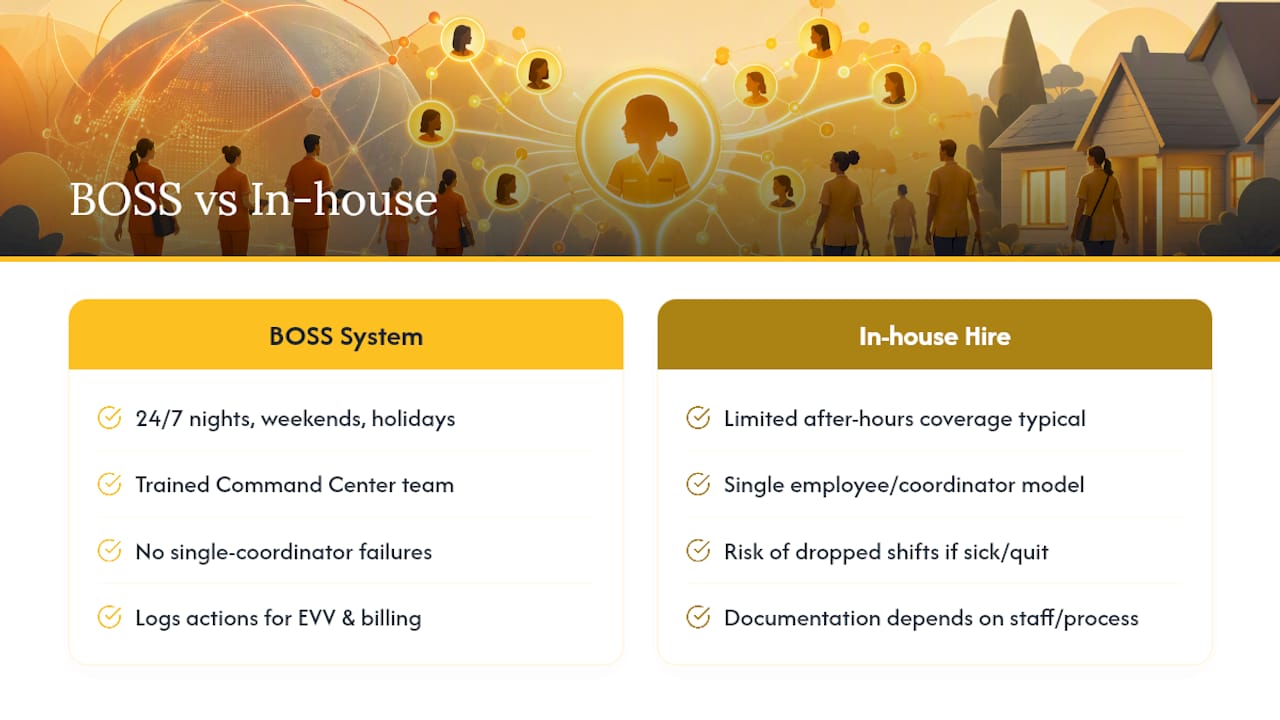
The ON-CALL PROGRAM gives you 24/7 coverage across nights, weekends, and holidays, with a trained team, not a single employee, behind every call. That means no dropped shifts because one coordinator got sick or quit. Families get a calm, consistent voice. Every action gets documented for EVV and billing. And because a BOSS coordinator costs roughly 70% less than an equivalent in-house hire once you account for payroll taxes, benefits, and equipment, the savings show up directly in your margins.
Start with a 30-day pilot. Track time-to-fill, open-shift fill percentage, and how many nights the owner actually gets to sleep through. Visit The BOSS System to set up your pilot and see the Command Center in action.
Sources
Ready to put this into practice? These resources cover the pieces this article touched on in more depth:
Recommended


Comments