


10 Call Documentation Fields US Home Care Agencies Must Record


Record who called, when, why, what was decided, and who is doing the follow-up. That is a professional phone record, and skipping any piece of it turns a documented conversation into a liability. Good call documentation protects continuity of care or service, and it protects you if a decision ever gets questioned. The templates and examples below make that standard easy to hit on every call.
TL;DR:
Call documentation must include date, time, call type, participants, purpose, actions, follow-ups, and reference links to ensure clarity and accountability.
For clinical or high-liability calls, detailed notes on symptoms, medications, instructions, and escalation guidance are essential to protect legal and safety standards.
Call recordings should only be made with proper consent, stored securely, and linked to written notes, especially when they involve patient safety or medication issues.
Standard templates for routine and clinical calls streamline documentation, reduce errors, and improve consistency across staff and shifts.
Call logs are metadata; effective documentation requires prompt, structured narratives that capture what was said and decided, not just the call’s basic details.
Table of Contents
What Should Professional Call Documentation Include?
A call note is only useful if the next person who reads it, sometimes you, three weeks later, can reconstruct exactly what happened without calling anyone back. That means a consistent structure, not a paragraph of loose memory.
At minimum, professional call documentation needs these fields:
Date and time the call happened, not when you got around to writing it up
Call direction (inbound or outbound) and call type (routine, urgent, follow-up)
Names and roles of everyone on the line, plus contact details if new
Subject or reason for the call in a few words
Summary of what was actually said, not a restatement of the subject line
Actions and decisions made during the call
Deadlines and follow-up owners, spelled out
Links to prior records or case IDs, so the note connects to history instead of floating alone
Recording or transcript reference, if one exists
Name or initials of the person who took the call
The weakest part of most call logs is the action item. “Will follow up” tells a reader nothing. Write it the way you’d want it written if someone else had to pick up the file tomorrow: “Scheduler to confirm replacement shift by October 12, 3:00 PM.” Active voice, a name or role, a date. That single habit is the difference between a note that holds up under scrutiny and one that reads like a shrug.
Avoid vague phrasing like “discussed the issue” or “advised caller.” Replace it with what was actually said and what happens next. “Advised caller to monitor symptoms and call back if fever exceeds 101°F” is defensible. “Advised caller” is not.
Pro Tip: Write the note during the call or within minutes of hanging up. Memory degrades fast, and a note written from recall two hours later tends to smooth over the details that matter most.
When Do Calls Need Full Clinical Detail, and What About Recording Them?
Not every call needs the same depth. A scheduling change and a symptom report carry very different risk, and your documentation should reflect that difference rather than treating every call the same way.
Administrative calls (confirming a shift, rescheduling an appointment, checking on a delivery) need the basic fields above and little else. Clinically significant calls, anything touching symptoms, medications, treatment changes, or a patient’s condition, need a full narrative. Institutional risk-management guidance is specific about this: document symptoms, medications, treatment plans, test results, and follow-up instructions in enough detail that a reviewer could reconstruct your clinical reasoning months later.
A one-line entry like “spoke with patient” does not meet that bar. Risk-management guidance from SVMIC makes the same point: notes need to capture what information was given, what instructions were provided, and when the caller was told to seek emergency care. That level of detail is what protects you if the call is ever reviewed after the fact.
A few things to settle before you pick up the phone, not during the call:
Never assume you can record a call. Consent rules vary by state, and federal wiretapping law adds another layer, so confirm your organization’s policy before hitting record.
Store any recording or transcript with the same access controls as the written note. It’s part of the same record.
Escalate to a formal incident or clinical record whenever a call involves a safety concern, a medication error, an adverse event, or anything your compliance policy already flags for escalation.
Templates and Sample Call Notes You Can Copy Today
Two templates cover most professional call volume: one compact version for routine business, one expanded version for anything clinical or high-liability.
Compact template (routine/admin calls):
Date/time, direction, caller name and role
Subject line (one phrase)
Summary (one to two sentences)
Action item with owner and deadline
Note-taker initials
Example: “10/8, 9:14 AM, inbound, caller: Maria T. (caregiver). Subject: shift call-off. Summary: Maria reported flu symptoms, unable to work 10/9 evening shift. Action: Scheduler to confirm replacement by 10/8, 3:00 PM. Notes by JR.”
Expanded template (clinical/high-liability calls):
Date/time, direction, caller and patient identifiers
Symptoms or complaint as described by caller
Medications and known allergies mentioned
Instructions given, in the caller’s or clinician’s own words where possible
Escalation guidance provided (when to call back, when to go to the ER)
Recommended follow-up and who owns it
Note-taker name and credentials
Example: “10/8, 2:40 PM, inbound, caller: family member of client D.S. Subject: reported shortness of breath. Symptoms: mild shortness of breath since morning, no chest pain, no fever. Advised caller to monitor breathing and call 911 if symptoms worsen or chest pain develops. Follow-up: clinical coordinator to call client directly within 2 hours to reassess. Documented by clinical coordinator, K. Alvarez.”
Pro Tip: Save both templates as text expansion shortcuts or note snippets inside your EHR or CRM, leveraging practical automations to streamline support interactions. A field-by-field template that takes ten seconds to insert gets used every time; one buried in a shared drive gets skipped on the busy days when you need it most.
Call Logs Versus Call Notes: Why They’re Not the Same Thing
Your phone’s call log is not a professional record. Native call histories on Android and iPhone capture metadata, timestamp, duration, incoming or outgoing, and nothing about what was actually said. Worse, that metadata can be deleted or lost entirely if a device is wiped, replaced, or the carrier’s retention window expires. None of it survives as a business record unless someone exports it into a system built to keep it.
A workable workflow treats metadata capture and narrative documentation as two separate steps that happen close together:
Metadata auto-captures the moment the call connects (via your phone system or a telephony platform).
A short narrative summary gets written within minutes, not at the end of the shift.
Recording or transcript gets attached to the record when policy and consent allow it.
The whole entry links to the relevant case, shift, or chart.
Telephony platforms like the Twilio Call resource can expose call metadata and recordings programmatically, which makes it possible to route that data straight into a CRM or case management system instead of leaving it stranded in a device log. Transcription tools speed up the narrative step, but every transcript still needs a human pass. Automated speech-to-text misses context, mishears names, and occasionally inverts a negative, exactly the kind of error you don’t want sitting uncorrected in a clinical file.
How We Operationalize Call Documentation at The BOSS System
Calls into a professional call center dedicated to home care get documented consistently by a trained team. When a caregiver calls off during off-hours, the coordinator on duty logs the call, fills the shift, and provides a clear written record.
That consistency is what changes the math for an agency. Fewer shifts fall through the cracks because the documentation trail shows exactly what was promised and by when. Families get a calmer response because the person on the phone has the full case history in front of them, not a guess. Owners get woken up only for the calls that actually require it.
Why Most Advice on This Topic Misses the Point
Most guidance on documenting calls stops at “write it down.” That’s not wrong, it’s just incomplete. The real failure point isn’t whether a note gets written. It’s whether it gets written in a format specific enough to be useful three weeks later, and fast enough that memory hasn’t already softened the details.
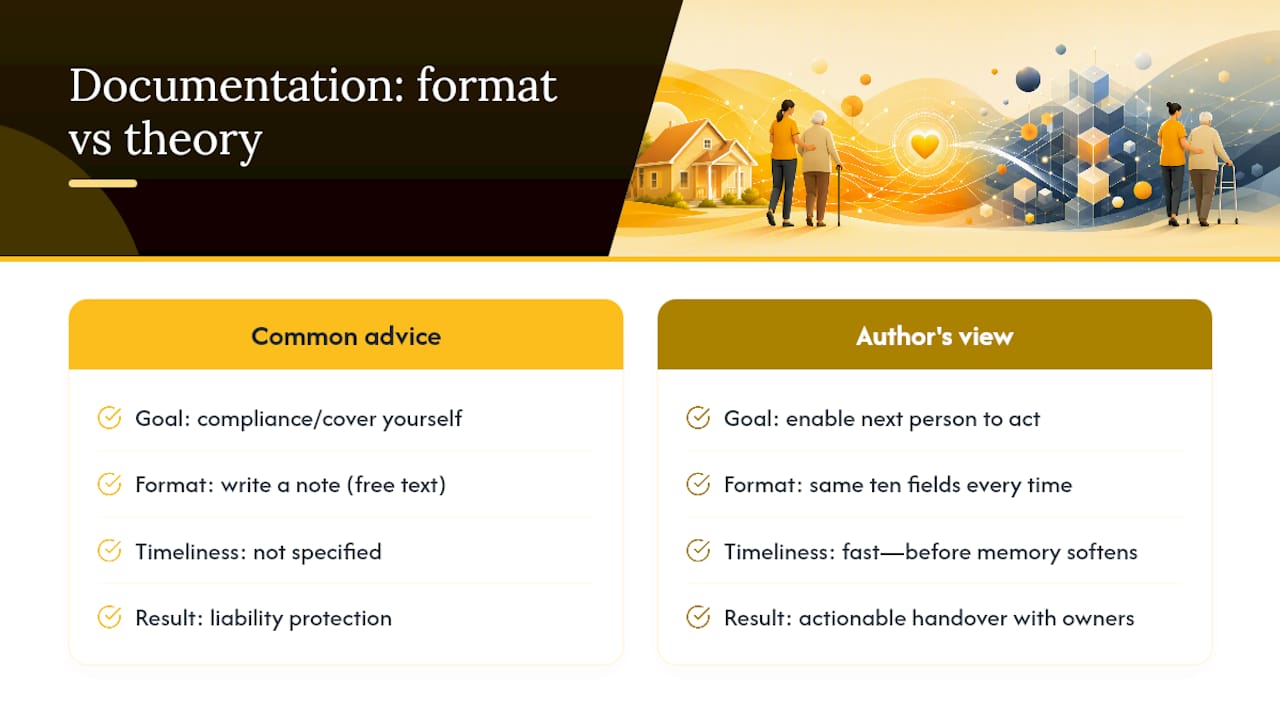
The conventional wisdom treats documentation as a compliance chore, something you do to cover yourself. That framing misses what a good call note actually does day to day: it lets the next person, a coordinator, a nurse, a manager, pick up a case cold and know exactly what was said and what’s owed. Liability protection is a byproduct of that, not the point of it.
If you take one thing from this piece, make it the field structure, not the theory. A team that fills in the same ten fields every time, with real deadlines and named owners, will out-document a team that “tries to be thorough” on every call. Consistency beats effort here, every time.
— Ian Dwight Abejo
Let The BOSS System Handle the Call, Every Time, Correctly
A dedicated nighttime call center service offers consistent call documentation without the need to hire and train an in-house night shift. A trained Command Center team documents every call uniformly, attaches it to the correct record, and escalates only genuine emergencies to agency owners.
This service model aims to reduce missed shifts by promptly logging and filling call-offs, provide callers with informed support by having access to case history, and create a reliable documentation trail for accountability. It is designed for agency owners and operations managers seeking reliable call handling and documentation.
If your current after-hours coverage doesn’t produce a written record you’d trust in an audit, look at the BOSS Command Center or read through the on-call program details and see what a documented call actually looks like when it’s handled by a dedicated team instead of a single tired employee.
Sources
Recommended


Comments